
Kitchen Project #205: Strawberries and Cream
A truly all-time pairing

Hello,
Welcome to today’s edition of Kitchen Projects. Thank you so much for being here.
Today, I am thrilled to explore one of the greatest summer combinations: Strawberries and Cream.
I find it hard to name a more iconic duo, and I take my responsibility to celebrate, elevate or sometimes just leave well alone this gorgeous double act very seriously. In this newsletter, I’ll share my technique for Strawberry Gloss that’ll adorn your cakes, and explore the world of whipped cream.
On KP+, I’m so excited to share my recipe for alternative no-bake cheesecake, ft glossy strawbs that rival even the most decadent freezer-aisle gateau! This recipe bridges the gap between rich baked cheesecake and the low-effort alternative. Yes, there’s still a bit of cooking, but no oven or water bath in sight. It’s so rich and creamy the whole way through, like the middle of a basque cheesecake. Click here for the recipe.
What’s KP+? Well, it’s the level-up version of this newsletter. By joining KP+, you will support the writing and research that goes into the newsletter (including the commissioning - and fair payment - of all the writers), join a growing community, access extra content (inc., the entire archive with 450+ recipes) and more. Subscribing is easy and only costs £6 per month or just £50 per year (equivalent to £4.10 per month). Why not give it a go? Come and join the gang!
Love,
Nicola
Just the two of us
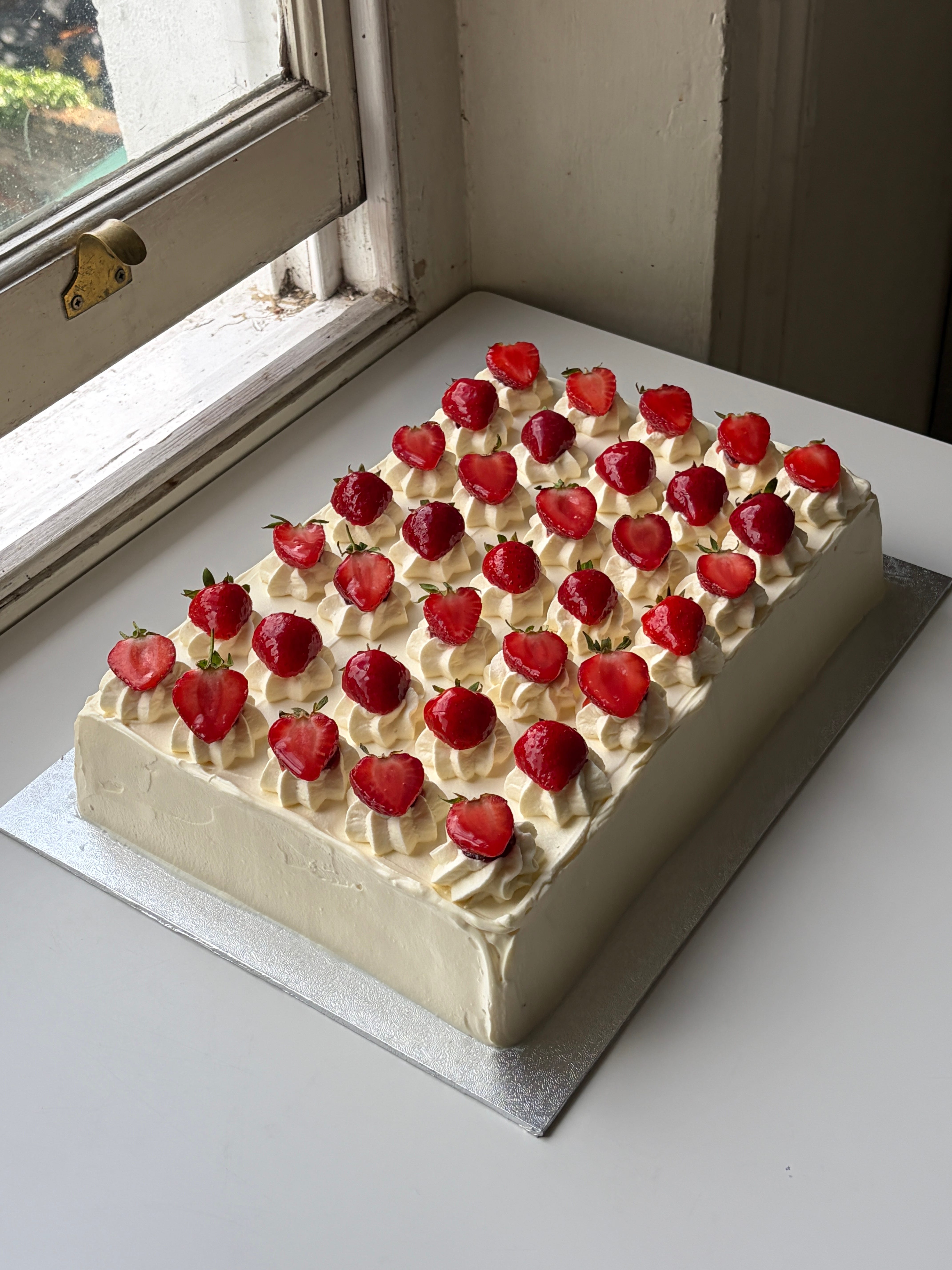
Few combinations claim a more beloved status than Strawberries and Cream. Deeply entrenched in British culture, a little pot of fresh strawberries covered in cream will set you back just £2.80 at Wimbledon and is a hallmark of summer in the UK. At the tournament, which takes place at the end of June and into July each year, it’s estimated that almost a quarter of a million portions are sold. That’s two million strawberries, which are often picked and eaten within 24 hours, and more than 10,000 litres of cream. During 2020, when Wimbledon was cancelled, Brits were urged to purchase strawberries, with thousands of kilos hanging in the balance. Don’t worry, it’s a happy ending – strawberry sales surged, and the berries all found homes.
This is all to say, strawberries and cream (or at least, cream-y stuff) is a divine combination. It is the backbone of so many desserts – Victoria sponges, both the Cottony Japanese-style Strawberry Shortcake and the very different American Strawberry Shortcake, Trifles, Summer Pudding, Fruit Tarts, and Strawberry Ice Cream, to name just a few. The appeal is obvious: Juicy, fragrant berries with gentle acidity meet rich, luxurious cream. While most of the desserts I’ve mentioned use whipped cream, the classic strawberries and cream is as simple as pouring unwhipped, unsweetened cream on hulled berries. How many other combinations can you name that need almost zero adulterating?
So when we’re gifted a combination this utterly perfect, it’s our job as bakers, recipe developers, pastry chefs, and plain old lovers of life to bring them together as often as possible during the season. This week I’ve been exploring the combination, with strawberry and cream cakes, strawberry and cream choux AND, a new era “no-bake” (but not no-cook!) cheesecake that is beautifully creamy and doesn’t require an oven OR a waterbath.
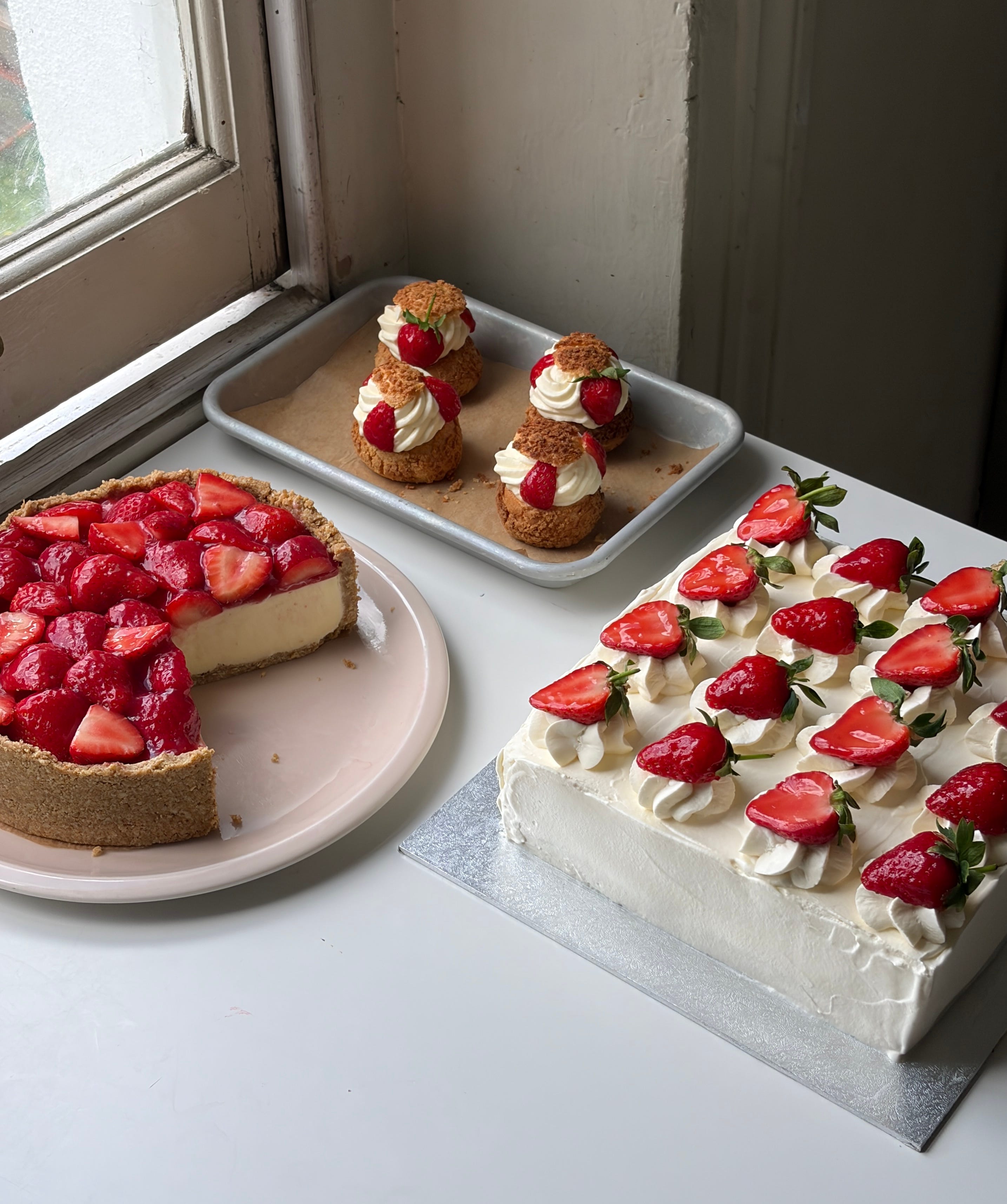
Strawberries and cream are an evenly matched duo, but they each ask something different of us. With strawberries, so much depends on choosing the right ones and waiting for the right moment. For cream, pouring is easy enough, but whipping? There’s a little more to it.
In today’s newsletter, I’ll be exploring the two sides of this perfectly balanced coin via two key techniques: Glossy Strawberries and the best way to whip cream. I’ll also dot through various on-theme goodies from the archive for you to enjoy. We’ll begin with strawberries, before moving into cream. Let’s do this!
Part 1: Strawberries
The desire to do the absolute minimum to a strawberry is a sure sign of its quality, so if you bite into a strawberry and desire nothing more than to eat the whole punnet there and then, perhaps with a little sugar or a drizzle of cream, then you know you’ve got a good one on hand.
I can withstand a lot of unpleasant aromas, but one scent that I really cannot stand is strawberries on the turn. I find it musty, dustbin-y and unfortunately, a bit vomit-y. Generally, if I bring a punnet of strawberries home, they need to be eaten within 24 hours, or prepared and eaten the same day. The only way to get to know a strawberry before you bring it home is by giving it a big stiff, through the holes in the punnet if need be. If you are friendly with your fruit seller, ask to try one! The fruit should be plump and firm, with tight shiny skin and no sign of softening, though a little give that winks at juiciness is allowed. I tend to avoid the bargainous troughs in supermarkets that, in my experience, are often on the verge of fermentation.
This excellent guide, written by Michael Y Park on Serious Eats, provides detailed context to strawberry season and offers answers to why strawberries aren’t as sweet anymore and why we shouldn’t be overly persuaded by colour nor size.
You needn’t do much to a great strawberry, but you can help coax it in a more vibrant direction. The first port of call is sugar; macerating strawberries in a little sugar. Just 5-10% of the strawberries’ weight (start with less unless you have very flavourless strawbs) tossed into your bowl of strawberries will begin a transformation, which you can adjust after an initial 10-minute rendezvous. At this point, you can add more sugar, adjust with lemon juice or introduce additional flavours.
Flavour friends of strawberries include vanilla (obvs), almond, elderflower, jasmine, orange blossom, mint, ginger, chamomile and peppercorns to name just a few. Once you have macerated your strawberries, they are best served immediately, or the sugar continues to draw water from the fruit, leaving them a little squishy, though you get a marvellous syrup. If you do want to macerate ahead of time, you can drain the strawberries and keep them separate from the syrup, then reintroduce later.
Last year, the brilliant Bronwen Wyatt developed a ‘strawberry elixir’, a special potion which makes strawberries taste like the fanciest most strawberry-strawberries you’ll ever have. You can get that recipe, and her divine Shortcakes (US!), here.
Choosing complementary flavours
If you aren’t sure which flavour you want to pair with your perfect strawberries, I have employed a ‘sniff and bite’ (not ™) test that helps me ascertain the flavour. Since our sense of smell is responsible for about 80% of flavour, you can simply hold the aromat to your nose whilst taking a bite of strawberry (also give it a sniff, too). This is how I decided to make jasmine syrup for the strawberry cream cake. Though I’m sure there is a perfect science to flavour matching (discussed here), this technique works pretty well, too.
If you have really flavourless strawberries, let me point you to roasting them, which yields jammy strawberries and excellent syrup.
Glossy Strawberries
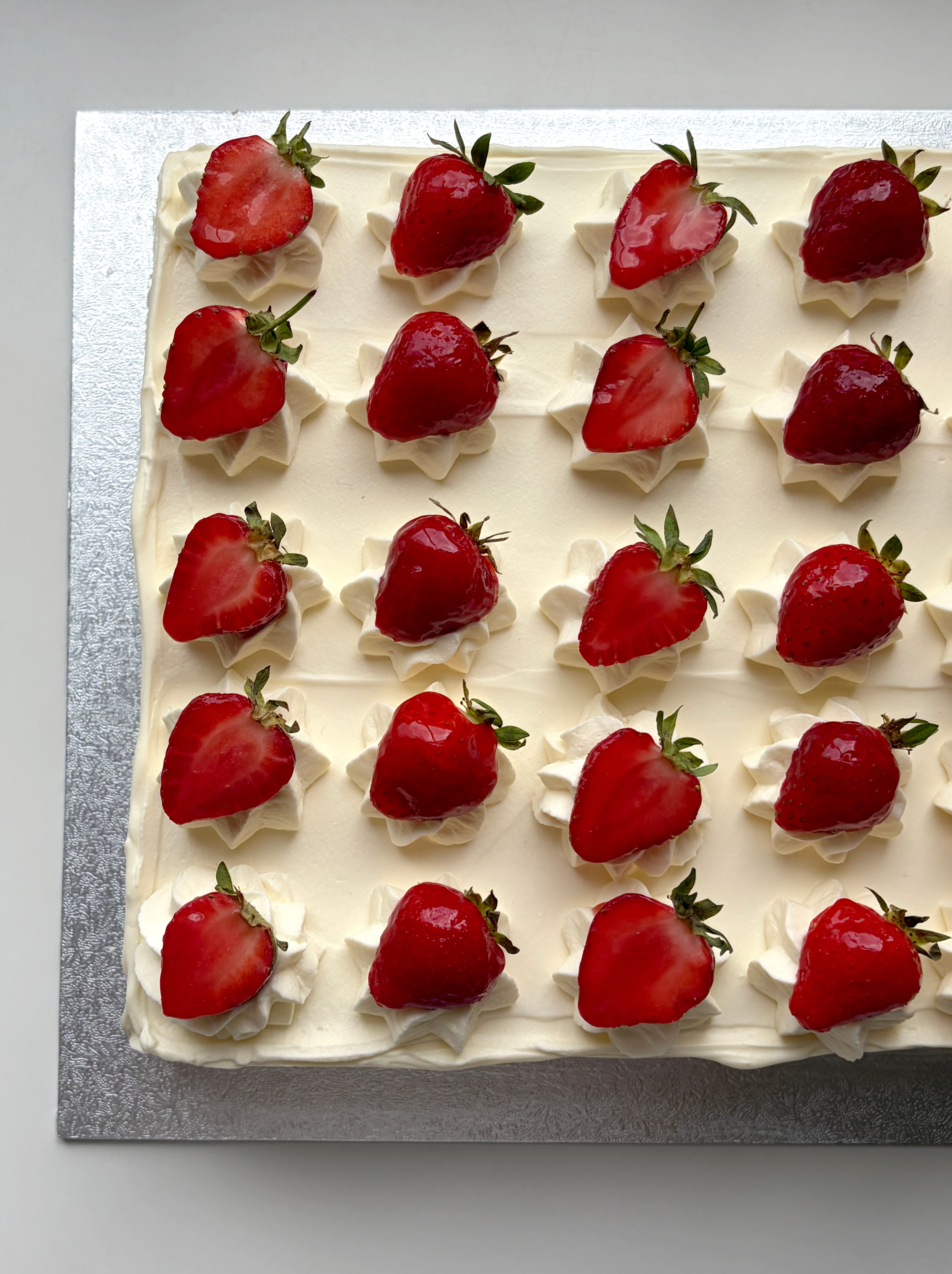
At the beginning of this week I was tasked with making a cake for a special occasion. It was to be served at an event celebrating British achievements, so strawberries and cream seemed an obvious choice. Of course, the cake had to be light and fluffy, and of course, it had to have fresh strawberries. The inside would be a stable whipped vanilla ganache to encase plenty of fresh strawberries; the outside would be fresh cream, stabilised with mascarpone, and on top, a perfect “patch” of peak-season strawberries. However, once cut, strawberries – and all fruit – begin to try. So how to secure perfection? Enter, glaze!
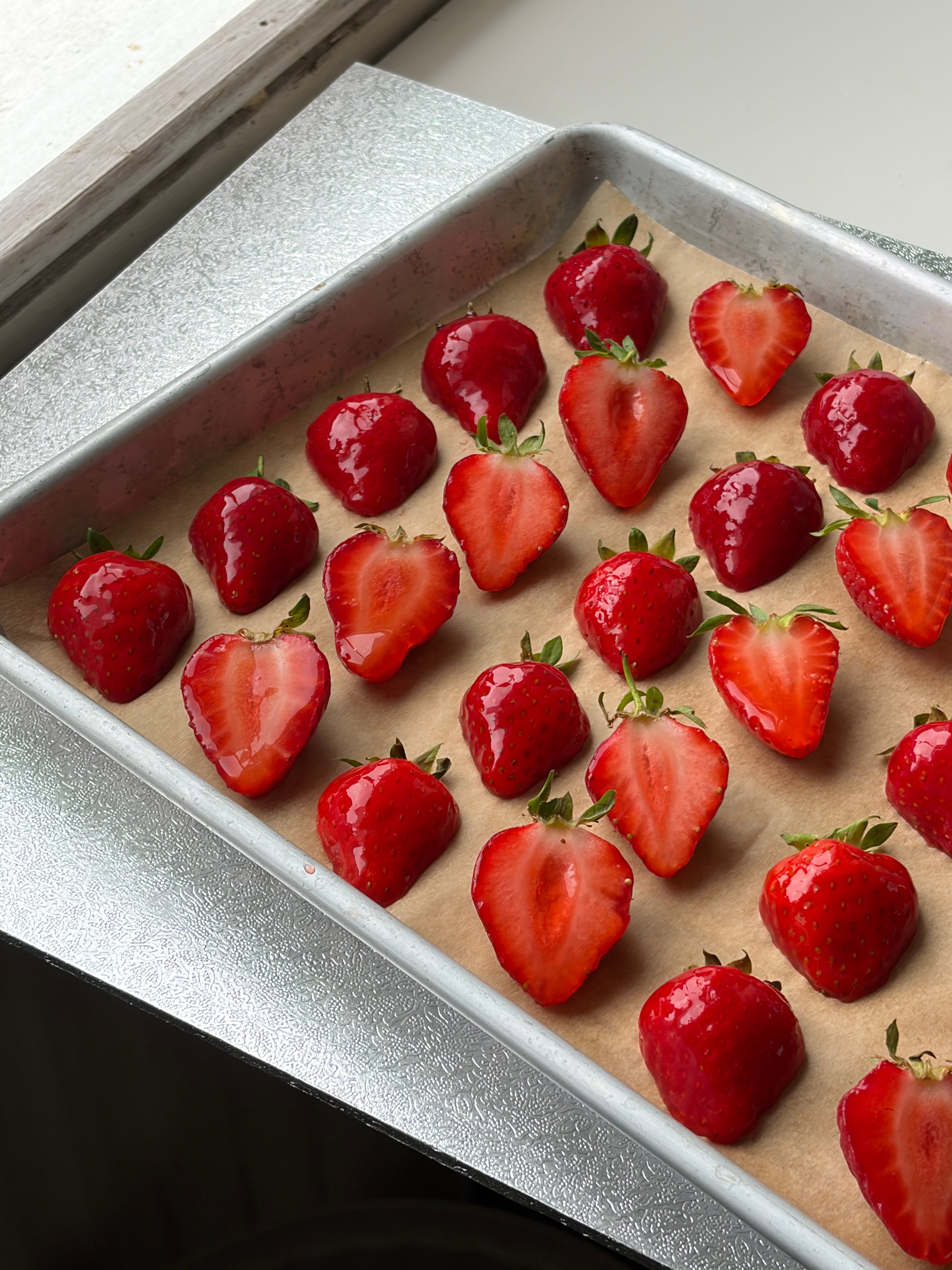
The most typical version of fruit glaze is known as nappage, which literally translates as ‘topping’ in French and is pectin-based. I’ve written about this before, developing a basic pectin nappage with plums (recipe here), but I know that pectin isn’t accessible to everyone, nor is it created equal. Sure, you could just use apricot jam, but why not make a special strawberry glaze to double down on that strawberry flavour? Taking notes from pastry chef Louis Thompson and his piece on fruit galettes (read here), I made a strawberry syrup, then thickened it with cornstarch and seasoned it with lemon juice. The result was an ultra-red, intensely flavoured and crucially shiny and clingy glaze that sat beautifully on the strawberries. Let’s call it Strawberry Gloss.


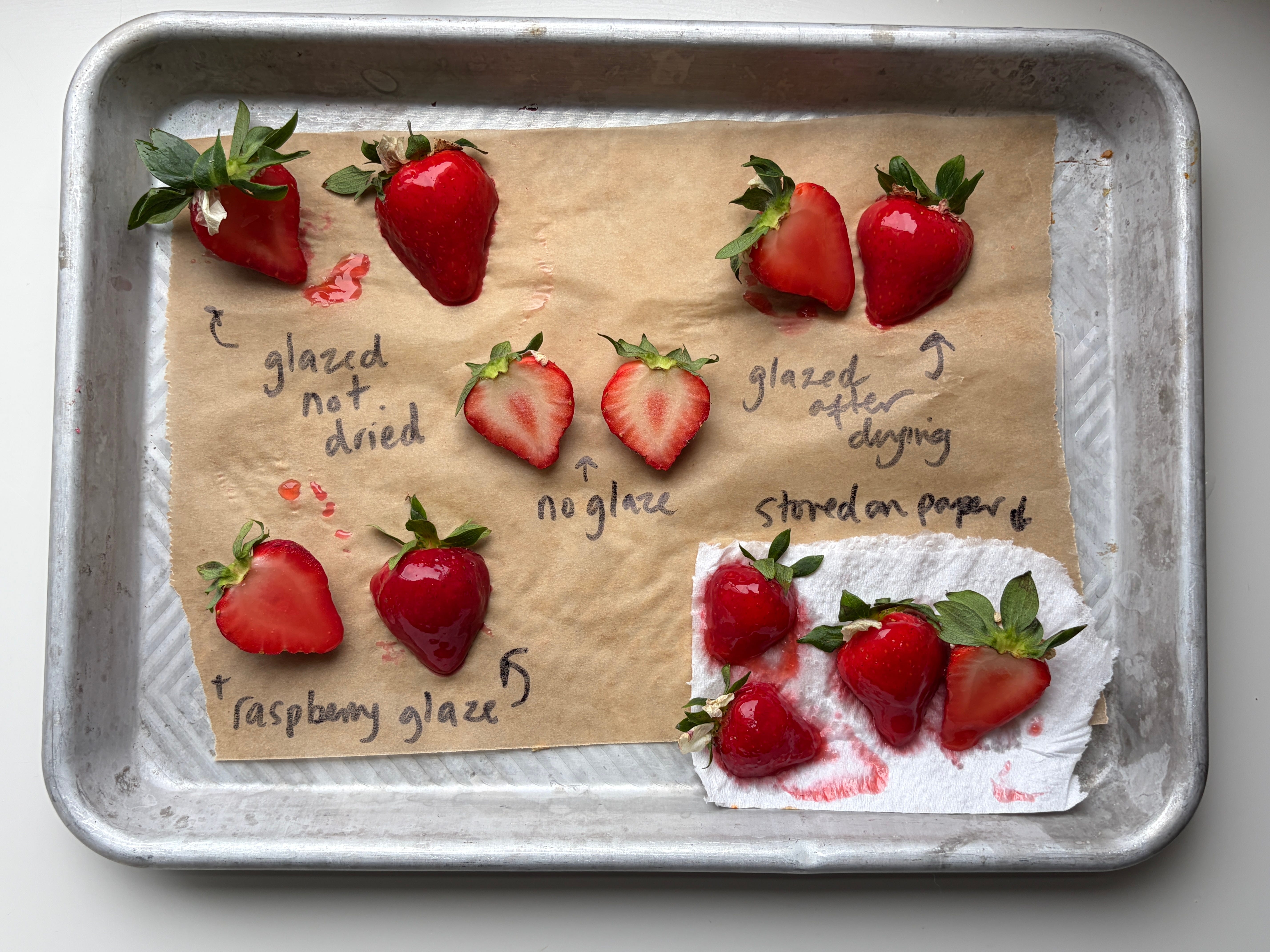
As I was going to place the strawberries well ahead of time (the cake was sent at 9 am and not served until 4 pm), I cut the strawberries and placed them on kitchen paper to remove any excess moisture, then coated each one with the gloss. I left them overnight in the fridge, then carefully placed them on my cream rosettes. The patch remained shiny and intact for the whole day. I retested this overnight, comparing a few techniques. While removing the excess moisture is good for an insurance policy, the gloss was very effective on all the samples, and put the gloss-less strawberry to shame.
ON KP+ TODAY!
As well as working beautifully on more elevated finishes, the strawberry gloss also has the charm of mass-produced desserts, akin to frozen-aisle gateaus and 90s advertisements for plastic baby dolls and associated food accessories.


I used this as inspiration for my no-bake cheesecake, which, rather than being whipped-cream based, borrows techniques from Parisien Flan for an unbelievably smooth and creamy texture that is closer to baked cheesecake, or that perfect middle bit of basque cheesecake.


If there’s one hill I die on, it is that Cheesecake IS custard, and therefore I don’t know if no-bake means no-cooking? In which case, this doesn’t qualify, but you definitely don’t need to turn your oven on to make this. You can get the recipe on KP+ now.
RECIPE: Strawberry Gloss
Makes about 200ml of strawberry gloss, plenty for coating strawberries.
Ingredients
200g Strawberries, halved*
200ml Water
20g Sugar
10g Cornstarch
20g Sugar
15ml Lemon Juice
*For a slightly tangier, darker red glaze, use 160g strawberries and 40g raspberries
Method
In a small saucepan, combine the strawberries and water. Bring to a simmer and cook for about 15 minutes, until the strawberries have completely broken down.
Mash the strawberries thoroughly, then pass the mixture through a fine sieve, pressing firmly to extract as much liquid as possible. Re-weigh or measure the liquid. You should have approximately 180ml strawberry juice. If you have significantly more, reduce it slightly; if you have less, top it up with a little water.
Return 180ml of strawberry juice to the saucepan with 20g sugar and bring to a simmer.
Meanwhile, in a small bowl, mix together the remaining 20g sugar, cornflour and lemon juice to form a smooth paste. Pour this into the simmering strawberry juice, whisking constantly. Cook for 30 seconds to 1 minute, until thickened and glossy.
Transfer to a clean container and refrigerate. The gloss will keep for several weeks in the fridge.
When ready to use, gently warm the gloss until loosened but not hot. A good test is to dip a finger into it: it should coat your finger easily in a thin, glossy layer. If it feels too thick, loosen it with a small amount of water or lemon juice.
To coat strawberries, halve them if desired and dab away any surface moisture with kitchen paper. For maximum shelf life, arrange the halved strawberries cut-side down on kitchen paper and leave them uncovered in the fridge for a few hours to dry slightly.
Brush the strawberries generously with the strawberry gloss, or use a spoon to coat them evenly. Transfer to the fridge and allow the gloss to set. The coated strawberries will keep happily for several days.
Part 2: Cream
The Sonny to our Cher, the Batman to our Robin, the Mary-Kate to our Ashley, there’s plenty of things that strawberries COULD hang with, but few things can beat cream.
While preparing “classic” strawberries and cream involves nothing more than hulling strawberries, maybe adding a little bit of sugar, then dousing with pouring cream (single, double, you do you), whipping cream, whether it’s for splodging, flumping, piping or spreading, takes a little more effort.
[NOTE: Brian Levy wrote an excellent piece about the best way to stabilise whipped cream on Kitchen Projects here (spoiler: mascarpone wins!), so with that topic covered, there is only one thing left to discuss: technique.]
When it comes to whipping cream, we have two things to think about: Firstly, fat content, and secondly, the method.
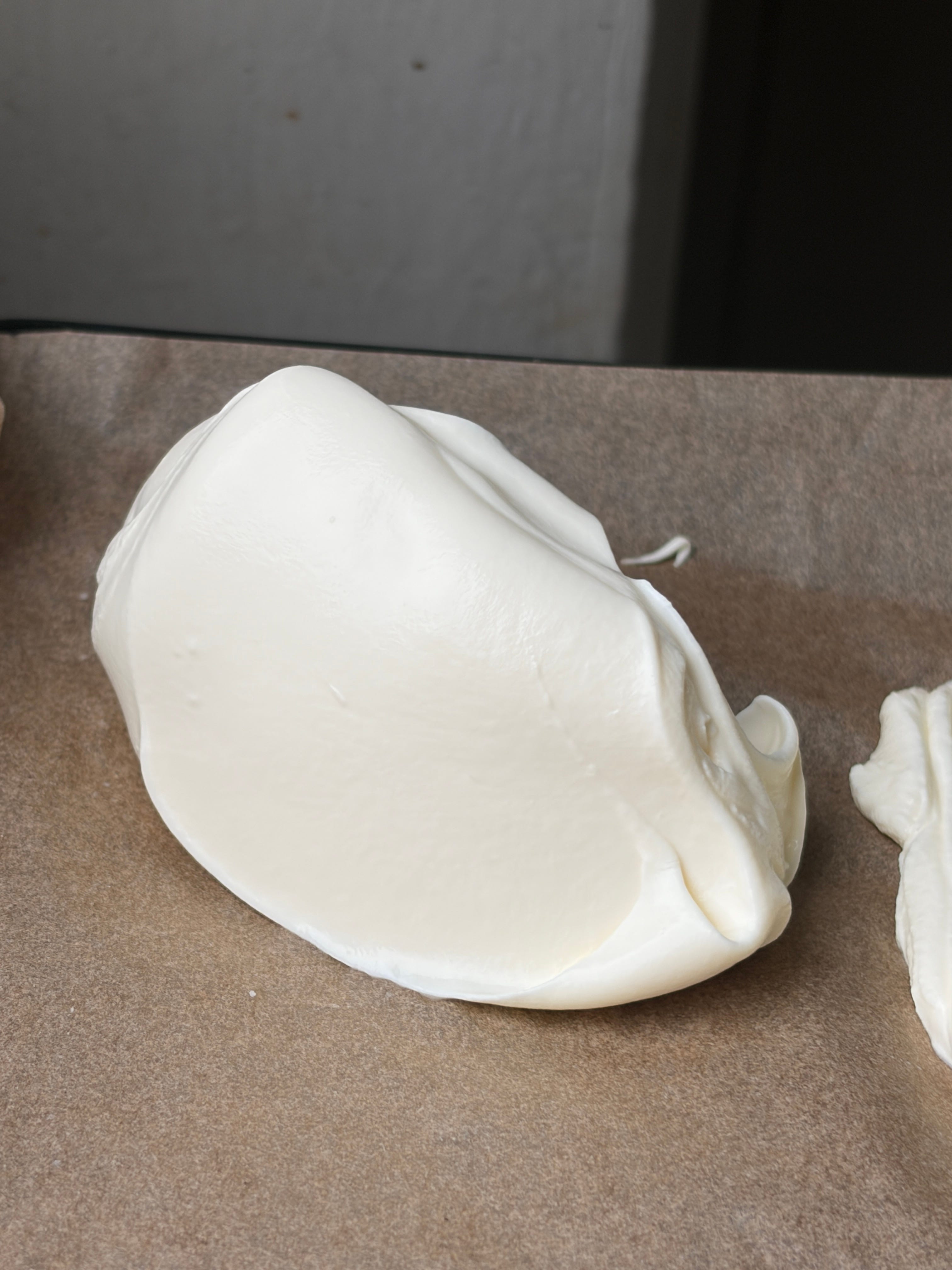
Fat content matters because it determines how thick your cream can ultimately become. As you whisk cream, you’re incorporating air. As you agitate it, the fat globules partially clump together around those air bubbles, creating a network that traps them in place. Keep whisking, and eventually those fat globules clump together so thoroughly that you end up with butter.
This is where cream can be slightly frustrating for UK bakers. We have amazing dairy, but our standard double cream sits at around 48% fat, which can make it harder to achieve that silky, softly whipped texture.
There are a few ways around this. You can seek out whipping cream, which is usually around 35% fat, or dilute double cream with a little whole milk. This isn’t generally an issue for other countries, whose standard ‘heavy’ cream already sits close to whipping cream. The thing is, the solution for silkiness is opposite to the solution for stability. As Brian Levy found out in his excellent piece on whipped cream, mascarpone acts as an effective stabiliser, helping lower-fat cream hold its shape by upping the fat content. So, these two things do sit at odds, which can be frustrating when you’re trying to decorate!
So what about the method? There are various ways to whip cream, all with a common goal. Curious how these approaches produced different results, I ran a series of tests using 300ml double cream. I whipped one batch with a whisk attachment on high speed, one with a whisk attachment on low speed, one using a paddle attachment on low speed (the Milli Method, after my friend Milli Taylor, who swears by the paddle… she even makes meringue with it. Let’s not talk about that right now), and one by hand.
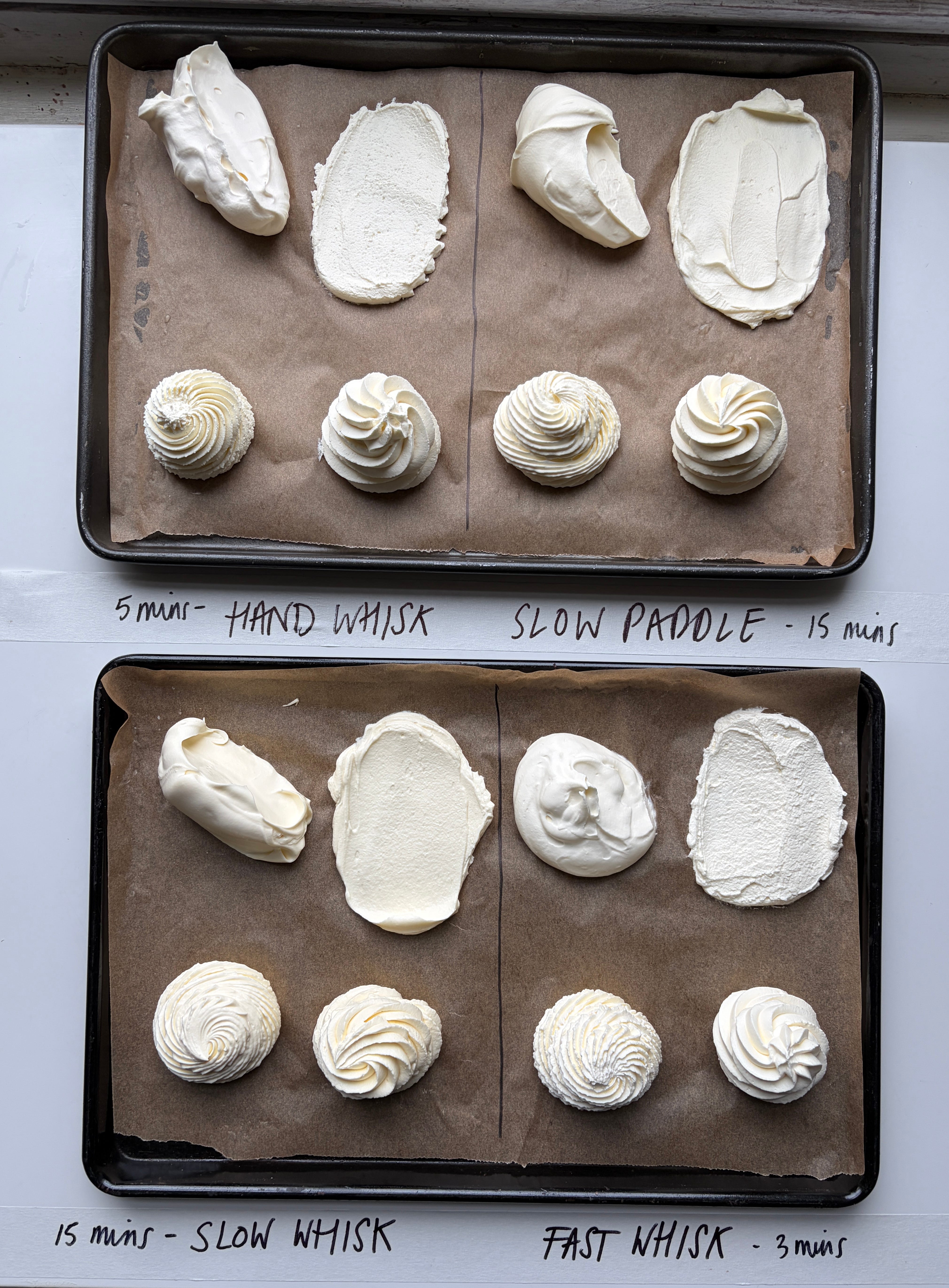
The low-speed whisk produced the finest bubbles and probably the silkiest texture. It also gave the poorest yield and took a very long time. On a cool day, this worked beautifully. On a warmer day, it barely worked at all. The cream simply warmed up too much before enough air had been incorporated.


My final method is inspired by the genoise sponge technique taught to me by Chef Ayako, which you can read about here. I begin on a higher speed to quickly incorporate air while the cream is still cold, then reduce to a medium speed as it begins to thicken. Finally, I finish by hand with a whisk. This gives me the best balance of efficiency, texture and control. But no matter what we do… it’s ultimately, it’s really all about stopping at the right moment.
Piping
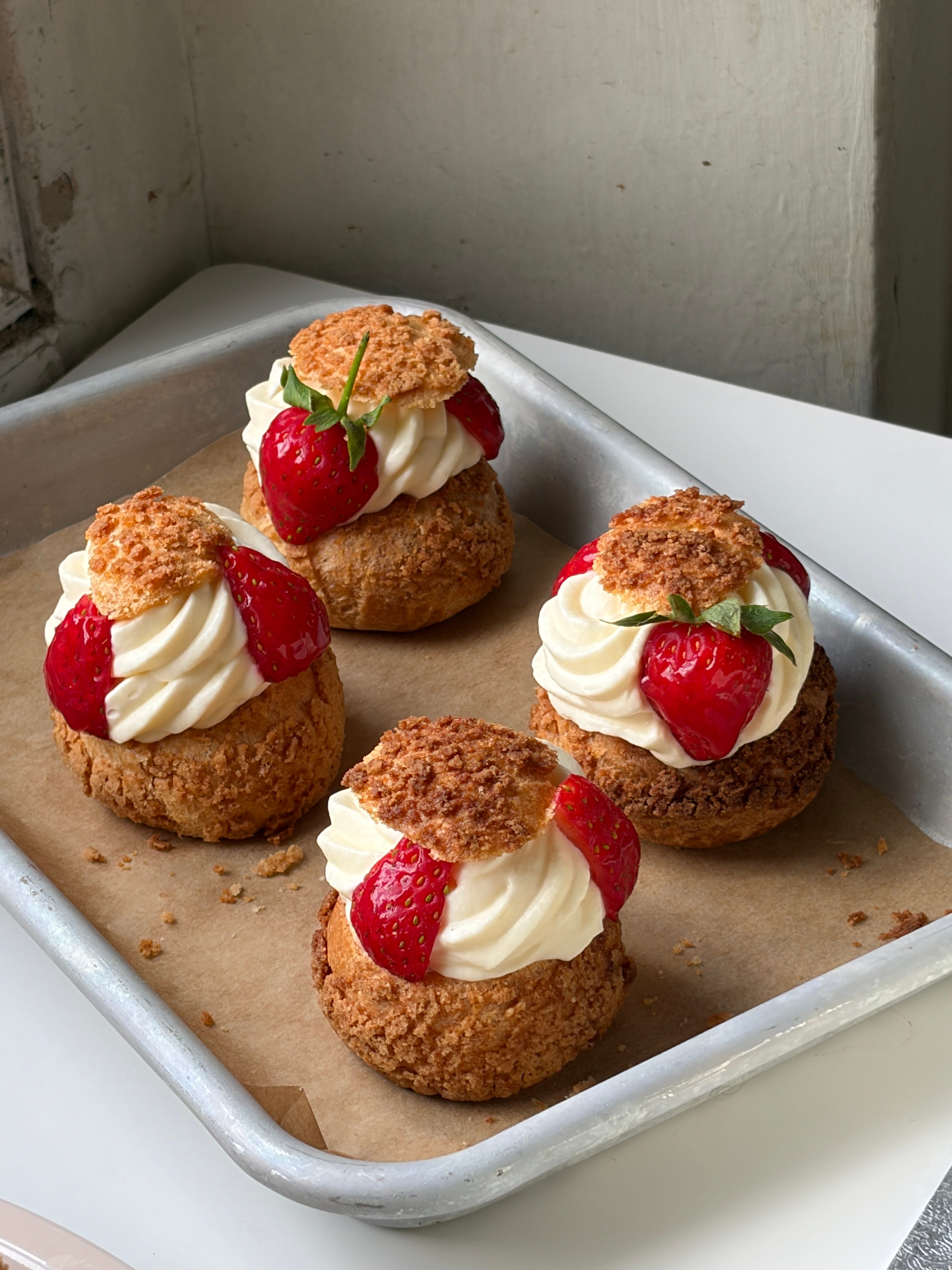
Cream continues to thicken once it’s transferred to a piping bag. The pressure of squeezing effectively gives it a little more agitation, so cream destined for piping should generally be stopped slightly earlier than you think. That said, I think I was overly critical of putting thick cream into a piping bag - even the very whipped cream on a high speed looks great, especially through a wide-toothed star tip. I’d actually avoid fine-tooth star tips in the future, as this always looked worse in my tests. Perhaps it shows more errors? In any case, if you want to work with more fragile, less whipped cream, be ready to get the cream into the fridge ASAP! When I piped the cream for the choux above, it was slightly too soft, but after an hour in the fridge, it regained strength!
Coating a cake
When I’m coating a cake, whether it’s with stabilised whipped cream or straight-up, I rarely aim for perfect smoothness with the main batch of cream. Instead, I’ll use a slightly firmer whipped cream to cover the cake securely, like a crumb coat, accepting that it may look a little rough. After a quick chill in the fridge, I’ll whip a small additional quantity separately, and slowly, sometimes adding a splash of milk right at the end to create an exceptionally silky texture, stirring it with a spatula. This softer cream becomes the finishing layer, spread thinly over the surface to create a smoother final appearance.
So you’ve overwhipped your cream. What now?
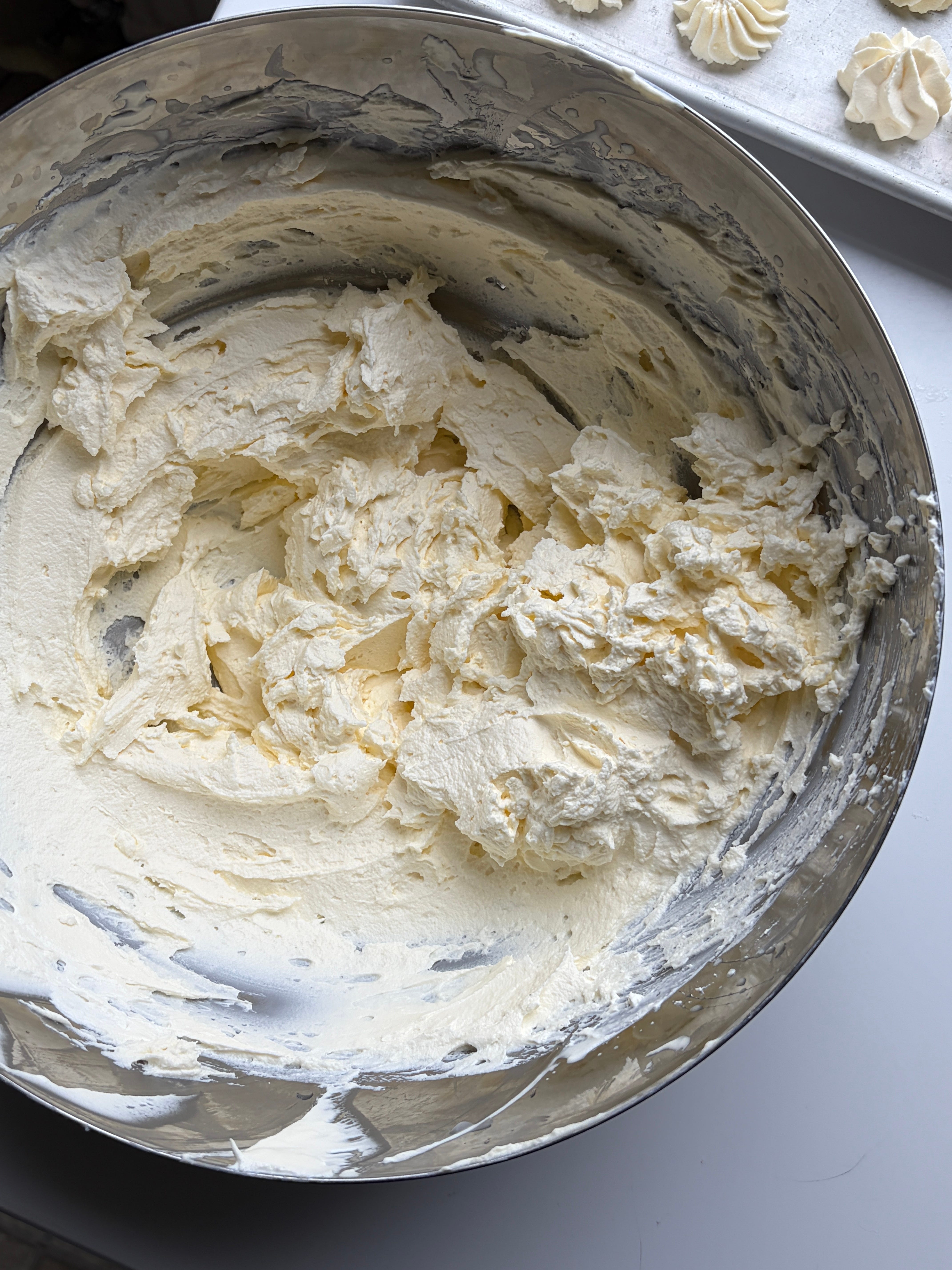
The standard advice is to fold in more cream. I don’t totally agree with this, because all you’re really doing is adding more fat.
I tested a few different approaches, folding in additional cream, folding in milk, and even gently melting and rewhipping the cream. The most successful fixes involved adding a substantial amount of liquid. Adding around 25% milk or 25% cream relative to the overwhipped cream worked reasonably well, but larger additions worked considerably better.
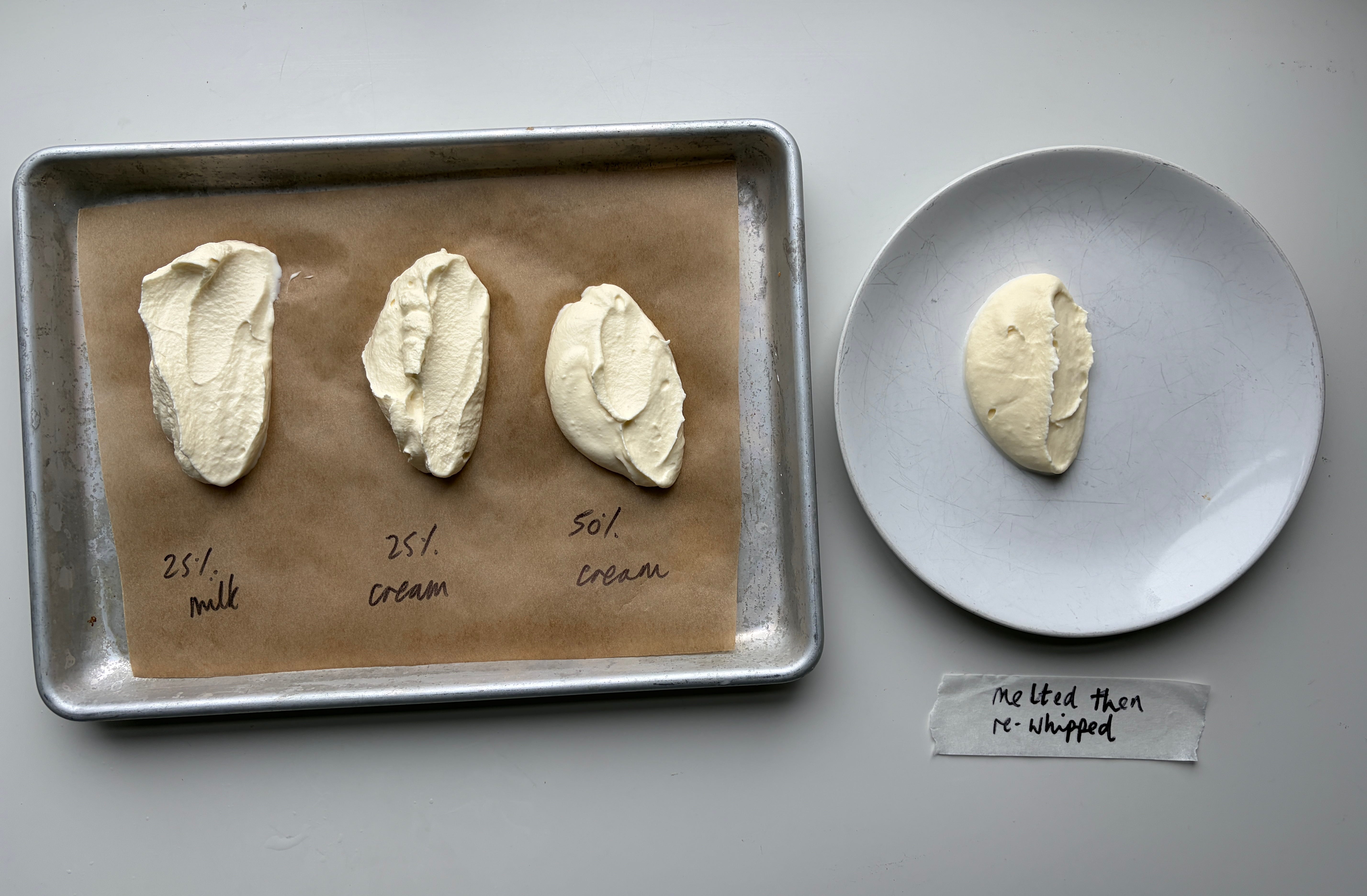
Remelting and rewhipping weren’t particularly successful. However, overwhipped cream isn’t wasted (And genuinely, if you are looking for soft, flumpy cream, it’s best to start again if you overwhip!). You can melt it down and use it elsewhere. In fact, the cream in my cheesecake recipe was originally overwhipped cream that I’d melted and repurposed, and it worked perfectly. You never would have known I’d taken it to the brink!
The Recipes
Rather than just give you another recipe for whipped cream, let me show you to various newsletters that have explored strawberries and cream, or whipped cream alone, in the Kitchen Projects archive. It is truly a goldmine!


New on KP+ today: New Era No-Bake Cheesecake with glossy strawbs
Camilla Wynne’s Strawberry Jam
Susan Spungen’s Strawberry Scones
Elderflower and Cream Cake with Elderflower Macerated Strawberries
The best way to stabilise whipped cream with Brian Levy
US Strawberry Shortcake with Bronwen Wyatt plus Bronwen’s Guide to Flavouring Whipped Cream
Strawberry Milk with White Chocolate Fennel Seed cookies
Plinth-lova, which uses a high ratio mascarpone whipped cream for max stability
So, go forth! Whip cream, hull strawberries, combine generously! And see you next week.
Extremely interested in the strawberries and cream cake recipe!!
The Bronwen Wyatt strawberry elixir recipe link doesn’t appear to be working, and I’m so curious!