
Kitchen Project #169: Doughnuts
A story of pastry redemption

Hello,
Welcome to today’s edition of Kitchen Projects. Thank you so much for being here.
Today I’m going somewhere I never thought I would… to the land of doughnuts. Via New York and Minnesota, I’m so happy to be on this journey with you all.
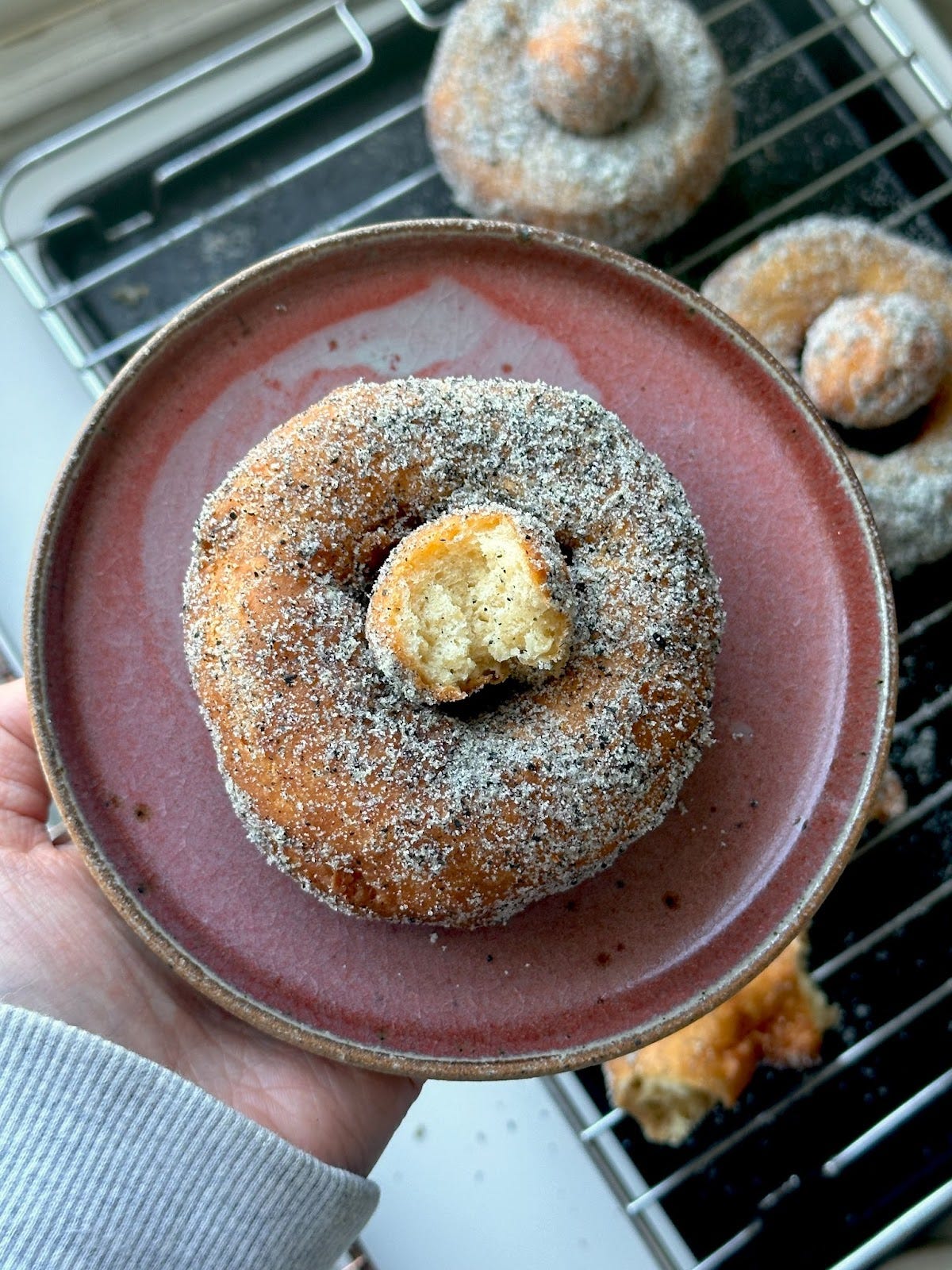
We’ll end up with a recipe for the most beautiful, airy simple glazed doughnuts, which have both a melt-in-your-mouth quality and a pleasant bounce. Over on KP+, I’m sharing my recipe for sour cream cake doughnuts with black sesame citrus sugar. Click here to read it.
What’s KP+? Well, it’s the level-up version of this newsletter. By joining KP+, you will support the writing and research that goes into the newsletter (including the commissioning - and fair payment - of all the writers), join a growing community, access extra content (inc., the entire archive) and more. Subscribing is easy and only costs £6 per month or £50 a year. Why not give it a go? Come and join the gang!
Love,
Nicola
Glazed and Confused
If you’ve been reading this newsletter for a while, you’ll already know this. But in case you’re new here, I’m about to disclose some information that might make you think differently about me.
I don’t like doughnuts.
UGH. I know. It’s an unpopular opinion. But I’ve just never vibed with them. Not the doughnuts at Brighton Pier, not the jam stuffed sugary ones from the bakery, not the krispy kremes that we’d buy discounted from Tesco as teenagers, not the ‘gourmet’ ones from fancy bakeries and markets in London, not even a single one whilst living in New York in my early 20s. I’m sorry.
It’s not that I’m anti-fried dough - I love plenty of doughnut adjacent things like Churros, Karepan (Japanese Curry Bread) and youtiao (Chinese dough sticks - pro tip: ALWAYS order the dough stick cheung fung at Dim Sum). And I know I am a contradiction - I’ve gone so far to write about Beignets in the past (their lightness and small size made them acceptable to former anti-doughnut me) but I can honestly name about 99 pastries I’d order BEFORE choosing a doughnut…. UNTIL NOW *dramatic dun dun dunnnnn*
Something unexpected happened to me in the last 8 months. I’m not sure if my brain chemistry has changed, but I’ve now met two, yes TWO, doughnuts that I’ve genuinely loved. One, a heavenly cake doughnut with kumquats and black sesame sugar, was just a few months ago visiting Zoë Kanan’s unmissable Elbow Bread in the Lower East Side. The other? Last summer at none other than the Minnesota State Fair.


If you’re not familiar with the Minnesota State Fair or State Fairs at all, let me catch you up: The Minnesota State Fair is a yearly event that attracts some 2 million people through its multicoloured gates over the course of a week.
Before I went to the Minnesota State Fair, I had no idea what it was. Not really. I mean, a fair is a fair, right? The kind of thing that packs up and down on some nondescript green strip by an A road? Not in the U.S of A! State fairs are annual gatherings that take place in each state, started in the 19th Century to promote livestock and agricultural traditions. This is still a big part of the fair today, with events like butter sculpting, sheep judging, milking demonstrations and tractor displays. It’s also filled with prize-winning crafts and produce adorned with blue ribbons, from crocheted blankets to apple pies.
The biggest draw for many, however, is the food. It is kind of like the final boss of deep-fried food. Pickles? Sure. Cheesecake? You bet. Oreos? Obviously. Ranch dressing? Somehow, yes! There are some legitimately incredible offerings - grilled sweetcorn, dipped into questionably big buckets of melted butter (or some kind of delicious liquid fat), is the best I’ve ever tried.
The queues are enough to make the UK proud. Some hours long, they wind down the dusty tracks, and the total lack of sun cover can be punishing. In my first two years, I braved almost all the queues (bacon waffle dogs - secured! Pickle lemonade - secured! Pickle pizza - got it!), but there was one that even I, even with queuing hard-coded into my DNA, could not manage: Peachey’s.
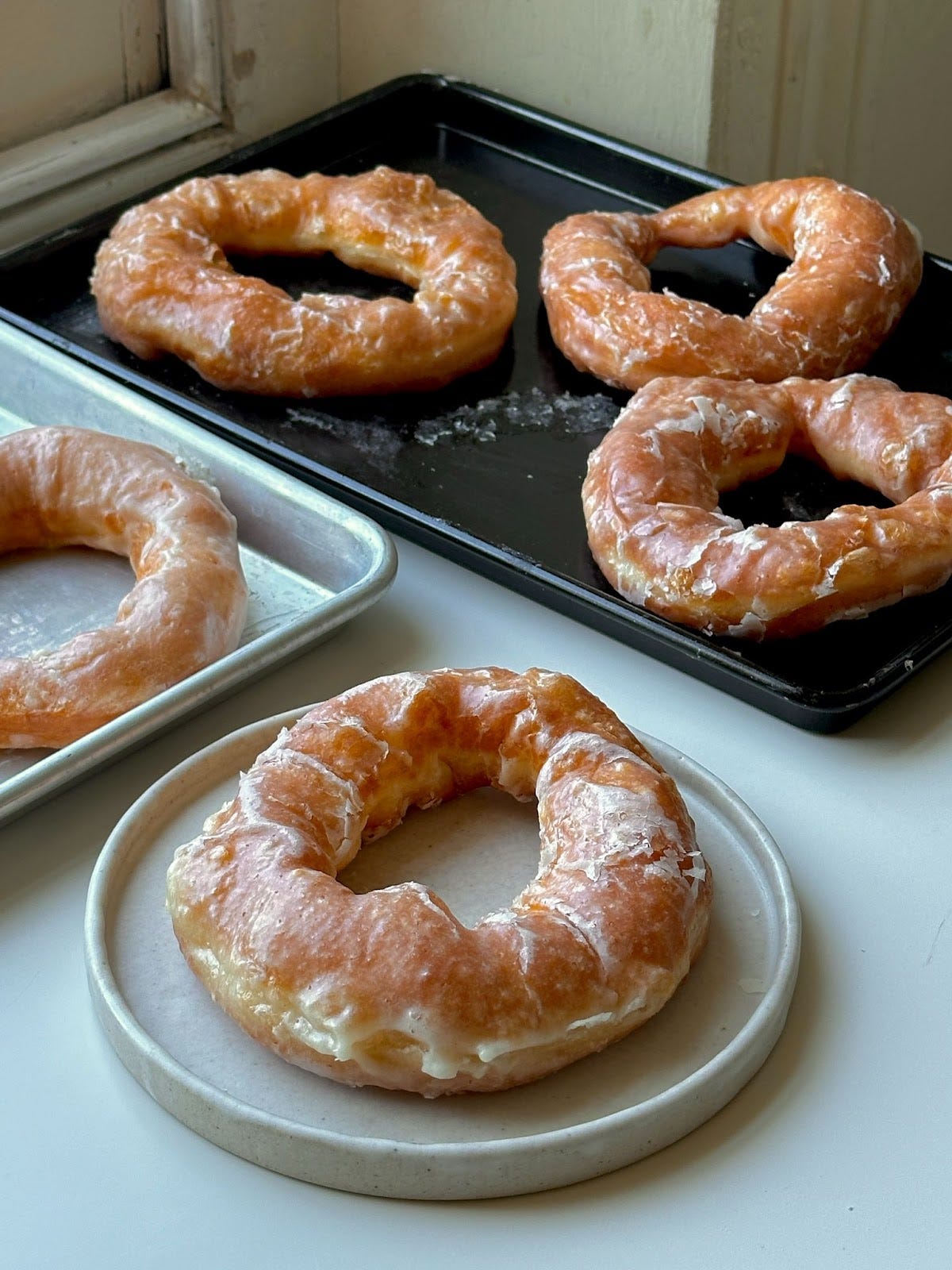
Peachey’s Baking Company, formerly known as the Amish Baking Co (more on that later), have a pale blue truck and a queue that never dies down. Even into the evening, when the eating crowds thin out and the drinking crowds settle in, the queue at Peachey’s remains pretty steadfast. A true sign of confidence in their product, Peachey’s sells just one thing: Big, soft, crackly “Amish” doughnuts. Hanging on wooden pegs these freshly fried and dipped golden dinghies arrive every few seconds, dripping encouragingly with glaze . Like everything at the fair, it is quite the operation.
![IMG_2920.MOV [optimize output image]](https://substackcdn.com/image/fetch/$s_!4o5-!,f_auto,q_auto:good,fl_progressive:steep/https%3A%2F%2Fsubstack-post-media.s3.amazonaws.com%2Fpublic%2Fimages%2F5040a50b-68ec-460c-9d45-7d19b0d4f648_800x1422.gif "IMG_2920.MOV [optimize output image]")
Peachey’s sells doughnuts in lots of 1 ($5), 3 ($12) or 6 ($24). Some wiley, capitalistic queuers pick up a half dozen, eat one, then try to sell them at a premium further down the queue, though most customers, like me, having already banked 30 mins plus of their time, refuse. I didn’t have the nerve to join the queue in 2023. But in 2024, I put my game face on and finally secured the goods (not on the black market).
Was it worth the effective one-year wait? I had low hopes - I don’t like doughnuts, after all - but friends, I was floored. Served warm and impossibly squishy, the Peachey’s doughnut is marshmallowy, airy but with a slight chew, and completely … perfect. Bread - or dough-forward, the inside is not too sweet (the glaze does all the talking in that regard), these are what the word pillowy was designed for.
BUT… is this the right doughnut for you?
Like cookies, and to be honest, all foods, doughnuts exist on a spectrum. I am not yucking your yum if you’re a jelly-stuffed kind of doughnutter, or if you love a chocolate glaze, or even one covered with bacon and M&Ms, I’m aware that we may never see fully eye to eye on all things golden and fried.
That said, sometimes creation is RE-creation. With my beginner-level interest in doughnuts, I’ll be working toward taking the metaphorical training wheels off by sharing homages to these two doughnuts that have changed my mind on an entire category of pastries. Here on the main, we’ll go on a journey to find the answer to the puffy Peachey’s style doughnut, while over on KP+, I’ve taken a swing at a fluffy sour cream cake doughnut inspired by Elbow Bread, complete with zesty black sesame sugar. Think of it as edible fan art.
To begin at the beginning
A few months ago, during my SIFT book talk at Floriole in Chicago, Tim Mazurek asked - with a look of genuine concern/amusement in his eye - “sooo… what’s the deal with Iced Buns?” The room was confused, and even more confused when I explained to a room of unsuspecting Americans that Iced Buns are literally white bread rolls with icing on them. It’s not a bake I gravitate toward on a daily or even monthly basis, but they are charming. But, perhaps this kernel of iced bun affection is what makes a simple, dough-forward doughnut appealing to me. I’ve made plenty of dough, but with such a specific goal in mind, I had to dig deep.
It was clear that this doughnut was an enriched, but barely, dough. It certainly wasn’t even the ballpark of brioche that is so often used in modern doughnut formulations, and the airiness and risen chew gave away its use of eggs. And since the dough is made constantly throughout the day, the ingredients had to be relatively straightforward. But could I do some detective work/stalking and find out more?
If you ever want to recreate a recipe, after you’ve tasted it greedily and lovingly, a really good place to start is on the information page on the company’s website. Peachey’s, who tour state fairs and festivals, is located in Sarasota, Florida, and has just opened their first brick-and-mortar shop. Thanks to allergens (words never spoken before), the FAQ reveals that “dairy [& eggs] is used in [the] doughnuts ….” Bingo.
But what of the “Amish doughnut” of it all? According to the same FAQ, Peachey’s do indeed make Amish Doughnuts, “probably because our business name used to be the Amish Baking Co :) We changed it a few years ago to Peachey’s because that’s our last name! The owners, who are also brothers, Nate & Sam, grew up Amish & this is an Amish recipe!”
Amish cooking traditions are often grouped alongside the Mennonite traditions and are characterised by hearty, unpretentious dishes that would keep you energised for a long day on the homestead. The ingredients are fresh and simple - presumably homegrown, milked or churned - and the techniques are slow-paced where needed, emphasising patience, generosity and community.
A quick Google will land you with plenty of “traditional” Amish doughnut recipes, though there’s no clear vein connecting them all other than the simple, fuss-free glazed finish.
What about preferments?
According to the friendly till operators at Peachey’s, the doughnuts are made on site in a pop-up Fair kitchen behind the truck, and take just a couple of hours from start to finish. This is good news for me, who wants to keep this process short. However, those brief few hours probably don’t account for the potential flavour builders and preferments that might be prepared ahead of time.
A preferment is simply a mixture of flour/liquid/yeast from your recipe that you mix ahead of time. There are many names for pre-ferments: bigas, poolish, sponge, and pate fermentee. It goes on. The reality is, they are all sort of… the same. All the variations achieve the same goal: an improved flavour and texture.
How does this work? When you make dough, time is an ingredient. As the dough ferments, the yeast converts sugar into carbon dioxide and alcohol (which burns off when you bake!). Flavour compounds are also produced here. Spending more dedicated time on the ferment stage is a great way to improve your dough's overall aroma and flavour. Maybe you’re thinking – why not just proof the WHOLE thing for longer, instead of just a small portion? Well, that’s a good question. It’s possible that the whole dough might over-ferment and you’ll get unpleasant, less welcome flavours (or a lack of chutzpah when it gets into the oven!).
I decided to mix up a series of doughs to see what was what. I came up with a base dough with 15% fat, a mixture of eggs, dairy and water (about 60%ish hydration) and used bread flour (13%) along with a touch of sugar and the necessary salt. I introduced various preferments. And since presumably the “original” Amish doughnuts were entirely leavened by sourdough, I threw that in the mix, too:
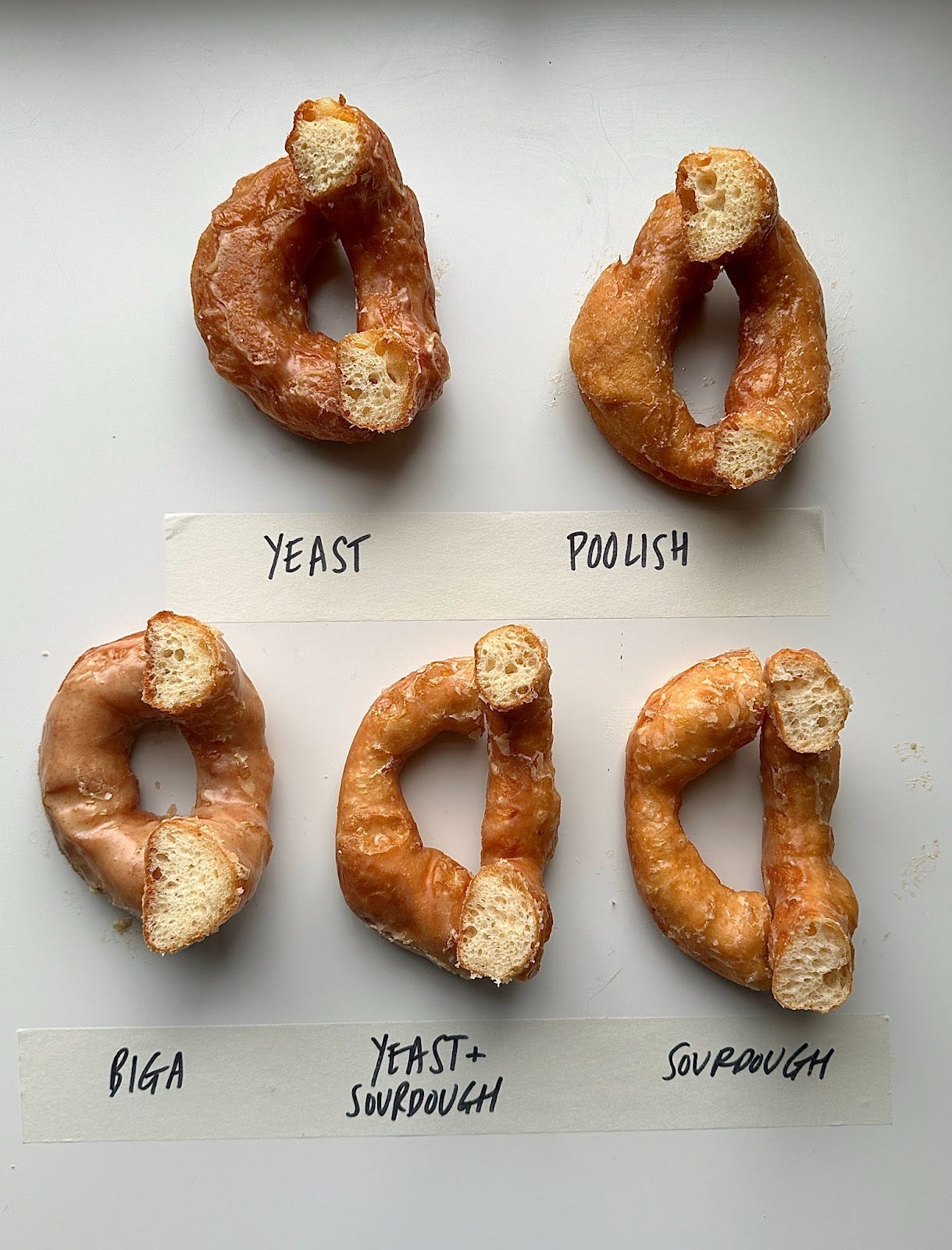
The results are in… by far the airiest is the overnight biga (relatively dry preferment that is 50% water to flour), followed by the yeast + levain combo, followed by the poolish (a wet preferment that is equal parts water and flour), then the direct yeast and then, in last place, the 100% sourdough. Each doughnut bubbled and rose to the occasion, though, joyfully bursting with reckless abandon in a focaccia-like manner.
I will say this, though - not a single one of these doughnuts was bad. The sourdough one was extremely chewy. Why? I asked the big bread guns, aka Andrew Janjigian, author of the ever-expanding and excellent Word Loaf newsletter and community. It turns out he’s also “NOT a fan” of sourdough-enriched breads. He explains, “I find the acidity off-putting, it seems to be accentuated by the sugar in the dough (either because of the combination of notes, or the effect on the fermentation itself, probably both). It often has a ‘cheesy’ flavour that ruins the delicacy of enriched products. For this reason, I either use yeast for enriched breads or a sweet starter, which is a royal pain to do, but makes incredible products that lack sourness entirely (and keep for ages, which makes the effort worthwhile when you have the extra time).”
As for texture, he explains, “[it] is secondary to flavour for me, but also a problem. It’s as simple as this: Acids strengthen gluten, so sourdough products of all kinds are inevitably more chewy. In lean bread, this is usually nice, though even then I often forgo sourdough for yeast when I want the product to be delicate and crisp-tender - things like flatbreads, pizza, baguettes, etc. With enriched breads, I want tender-tender, so sourdough is usually not the way.” Perfectly explained (and gosh, doesn’t this taste of the gospel of bread, according to Andrew, just make you SO excited for his book, which will hopefully be out in the near future!)
So, biga it is! Anyone who shuddered at the idea of me suddenly insisting that we go sourdough… you’re safe. FOR NOW!
Ooops, I forgot to make the Biga
So… Friday morning comes and I bound into the kitchen ready to make the “FINAL” recipe for the newsletter. And gosh darn it, would you look at that? I didn’t make the preferment that I’d decided was ‘essential’ for the dough. It was bad news for me in that moment, but ultimately, it was good news for all of us. Preferments use only a speck of yeast because they have so much time to develop flavour and ferment, but it is possible to expedite the process by increasing the amount of yeast. Sure, you miss out on some of that flavour, but that airy texture can still be secured. There’s too much of a good thing, of course - too much yeast makes the dough susceptible to overproofing, and you need to develop the gluten in time to capture the fermentation gases.
I mixed up a biga-esque preferment - 60ml of 40c water, 120g bread flour, and 4g yeast (that’s about 3.5% to flour weight, a huge amount compared to the 0.5%-1% you’d usually do) and 1tsp sugar into a crusty ball, popped it into the (Switched off) oven with a pan of just boiled water and went out for an hour. When I came back, it was still a crusty ball, but an airy crusty ball! Success.
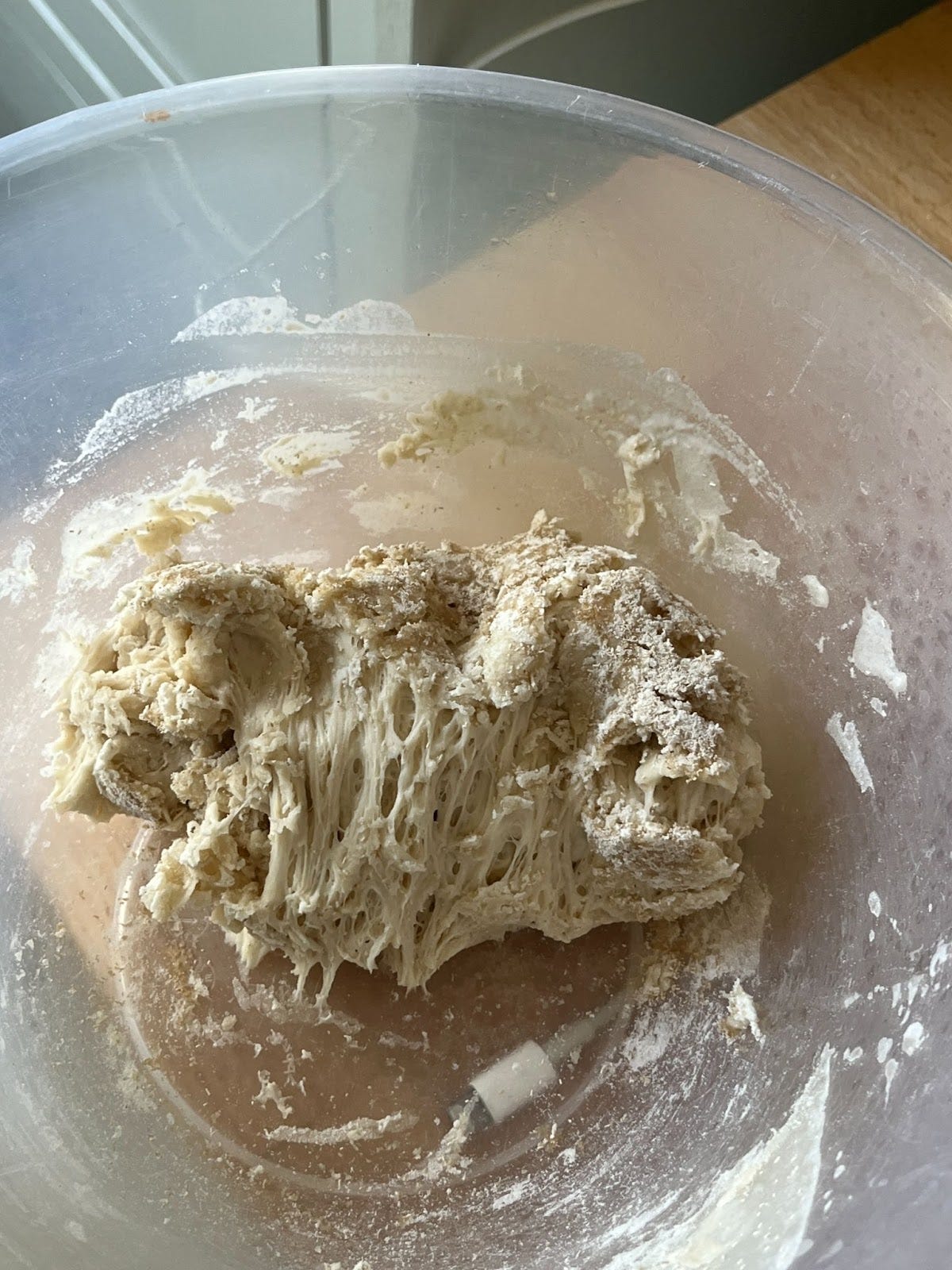
I scraped this into a mixer and added the rest of the ingredients and mixed it into a supple dough, proofed it again for an hour, then shaped it into rings. After a final proof, they went in - bubbly as anything! Sure, the flavour was less complex, but the texture was perfect - my faux-biga doughnuts are definitely the way forward!
Type of Flour
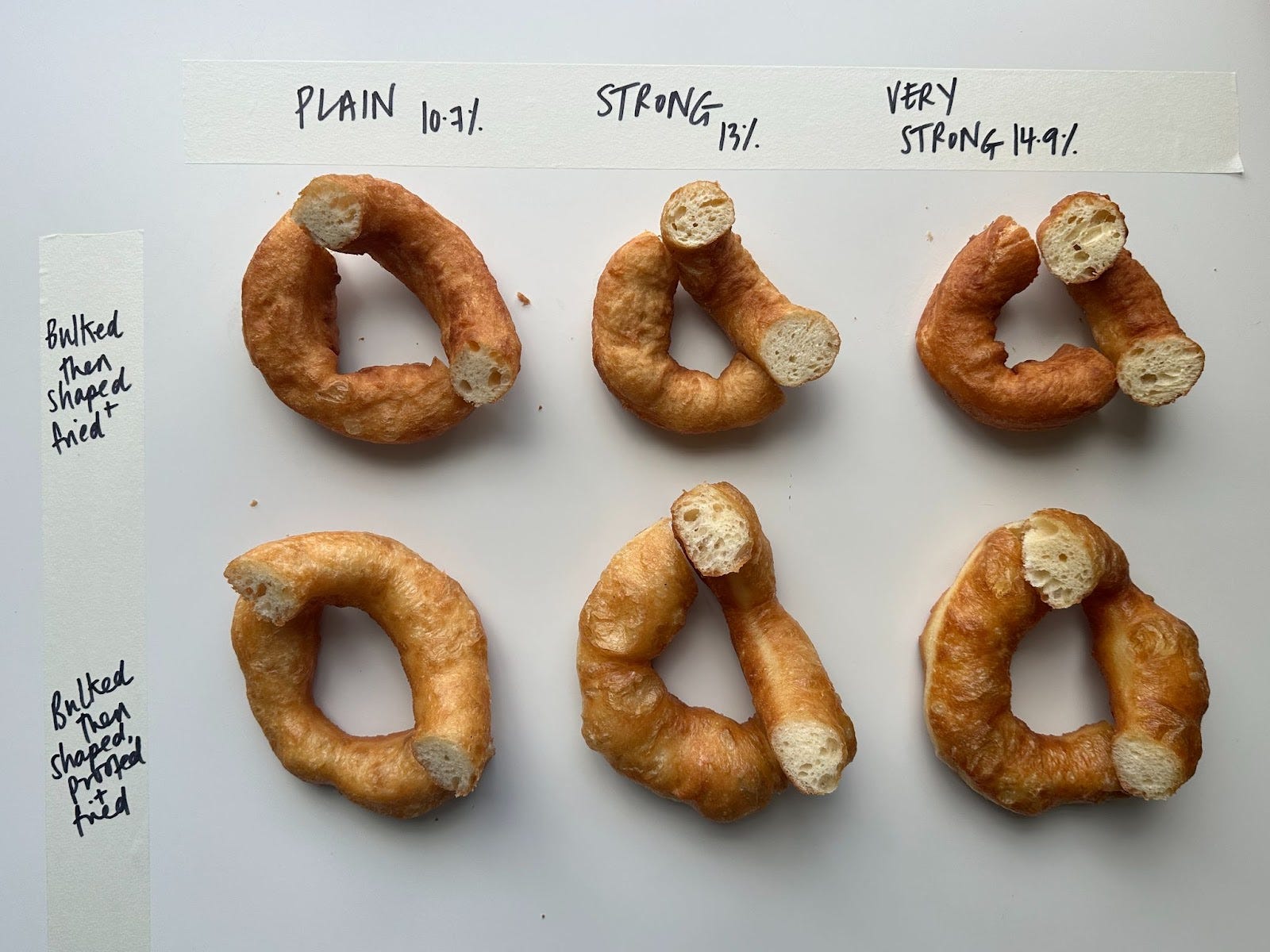
I’m aware we all have different access to different flours so I decided to see how it would behave with plain flour (10.7%), bread flour (13%) and ‘strong’ bread flour (15%). (Disclaimer, I realise now, writing this, that I used a biga made with strong flour, which means this isn’t a pure test as 30% of the test’s flour is made with bread flour, but hopefully still helpful!). I found each worked, with a slight preference to the middle ‘bread’ flour, though if you had to decide to go up or down from this median, I’d go down. This dough is relatively manageable in terms of moisture, around 65%, so it can be handled by a lower protein content if you need.
Inspired by other pre-fermented doughs, I thought I might be able to ‘skip’ a step by shaping right after mixing and proofing in rings, instead of doing the final proof before frying. The verdict? In true Amish fashion: No shortcuts.
The shaping
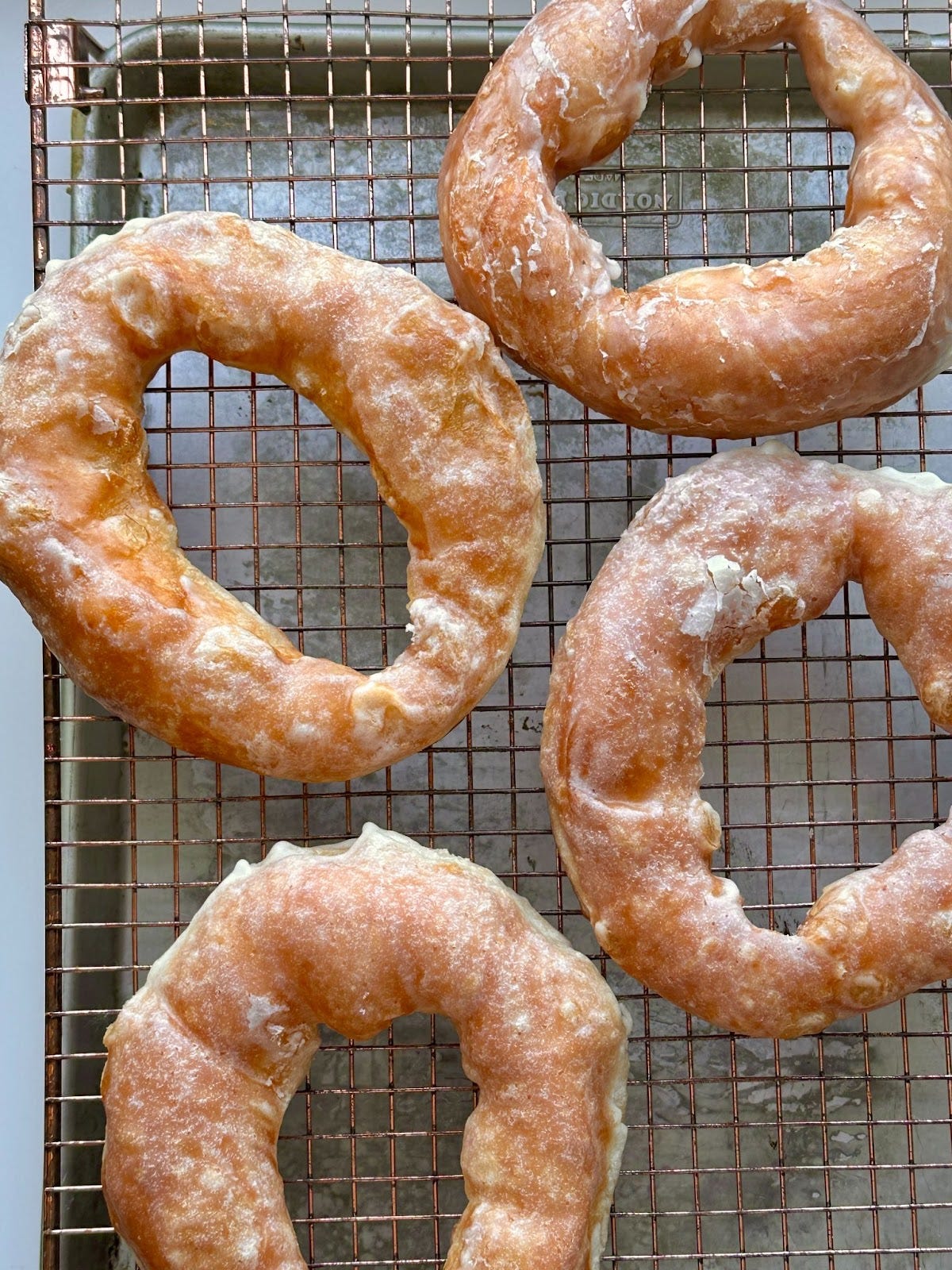
In the spirit of no-waste, the doughnuts are cut into circles (they use a tin can at Peachey’s, which is adorable) and stretched by hand. This gives the doughnuts a pleasant organic shape, no two quite the same. These are very large doughnuts, coming in between 80-90g per doughnut. You can certainly make smaller ones.
Deep frying
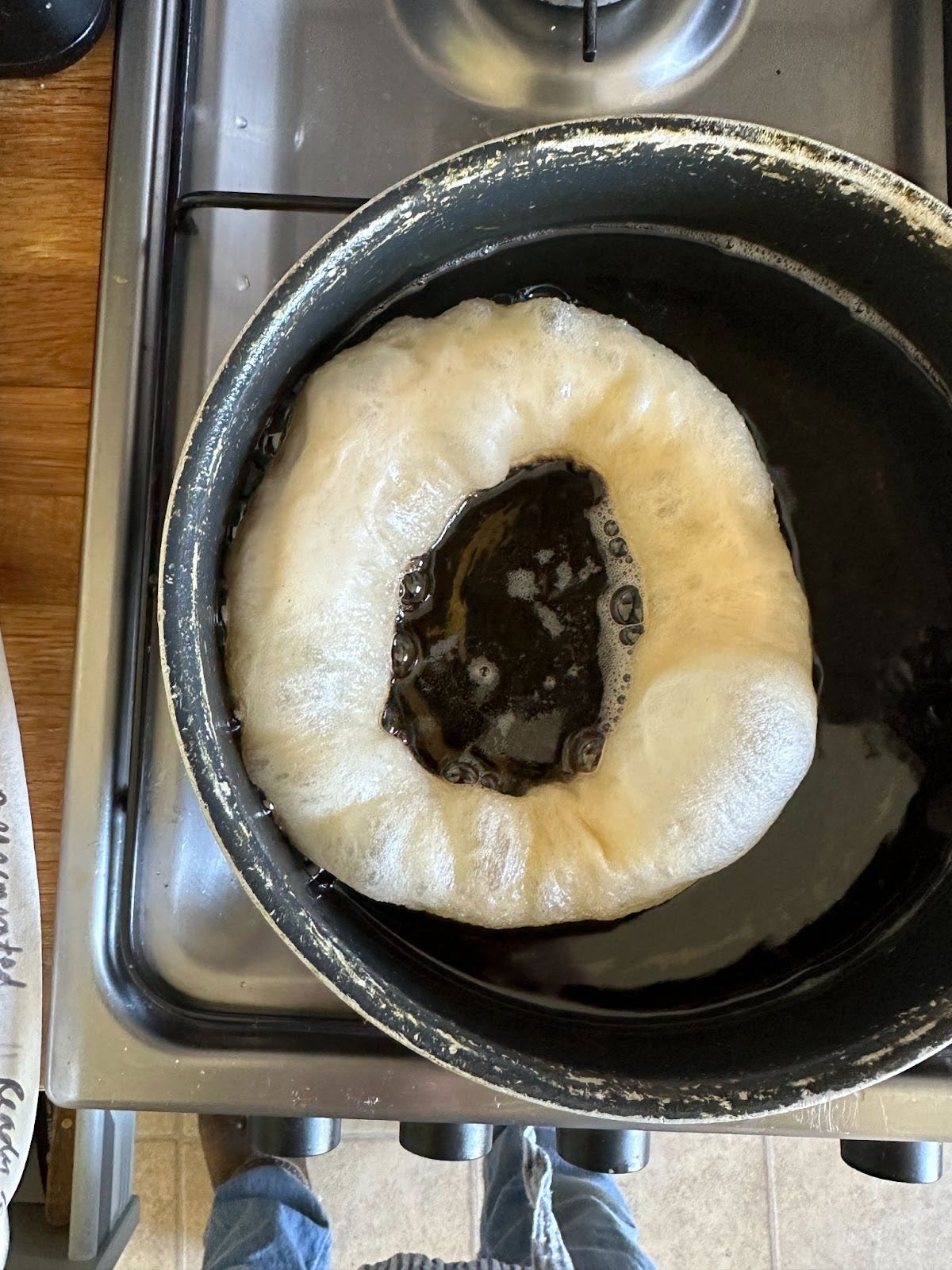
I know deep frying feels scary for a lot of people, but this cooking method is essential for the character (and pleasure) of doughnuts. Bubbles can form from each side giving an airier inner texture and the oil absorbs into the outer layer, making way for that wondrous crust.
During the deep-frying process, the surface temperature of the dough rises very quickly, and the heat begins to radiate inwards. As a result, the water in the dough starts to turn to steam and tries to escape, explaining a large number of bubbles and sputtering in the first parts of the frying process. At first, the crust remains somewhat flexible, allowing for interesting expansion which helps form that erratic, open and bubbly centred crumb. I tried baking the dough to see what happened, and it’s a sorry sight. Not unpleasant to eat, but certainly not a doughnut.
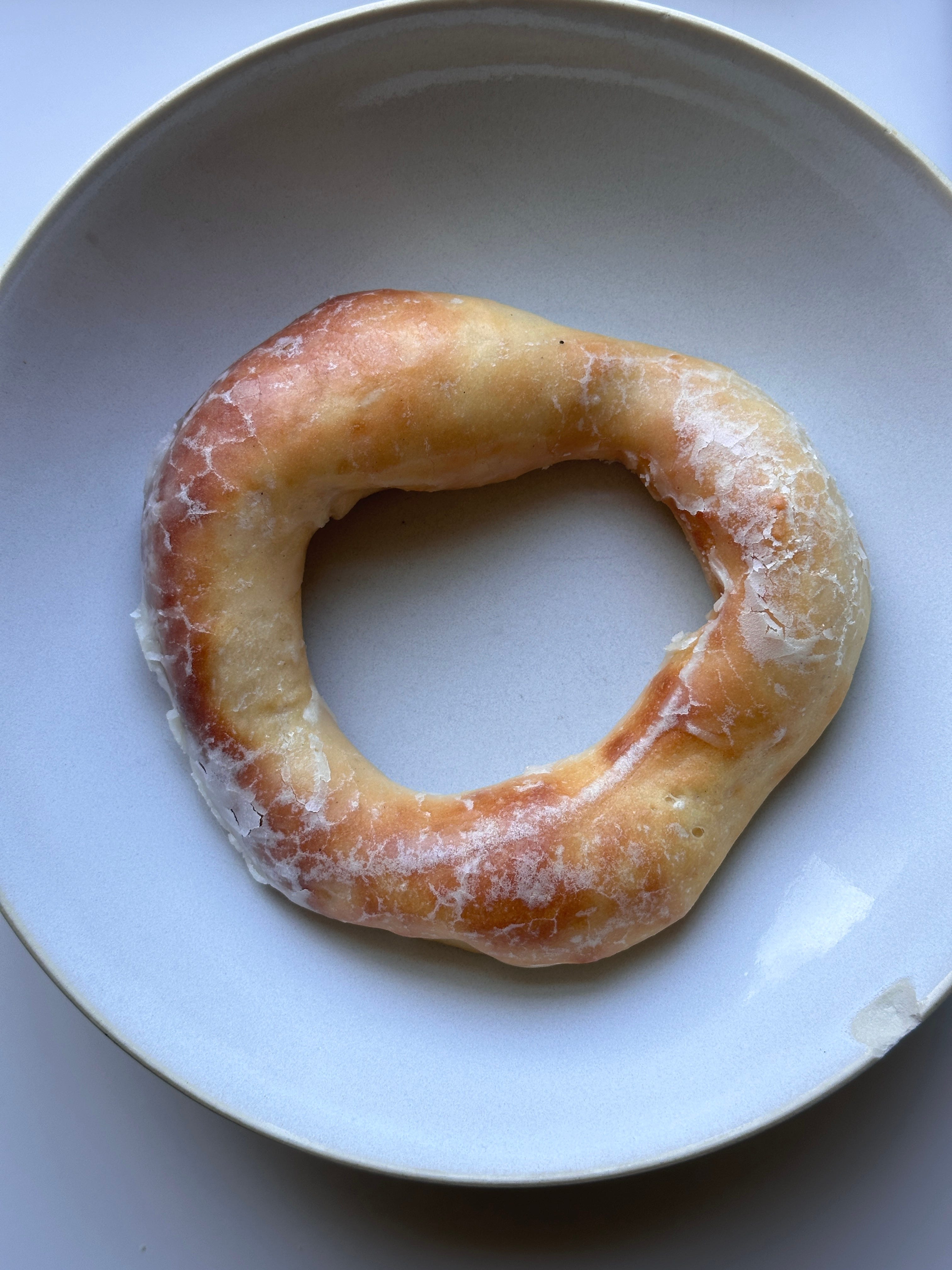
You can find my deep-frying tips in this newsletter here. Please don't be afraid! I’ll definitely work on doing a deep-frying, fear-quashing demo for you soon.
The Glaze
The glaze is simple and tastes, in the best possible way, a bit mass-manufactured. If that isn’t your thing, omit the vanilla essence and use vanilla bean. The glaze is a simple mix of icing sugar, salt, vanilla essence, buttermilk for tang, milk and melted butter. Oh, and a secret little pinch of cinnamon for balance. A little really goes a long way. I tried out a version with slightly coarser “home-made” (aka I ran out and didn’t want to go to the shops) icing sugar, which has a more fuzzy texture, and I played around with how much to thin the glaze down.
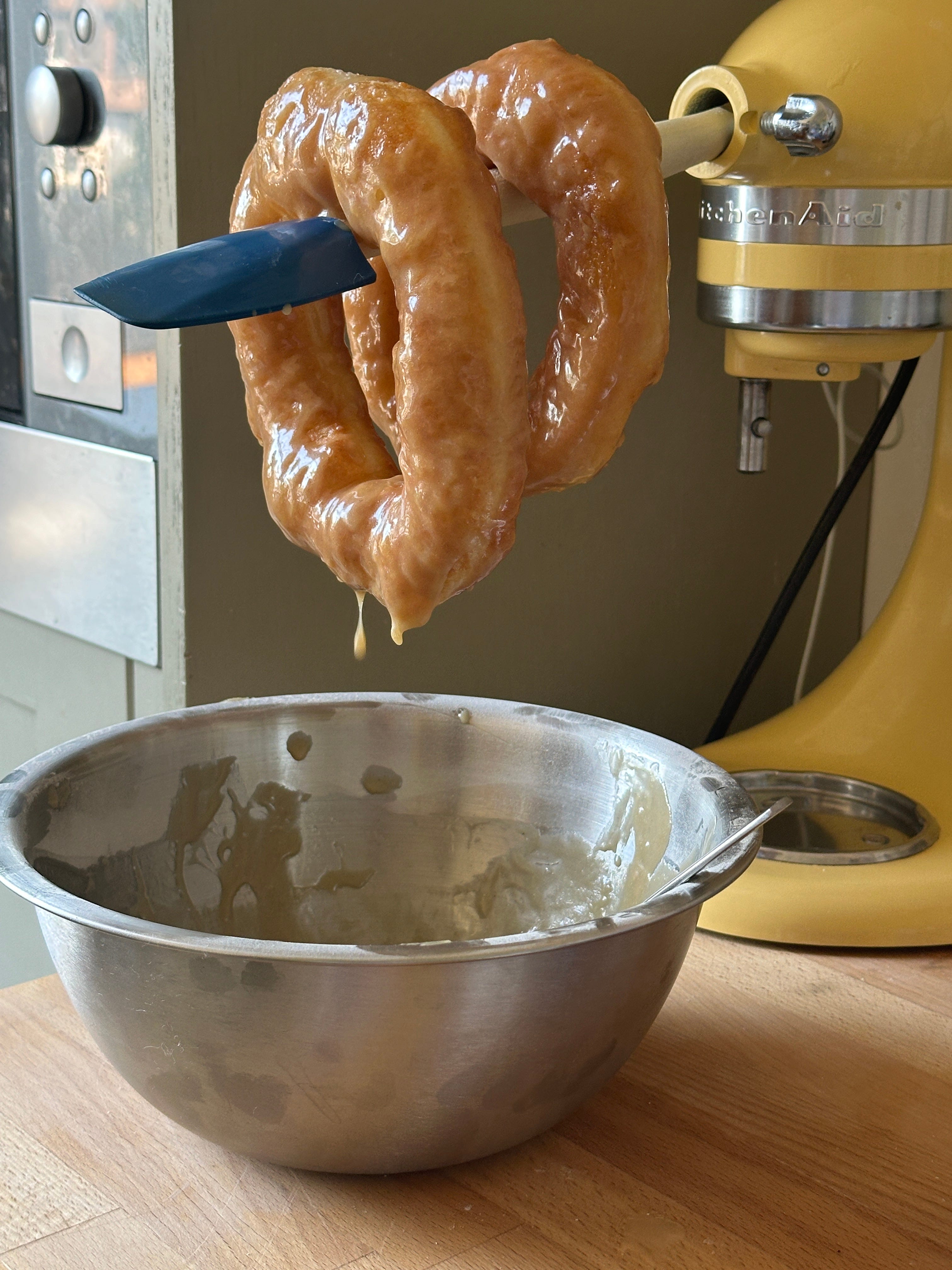
I would say it takes a bit of experimentation to get it perfect for you, so don’t be afraid to adapt to suit your tastes. ALSO: You get the crackliest crust by dipping the doughnuts while warm, but not too hot. The glaze melts around it - a little of the fry oil gets into the glaze, which is tasty! - and they drip like a dream.
So, long story short, I like doughnuts now (terms and conditions apply). Shall we make them?
RECIPE: Simple Glazed Doughnuts
Inspired by Peachey’s doughnuts
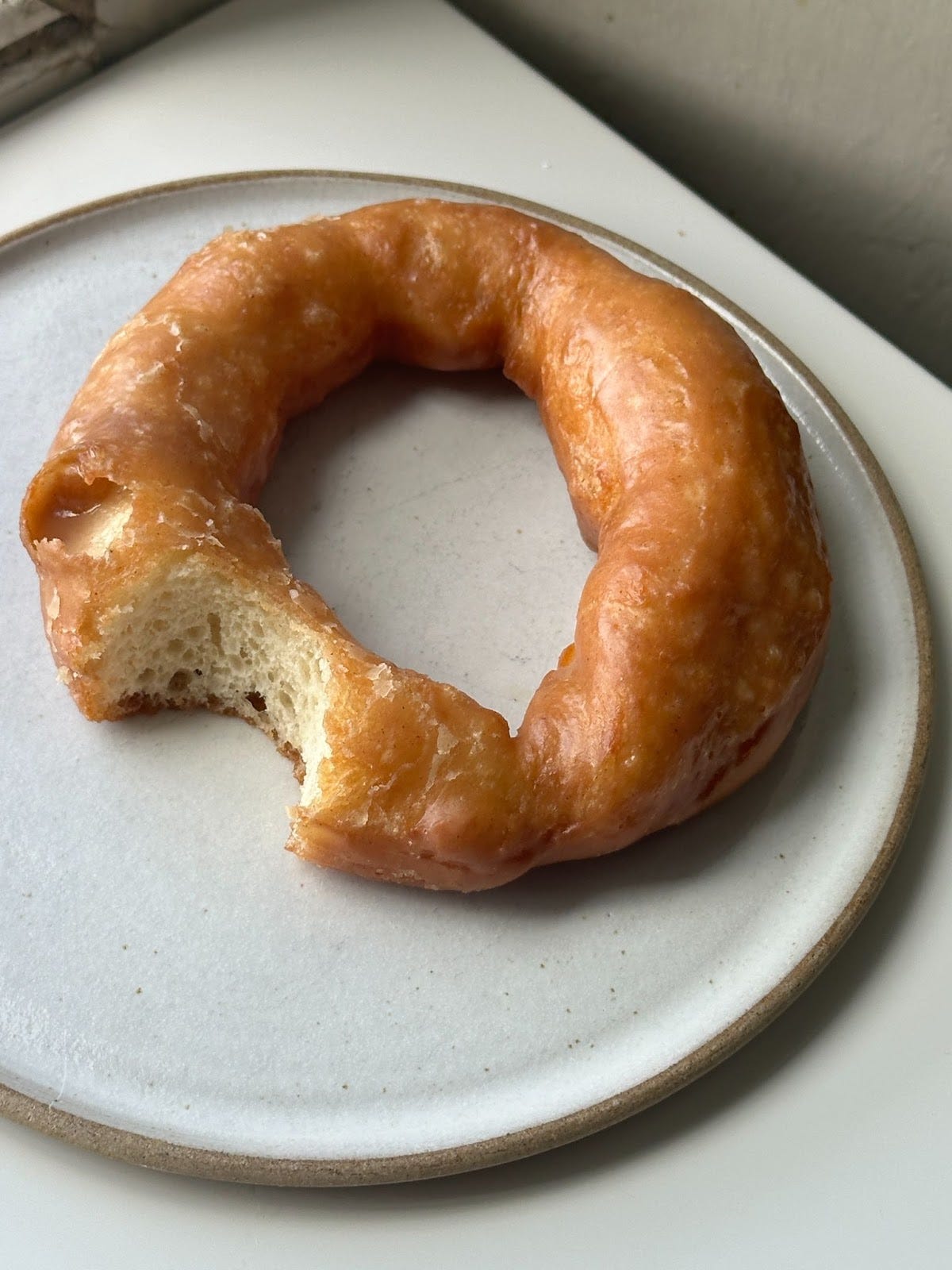
Makes 8-10 large doughnuts. You can halve this recipe, which means halving an egg, which is annoying, but not impossible. Just whisk it up then scale out 25g. Put the rest in your morning scrambled eggs. Easy.
Also, if you really want to make these doughnuts quickly and you don’t want to do the preferment, this does work! It isn’t quite as airy, but still good. Just throw all the ingredients in together and mix as directed.
Preferment
60g Water, 40c
120g Bread flour (mine is 13% protein)
4g Instant Dry Yeast
1 tsp White sugar, about 4g
Main dough
All preferment from above
110g Water, a bout 40c
50g Milk, about 40c
50g Egg, about 1
280g Bread Flour (13% protein)
10g Caster sugar, about 2tsp
6g Fine sea salt
60g Unsalted butter, soft
About 2L vegetable oil for frying
Glaze
300g Icing Sugar
50g Buttermilk
20g Melted butter
1 tsp Fine sea salt
2 tsp Vanilla extract
25g Whole milk
Pinch of cinnamon to taste
Method
For the preferment, mix all the ingredients together into a rough, dry-looking dough (it's ok if there are dry bits of flour), then put in a warm place, covered, for about an hour until it is very active, stretchy and there are clear signs of fermentation. I put mine in the oven with the light on and a pan of just-boiled water - I call it my dough spa (but proofing chamber also works). If you check the temp, it should be around 28-30c! Note: You could do this the night before, but use room temp water, then leave at room temp overnight. If making many days in advance, keep it in the fridge!
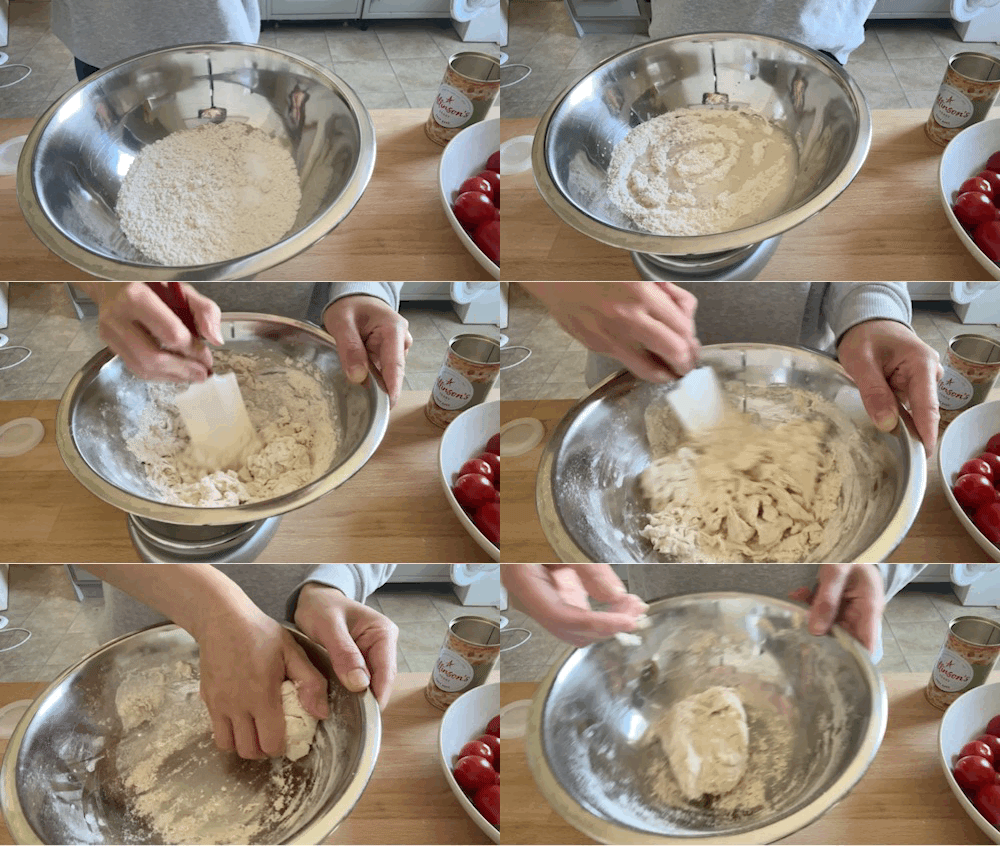
To mix the dough, tear the preferment into 7-8 smaller pieces and put in the bowl of a stand mixer (fitted with the dough hook), if using, then add the liquids on top, followed by the dry ingredients. Mix the dough for about 4-5 minutes on medium speed until it comes together into a homogeneous, sticky, dough that doesn’t stick to the side of the bowl. Start adding the butter, a teaspoon at a time making sure each piece is mostly incorporated before adding the next, while the mixer is running. Once it is all in, increase the speed to medium-high and mix until you get a smooth, shiny dough that pulls away from the side of the bowl, and can be stretched into a thin translucent pane, 8-9 minutes. You can mix by hand, but it takes more time and patience!
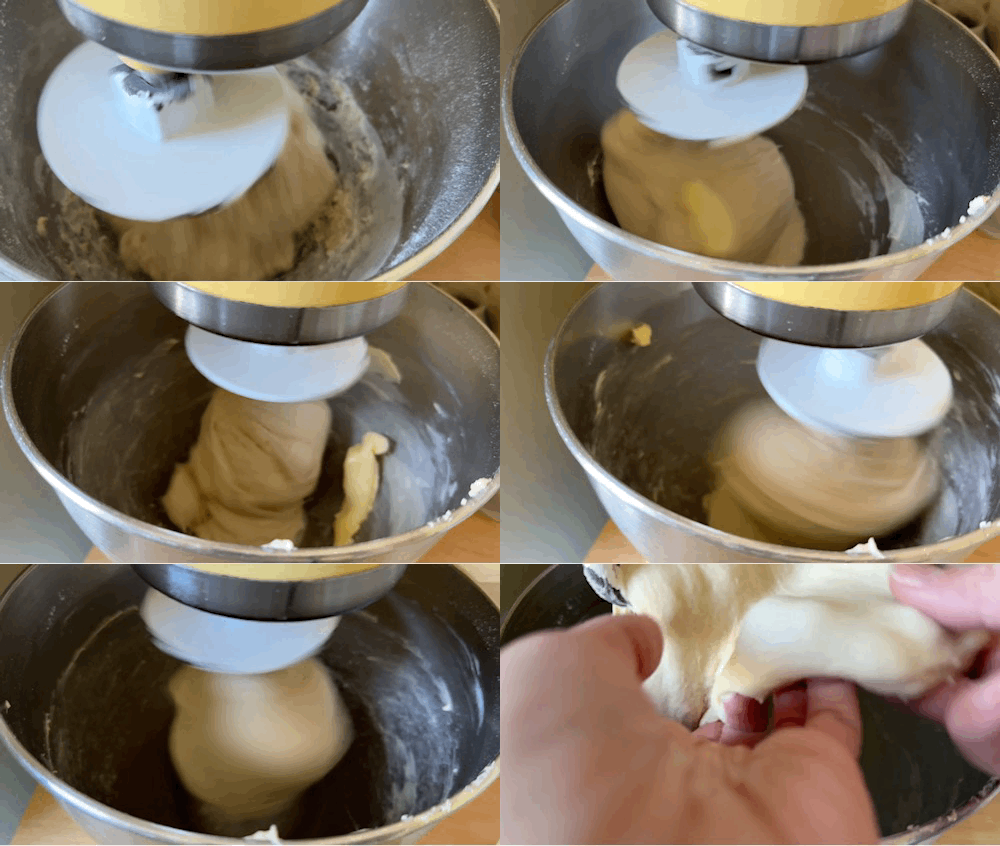
Remove the dough from the mixer, smooth it into a ball, then place it into a smaller, oiled bowl and put it back into the dough spa, aiming for an ambient temp of around 28- 30°c. Leave to rise for about an hour - it should have at least almost doubled.
Once risen and aerated, put your dough onto the bench (dust the dough and bench with flour, if needed) and press to be roughly 1 inch thick. Using an empty can (or a cutter in a similar size, about 8cm), stamp out rounds. They should be about 75g - 90g. If they are far off this amount, adjust the thickness of your dough before stamping more. Leave to rest for a few minutes on the bench, then pinch a hole in the centre and stretch the rounds into large rings. Go bigger than you think - they’ll spring back so you may need to repeat it a few times! Test one out to get a feel for it. I promise you can go bigger than you think if you want those epic proportions.
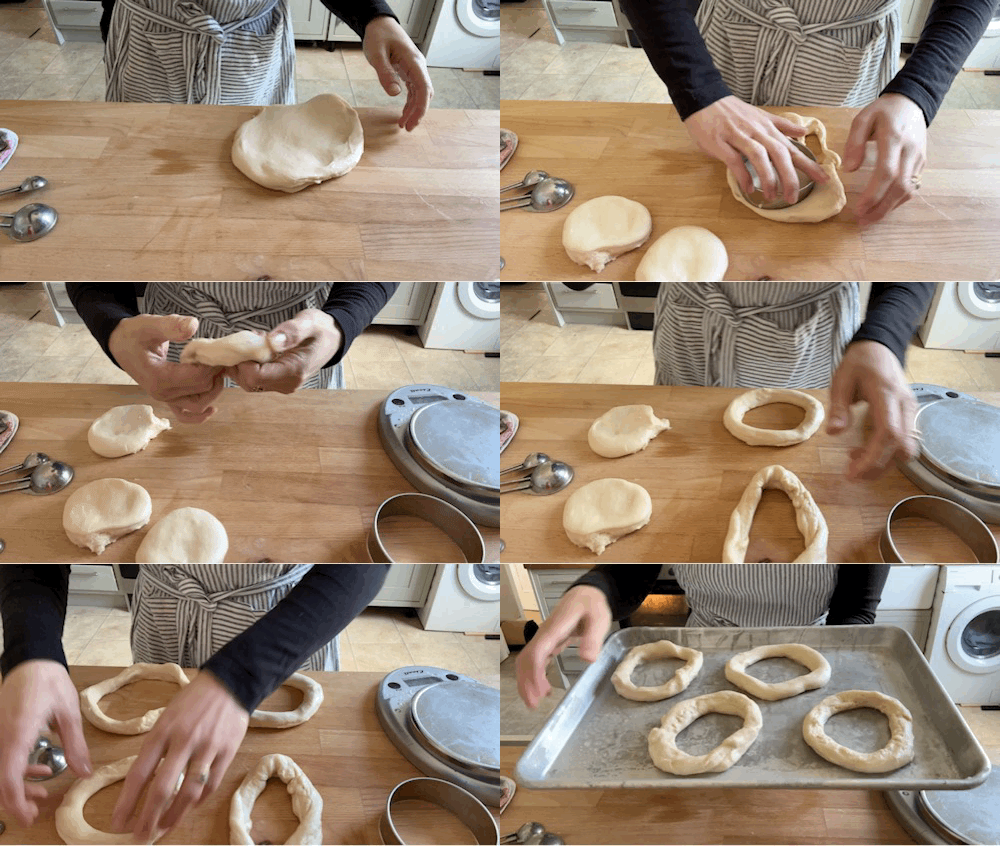
Place them on an oiled baking tray and put back into the dough spa, or somewhere warm (but if not in the dough spa, cover to prevent crusting) to make them lovely and puffy. It’s hard to tell with such thin rings, so take a photo before, and you’ll see when they’ve increased about 1.5x in size. Mine took 25 minutes one day, 40 minutes the other. It all depends on how active your dough is and how warm your dough spa/house is. They’ll have a puffa coat like quality to them!
For the glaze, mix all the ingredients in a large bowl. Taste and check if it needs more salt, sugar, etc. It should be slightly thinner than runny honey, but you can always adjust with milk. Cover with a plate to prevent crusting.
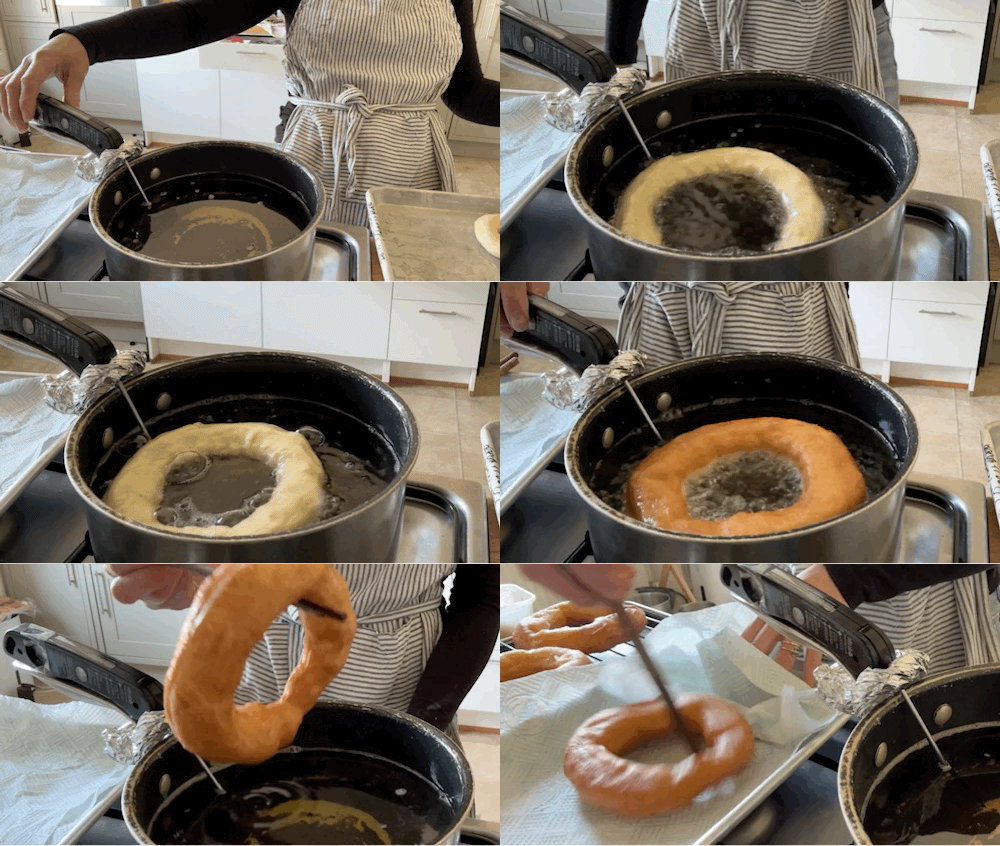
To fry the doughnuts, heat oil in a large saucepan. You want there to be 3 inches of oil. Heat to 170°c. Pick up each doughnut and stretch slightly (Note: it’ll do this naturally as you pick it up, so go gently!) before laying it gently in the oil away from you. Fry for 1.5-2 minutes, taking care of the temperature and checking it regularly, before flipping and cooking for another 1.5-2 minutes. Remove carefully from the oil, drain both sides on kitchen paper, blotting slightly, then pop on a wire rack set over a tray to cool a little.
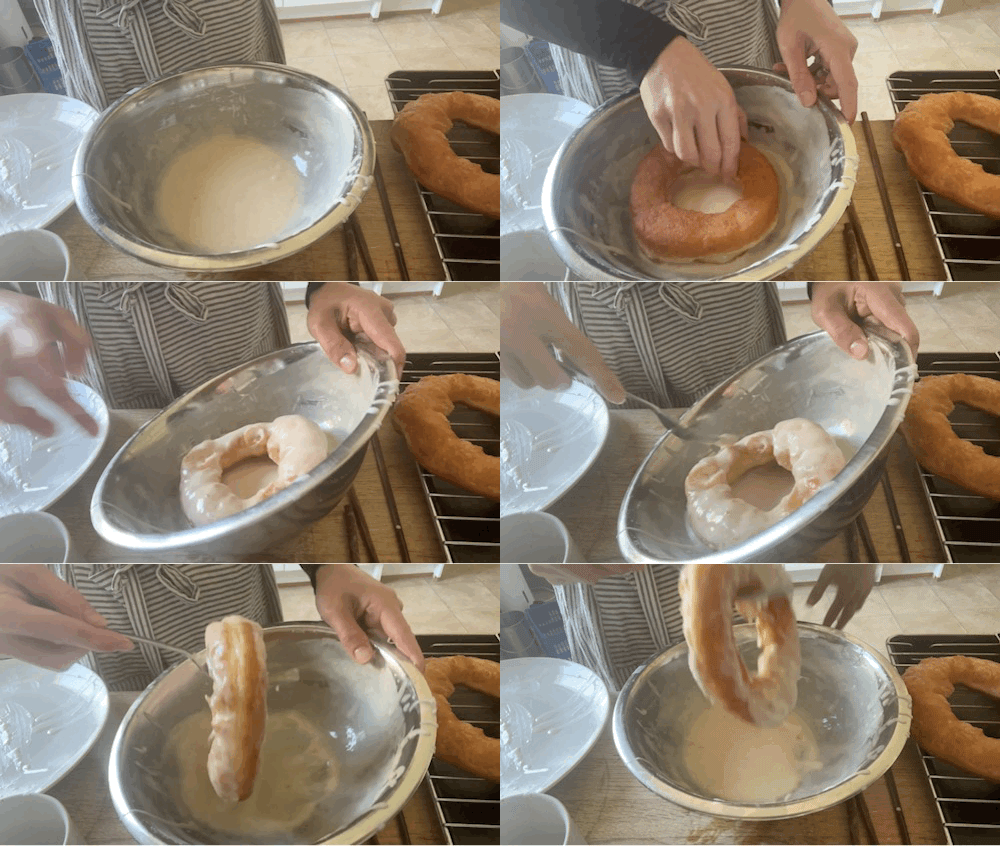
Dip the warm doughnut in the glaze, turn it over and then let it drain completely on the wire rack (or fashion yourself a Peachey's-esque doughnut draining stand like I did by shoving a spoon in a wire rack/the attachment hole of my kitchen aid.). Adjust the glaze if it's too thick (add milk), or thin (add sugar) - you can always make more if you run out from being very generous with your dip.
For the absolute best experience, it is crucial to eat these warm. Reheat in the microwave for 10-15 seconds if they’ve cooled too much, or turn on the oven to about 100°c, switch it off and pop the doughnut in to warm in the ambient heat. Best served the day they are made, but they can be revived with warmth if kept in an airtight container.
Your writing is every bit as enjoyable as your food. Such a joy to read , thank you !
Donut lover here, super thrilled to have you join us on the "other side". I also thoroughly enjoyed reading through this and am a big fan of the GIF visual format!