
Kitchen Project #168: The Mystery of Mango
Tis the season - let's (man)GO!

Hello,
Welcome to today’s edition of Kitchen Projects. Thank you so much for being here.
Like clockwork, the delicious kind, I am here to talk to you about the pride and joy of my May each year: Indian Mango Season! (though any great mango will benefit from these recipes and investigation into flavour). Today, we will look into the mysterious flavour of mango… why is it so hard to capture? And what can we do about it?
We’ll end todays newsletter with a recipe for Vanilla Buttermilk Cake with Mango and Jasmine Tea Whipped Cream. Over on KP+, I am delighted to share the recipe for Mango Princess Cake. Inspired by my recipe for Princess Cake on the New York Times, I’m sharing the development process behind this gorgeous bake and giving it a Mango makeover with mango custard, yoghurt whipped cream and mango syrup. Click here to read it.
What’s KP+? Well, it’s the level-up version of this newsletter. By joining KP+, you will support the writing and research that goes into the newsletter (including the commissioning - and fair payment - of all the writers), join a growing community, access extra content (inc., the entire archive) and more. Subscribing is easy and only costs £6 per month or £50 a year. Why not give it a go? Come and join the gang!
Love,
Nicola
Let’s Mango!
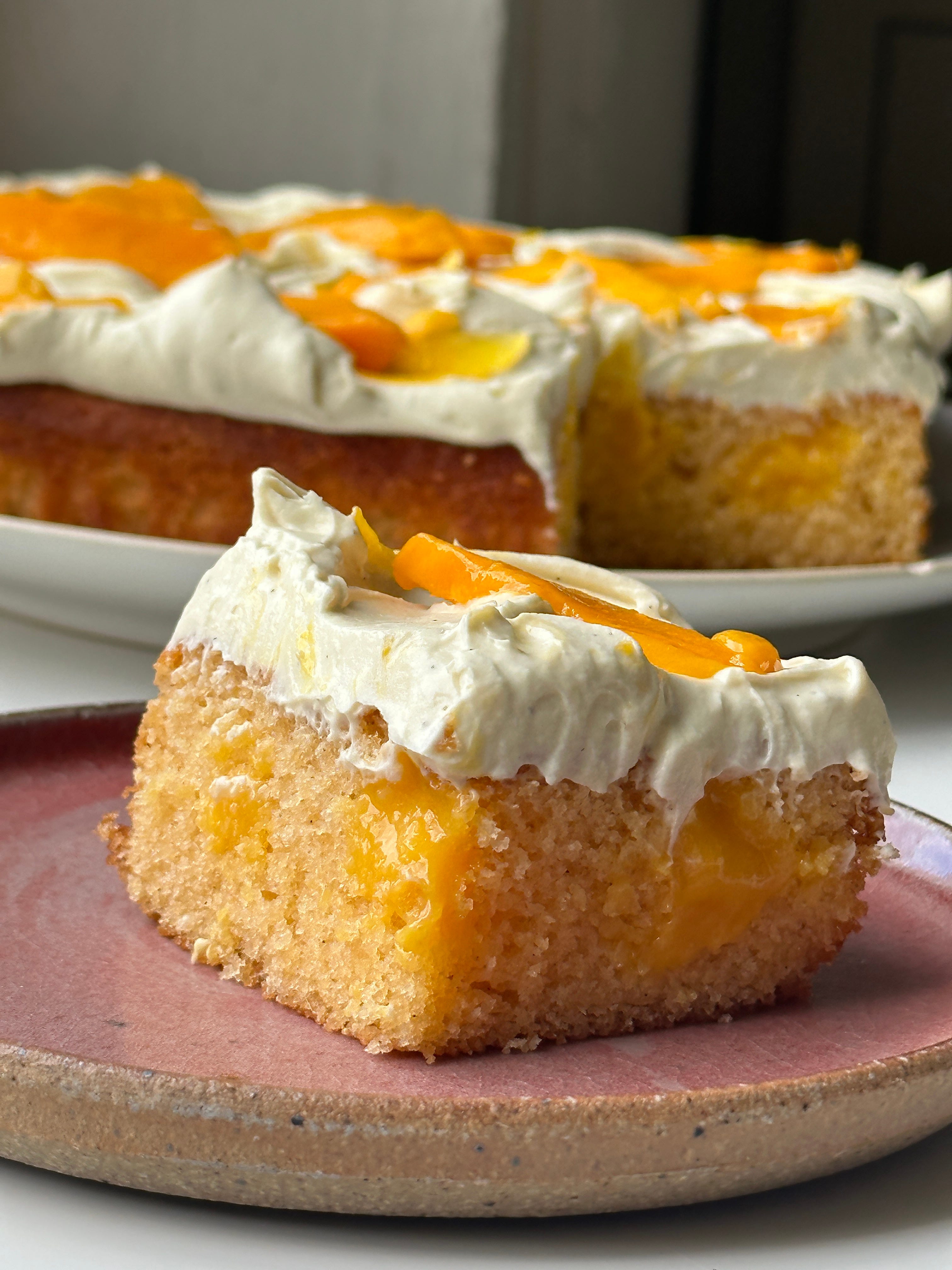
Few pleasures beat eating your first Indian mango of the season. Each May, I savour the pilgrimage to the Drummond St Spice shop around the back of Euston station and see the stack of mango boxes piled unceremoniously on the floor by the ice cream freezer. There are boxes of six or twelve - you can get alphonso and kesar at this time of year - and I always get the big box. Unlike many fruits, mangoes are not eat-on-the-go friendly, so the journey home is excruciating. Even if I brought my own little paring knife to gut the mango right there on Drummond Street, the excess juice bleeding onto the London pavement would surely defeat the point of my greedy haste.
On the tube, I wonder if other people can smell the mangoes, too. Usually, the tube is full of bad smells you want to avoid, but a box of mangoes on the Victoria Line at rush hour is surely appreciated? ‘You’re all SO welcome’ I think. I rush back to my house and within seconds my first mango of the season is cut, scooped and devoured. The stone is always sucked over the sink. The second follows quickly.
And so begins the Indian mango season, which starts in May and goes ‘til the end of June. My pride. My joy. (Note: the delicious mango baton is passed promptly onto Pakistani honey mangoes, and there are a whole host of divine Thai, South American and Filipino mango varieties which I’m yet to find a good supplier for… but I’m working on it!)


Whether you’ve tried them before or not, let me be clear: The flavour really is extraordinary. On eating my first Alphonso, I remember thinking, ‘Oh, so this is what mangoes are supposed to taste like?!’ The dense, bright orange flesh of Alphonsos is the perfect medium for the perfumed juice, which expertly straddles acidic brightness, sweet green earthiness, floral creaminess and is even somehow smoky. Brilliantly complex.
BUT… because there’s always a but… and I swear I'm not trying to come for mango or anything but as a flavour, it is kind of… lazy. Ok, not lazy per se - perhaps passive is the word I’m looking for. Mango seems perfectly happy to be dominated by other flavours. In a group situation, mango would hold the door open for ten minutes and never actually walk through. This is lovely and polite in theory, but when it comes to flavour? That kind of humility is at risk of fading into the background.
Where does the flavour go?!
How does this magical flavour lose its spark so easily? Perhaps its complexity is the answer. Seemingly, even a small push in any direction - acidic, floral, creamy - risks losing its character. I’ve lost mango to dairy, eggs, and citric acid in the past, easily becoming indistinct. Considering how divinely delicious a perfectly ripe mango is, this feels like a tragedy.
I’ve struggled through this every single year in mango season. And though I’ve always been delighted with my final recipes, I wanted to investigate what makes mango…. mango. A mystery I can really get behind.
And then, of course, with my newfound understanding, I develop a few new recipes to celebrate the season: A fluffy vanilla buttermilk cake stuffed with a new and improved mango (not)curd, and a complimentary jasmine tea-infused whip on top for main, and over on KP+... a mango princess cake. Need I say more? So, let’s dive in.


Everything Mango
If you’re new to mango season here on Kitchen Projects, let me direct you briefly to this compendium EVERYTHING MANGO. I’ll summarise all the mango goodies here on the newsletter toward the end of today’s edition, but it’s a good starting point for recipes, storage instructions and the rest. And, so you’ve got it up front, here’s my link to the Mango map of London (and now one spot in Newcastle, thank you, Sophie Bamford!). PLEASE, if you have any hook-ups, let me know so I can add them to the map. No mang-gatekeeping here! Keen for this map to go international, too, so leave a comment or email me, please!

Click here to see it. Tips on buying mangoes can be found here and here. For online, I’ve purchased from Indifresh and Red Rickshaw before.
The mystery of mango
Can it be solved?
I decided to consult my library to try and find the answers: According to the excellent Flavor-ama, Arielle Johnson’s thoroughly enjoyable guide to the science of flavour and a practical source on how to maximise flavour in cooking, we have some four hundred receptors to interpret smells on top of the ‘Big Five’ taste receptors (bitter, sweet, etc. you know!). But what exactly is it that we are smelling? Put simply, it’s molecules that provide our brains with signals - it’s not that flavour is imaginary, per se, but to quote Arielle, our nose and tongue “function as detectors … sending signals to our brain. Only then does [it] cook up your perception of flavour … Technically flavour is entirely a figment of your perception.”
I’ve covered this topic briefly before in this edition ‘how to pair a pear’, but let’s go over the basics: It's estimated that >80% of our flavour experience comes from aroma and less than 20% from taste. Losing your sense of smell - as so many of us did during the pandemic - leaves food bland and lifeless, the joy completely removed. There’s also the importance of texture - whether something is crunchy, soft or chewy impacts our experience.
When we eat, we get two hits of aroma: Firstly, 'orthonasally', when we get a whiff of something delicious externally, and secondly 'retronasally', when we experience aroma as we eat. Odours and aromas are potent triggers for memory and emotion because the olfactory system (olfactory is the medical term for anything relating to our sense of smell) has a unique structure, and as we chew and swallow, molecules are released into our brain. What you might think you’re experiencing in your mouth, you’re actually experiencing in your nose. Weird, right?
A look inside Mango
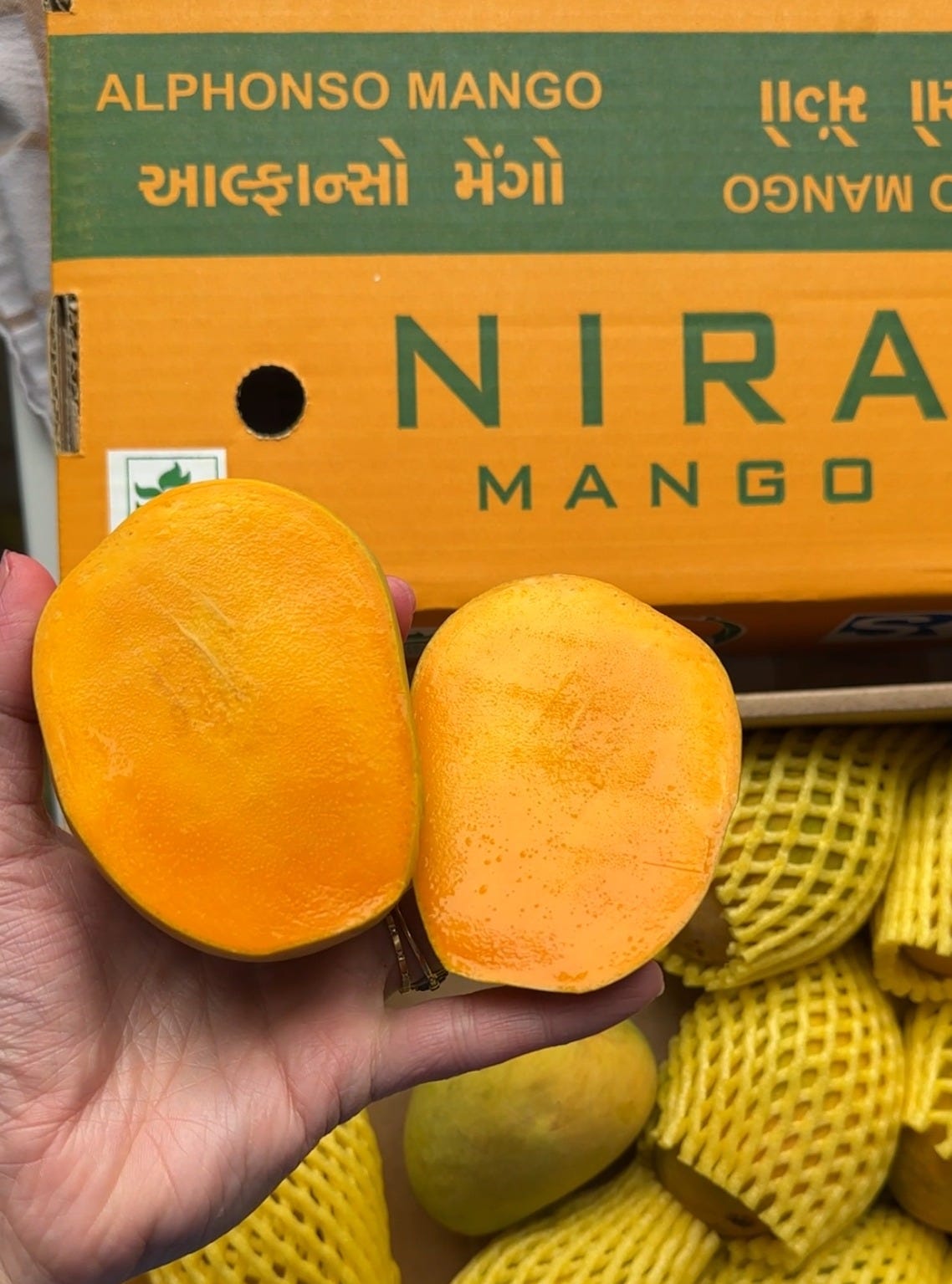
If you take away the romance of mango, what you’re left with is 285 aromatic compounds: A big mix of terpene hydrocarbons, esters, lactones, aldehydes, and alcohols. If like me, you might be thinking, is this a little or a lot? Well, it’s a lot compared to potatoes, which only have about 30 aromatic compounds, and quite a few more than white rice, which has about 85 (all of which must be top tier because boy, do I love the smell of rice!). However, compared to chocolate or coffee, which apparently have some 600+ to 900+ aromatic compounds respectively, mango doesn’t seem as impressive. That being said, compared to other fruits, it ranks among the most complex. Let’s take a closer look at the compounds, the names of which will win no awards for being memorable:
Terpenes: Responsible for citrus, herbal and spiced flavours. Think bright citrus, woody, piney, resinous, earthy, sweet green, liquorice and basil.
Esters: Responsible for sweet, tropical flavours: Think of ripe fruits and florals. A lot of fruit flavoured sweets contain the ester 'isoamyl acetate' (referred to as ‘banana oil’) which, despite not actually appearing in some varieties of fruit, makes fruit taste more ‘like itself’ than the real thing!
Lactones: Also responsible for full-bodied, sweet, tropical flavours: Think coconuts, stone fruit, rich and creamy scents. Lactones develop during the ripening and ageing process.
Aldehydes: Responsible for fresh, green flavours: Think grassy, almost spicy freshness.
Alcohols: Responsible for fermented flavours: Think complex sweetness, floral, boozy
These can be further split into ‘top’, ‘middle’ and ‘base’ notes, which is usually language I see written on perfume or scented candle labels. Top notes are the most volatile and fleeting (aroma of citrus, pine and freshness), middle notes last a bit longer but can easily be driven off with time/cold/heat (complex floral), while base notes remain steadfast (stonefruit, sherry, caramel). It’s the marriage of these compounds that makes it such a symphonic flavour.
The issue with heat
Many flavour molecules are volatile, which means we have to be careful how we prepare them and how much heat is applied. You know how you are careful not to boil anything with alcohol in it (provided you want it to remain alcoholic, of course), otherwise you lose the booze? It’s the same with any flavour molecule.
I remember watching a Heston Blumenthal’s “How To Cook Like Heston” on Channel 4 as a teenager and it stuck with me when he said that if you can smell your food cooking, you are losing flavour. He was a big proponent of very slow, super low temperature (thus barely scented) cooking methods. BUT, this is a chicken-and-egg situation - you need heat for delicious processes like the Maillard reaction, or a good char. Plus, heat is essential for texture - sure, your water-bathed chicken might have supreme flavour but isn’t crispy skin the whole point?! You may be losing some of the original compounds but gaining new ones. Think of it as a flavour trade.
In the case of mango, the terpenes and esters - those unique and complex tropical flavours - are the most at risk, losing over 50% of their character when heated. This isn’t to say we shouldn’t do it, but to be aware of the trade we are making - it’s a battle of texture vs. flavour. Ultimately, the joy of a fresh mango is that it is.. Fresh! But in the same way that an apple pie or crumble is deeply lovable despite lacking the crunch, spray and freshness of a raw apple, it’s worth it.
In the case of mango jams, jellies, curds and custards, it may be unwise unless you are using extremely fragrant varieties like alphonso, kesar and honey mangoes that can afford to lose a few. Even in the best-case scenario, any cooked application (which will seem relatively one-dimensional in comparison) is always bolstered and improved by fresh mango with all its faculties and compounds intact. It brings out all of the (muted or lost) aromatic compounds, meaning you don’t have to miss out on flavour or texture. Win Win!
Cold as (n)Ice?
So, if being too hot dulls flavours, does the opposite amplify them? Unfortunately not. This is because when cold, molecules literally move more slowly, meaning the transfer of aromatic compounds diminishes. In addition, some are lost entirely and others are prevented from ever developing (consider that fruit will not ripen in the cold). This is why it is unwise to keep fruit in the fridge (stop refrigerating your tomatoes, people!) and why ‘fridgeyness’ is the curse of any kitchen. What about ice cream then?


As Louis Thompson discovered in his tropical fruit exploration here on KP, the addition of dairy, eggs, and sugar can sometimes amplify flavours. In the case of ice cream or sorbet, fresh fruit avoids heat completely by being blended straight into custard or syrup (which has been cooked and cooled) before being preserved in a glorious icy prison. As it melts when you eat it, the flavour opens up. This is where sugar, dairy, and eggs come in handy - being mainly water, frozen fruit does not readily or easily melt and is as hard and crunchy as ice. When combined with sugar, which mingles with the water and lowers the freezing point, and fat, which is a great carrier / dissolver(!) of aromatic compounds, the flavours are delivered efficiently. In the case of sorbet vs ice cream, sorbet will smell more strongly as fat molecules do not entrap the compounds.
Making Mango make friends
So while the magic of a fresh mango cannot be replicated and should be savoured, this doesn’t mean we shouldn’t bake with them. However, understanding how other ingredients will help or hinder our cause is essential. Fat and butter may trap and stabilise aromatic compounds while muting the top notes. Sugar can enhance and anchor the natural sweetness, especially if it’s being mixed with other ingredients. Acid maintains brightness, but can easily overwhelm or make the aroma one-note. Dairy can overpower delicate compounds, but acidic dairy like yoghurt makes for classic combos - mango lassi is gorgeous after all. Eggs will help give body and texture, but can obscure flavours. Starch can thicken and add body, but not without heat. PHEW, it’s a minefield! I decided to analyse a few of my mango recipes available here in the newsletter:
Mango NOT-curd
A new recipe for this year, I’ve updated my mango curd recipe from 2024 to be much more mango-ey. I have forgone eggs, which is why i am calling it a not-curd, since I’m not sure it classifies any longer. It still has butter, but it is thickened with (a tiny bit) of cornstarch.
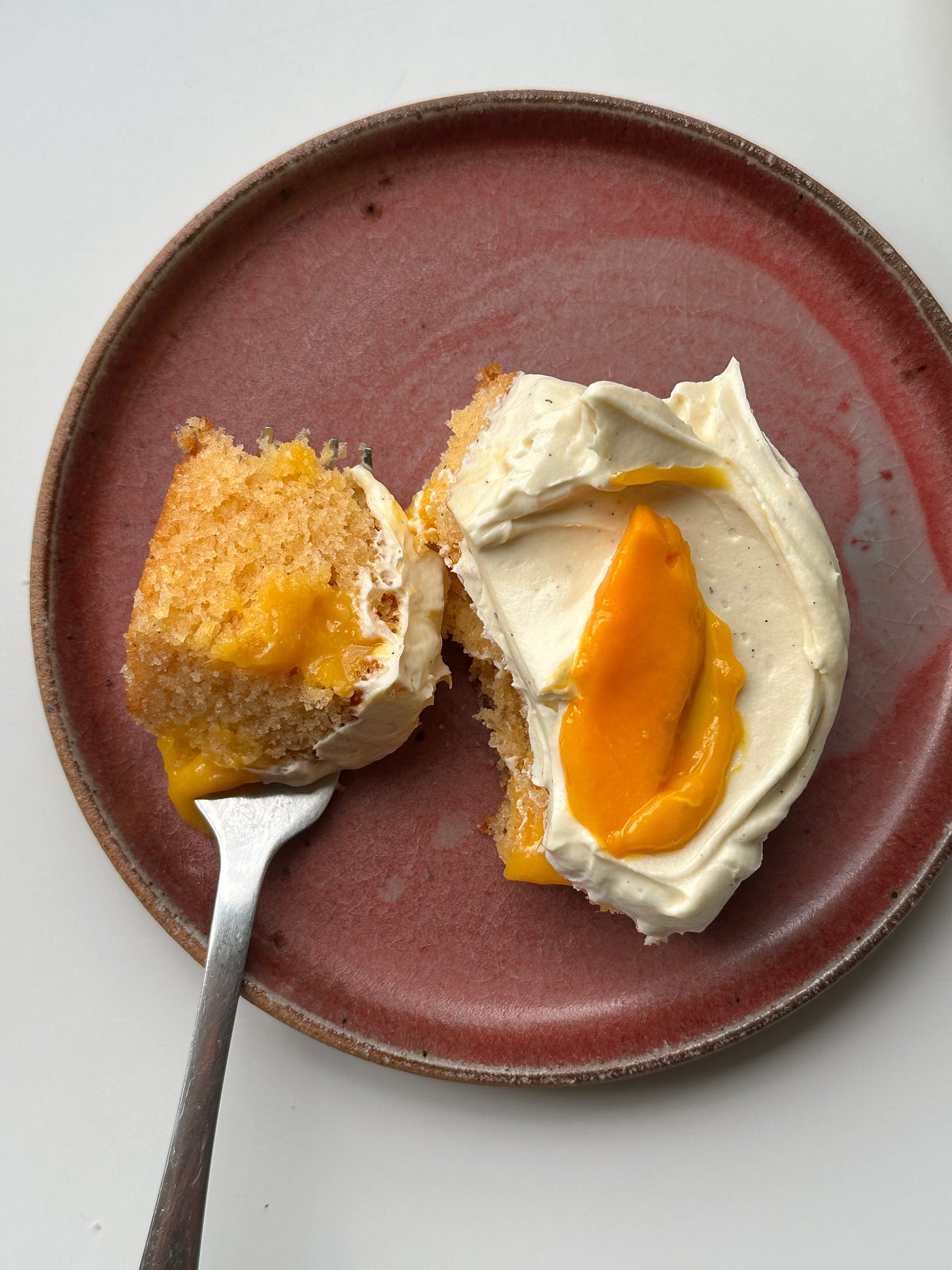
The result is a thick-ish textured mango spread which is wonderful for piping inside cakes. It retains much more mango flavour than the version with lots of eggs - the purpose of the not-curd is to amplify the mango while making the texture more ‘user friendly’ - spoonable, pipeable, etc.- able. I tried a version where I added fresh puree into the cooked, but the texture wasn’t right. I could probably have a good go at this using gelatin, but I’ll figure that out another season! Find it piped into and spread on top of the vanilla buttermilk cake below.
Mango Custard Tart
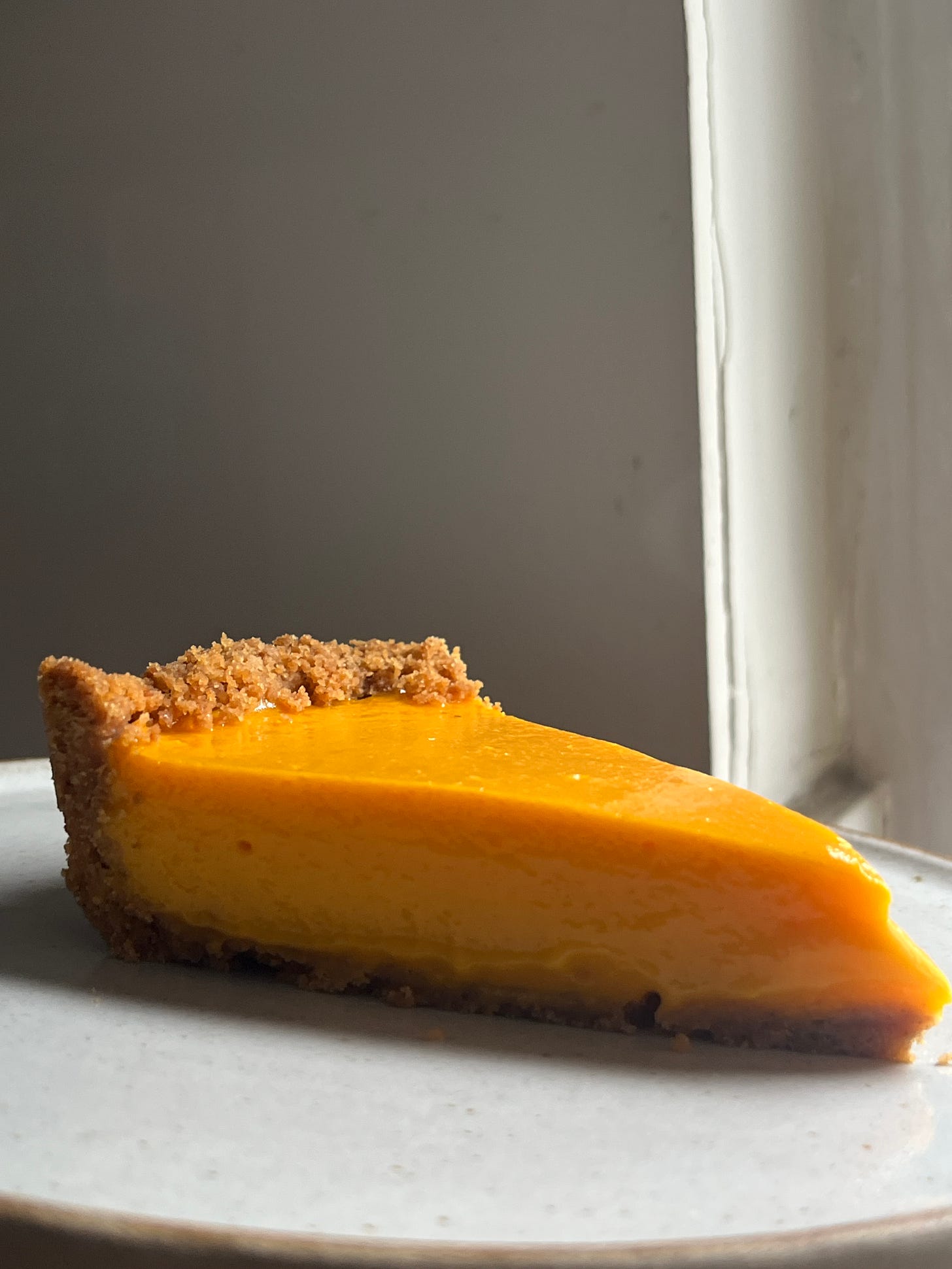
Developing this tart was humbling. But we got there - yolks, a touch of sugar and butter help create the most extraordinary smooth texture. For those with deodorised coconut oil, you can make the mango flavour sing even more. That said, it is still beautiful and tropical, but it benefits from fresh mango flesh on top to bolster the aroma. For a more pure mango flavour, blending fresh cold mango into gelatin-infused double cream aka a panna cotta is worth investigating - in fact, this in a tart case would be killer! Click here to make the custard tart.
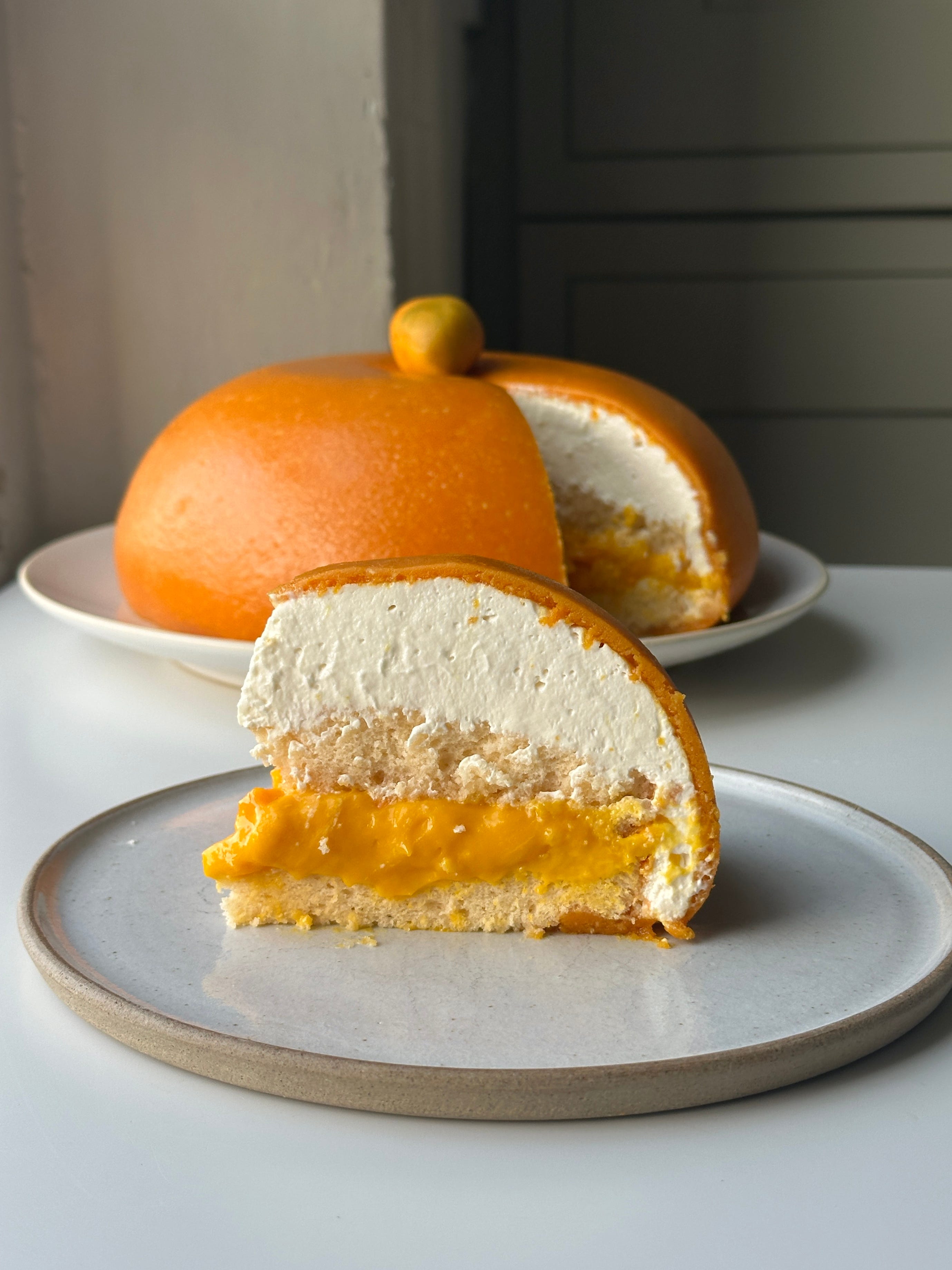
Mango Princess Cake
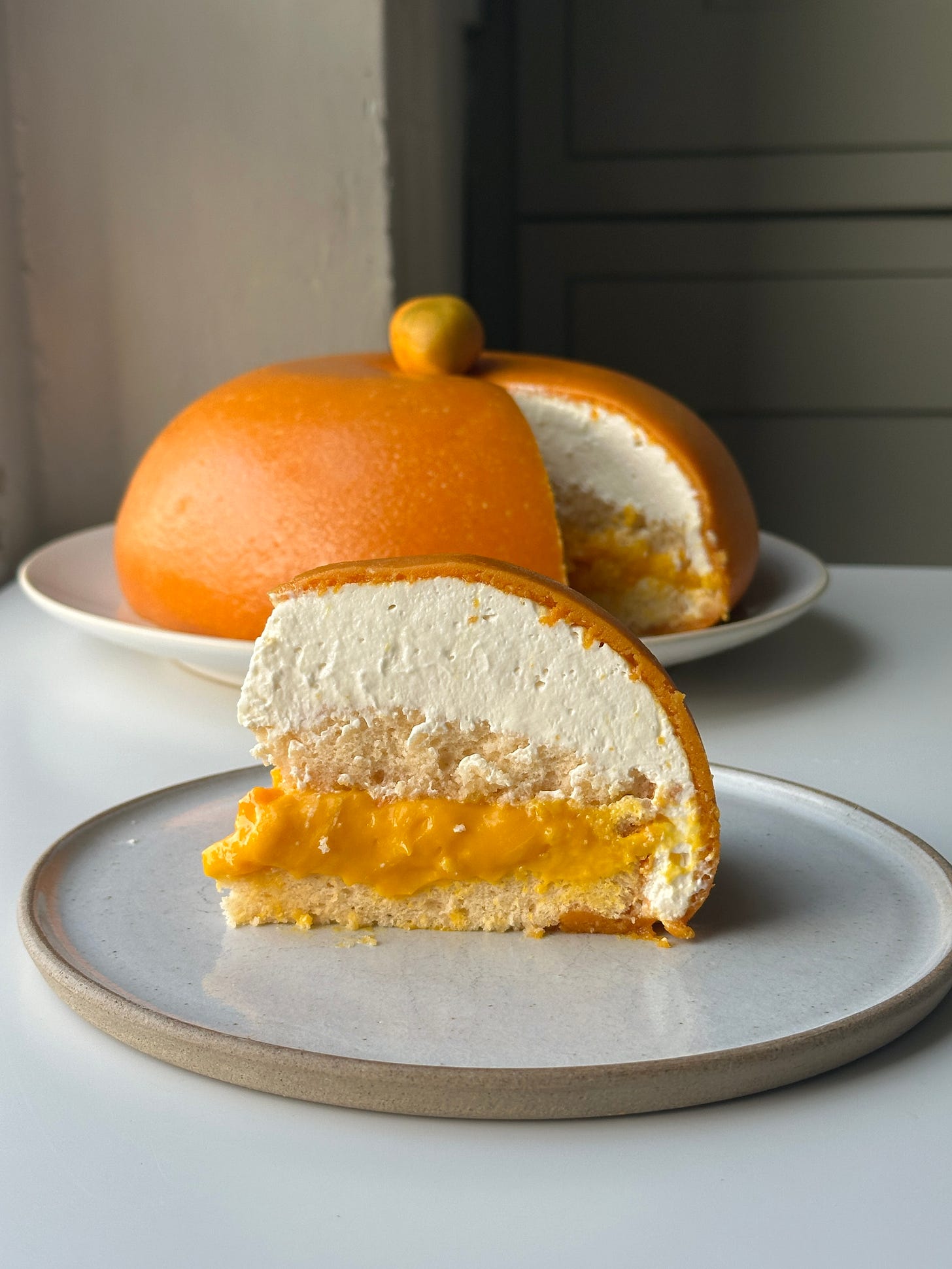
This week’s KP+ takes all the lessons I’ve learned and applies them to this magical format. The mango custard layer is brightened with fresh mango flesh, and pit syrup permeates the soft cake crumb. Adding coconut to the marzipan (optional) and using yoghurt in the whipped cream helps bring home the tropical flavour. Don’t miss it! Click here to make it.
Perfect Rice Pudding with Mango
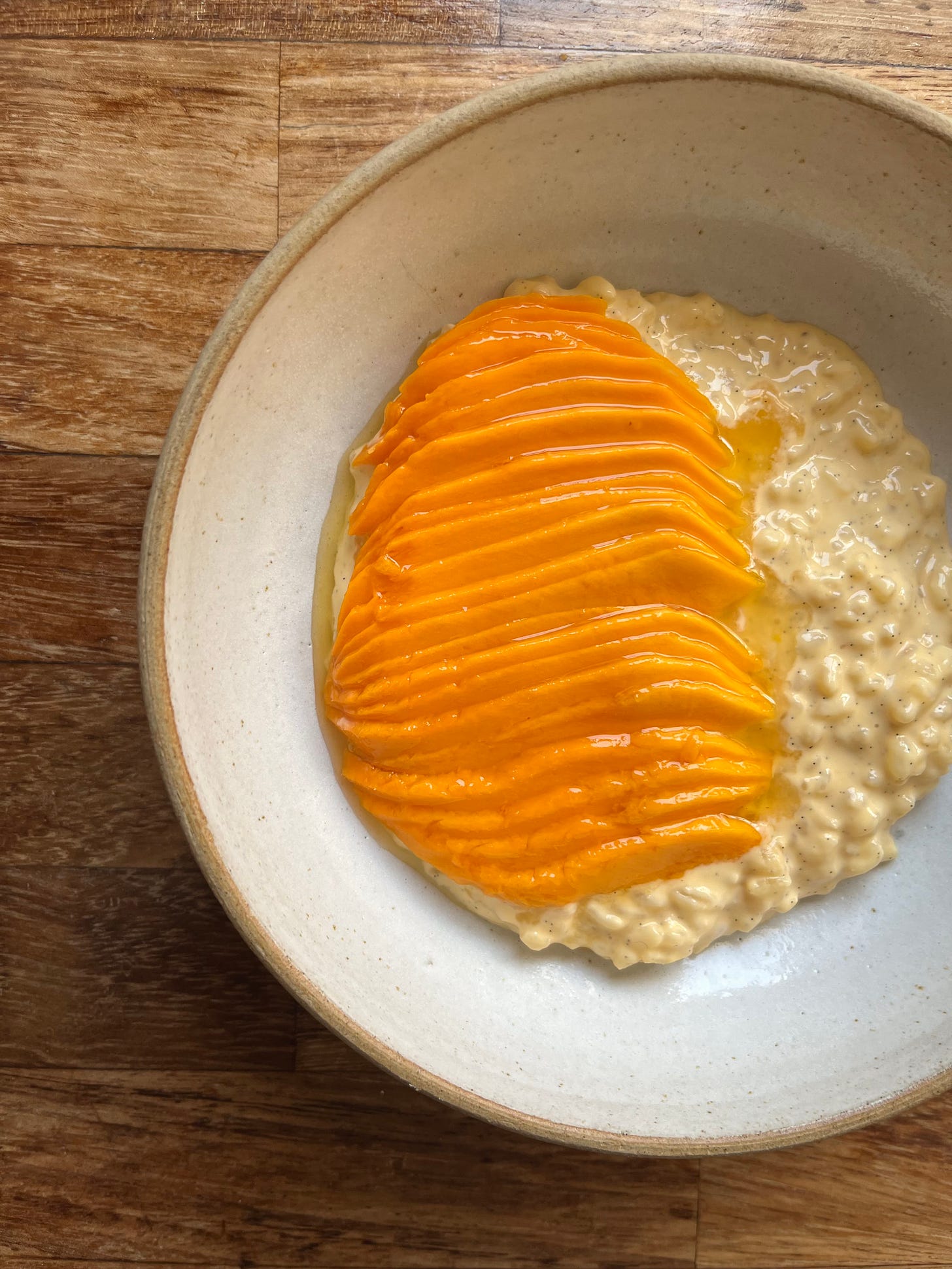
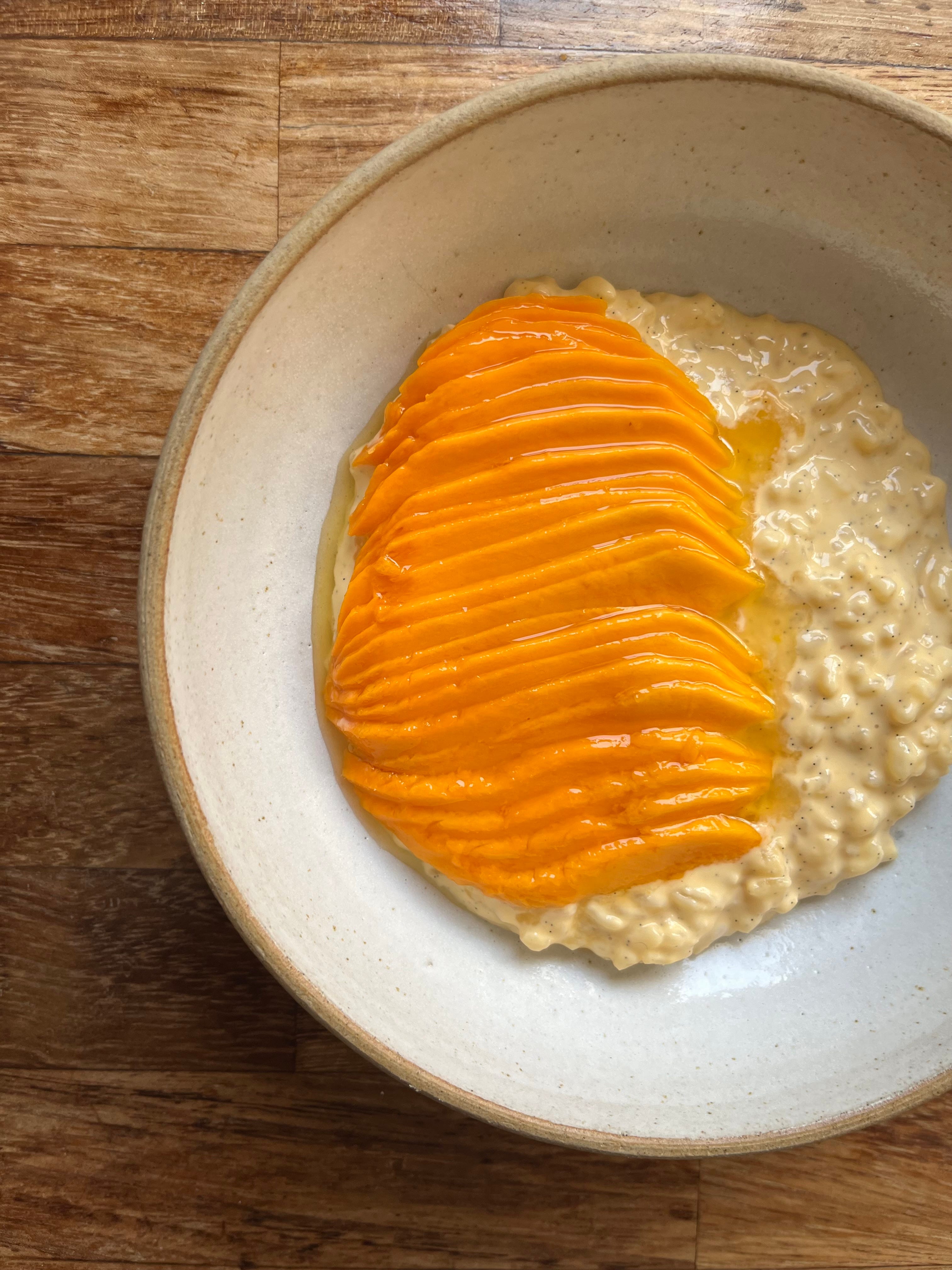
Purists who wouldn’t dream of heating a mango and losing even a single aromatic compound may prefer to artistically lay their rice mango atop rice pudding (also note to self: NEED to do a sticky rice and mango recipe. Next year!) or any kind of creamy bed. This rice pudding, soft with vanilla, is a perfect bed for your best mangoes. Click here for the recipe.
Mango Loaf Cake
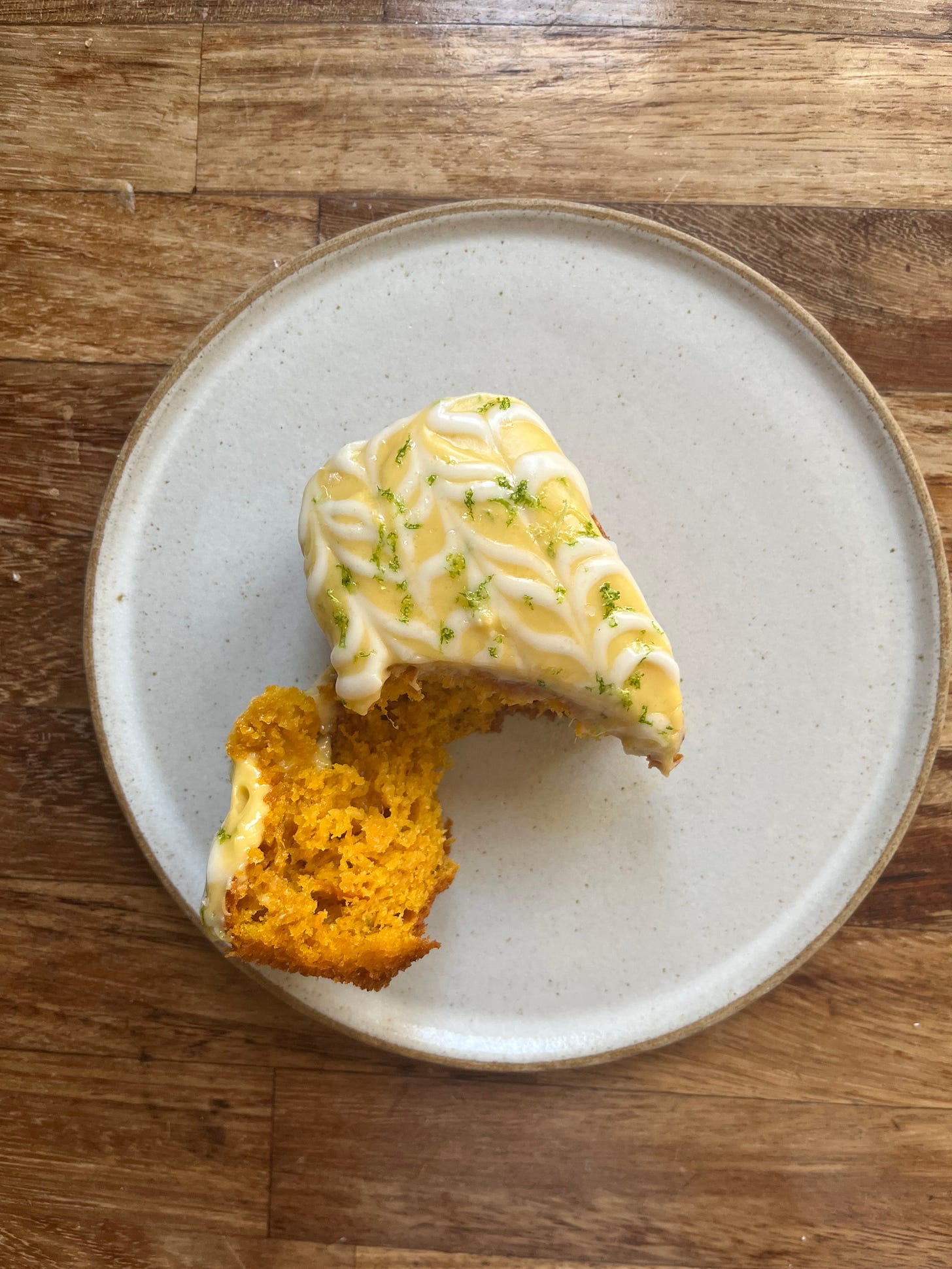
This really throws all the rules we’ve been talking about OUT the window, but is the perfect use for any mushy or less-than-perfect mangoes you get (it happens, sadly!). It has no overt flavour of mango in itself, though we reintroduce it in the icing and with mango pit syrup (see below). But, its fibrous and sweet flesh gives the cake a gorgeous texture. Click here for the recipe
Mango Pit Syrup
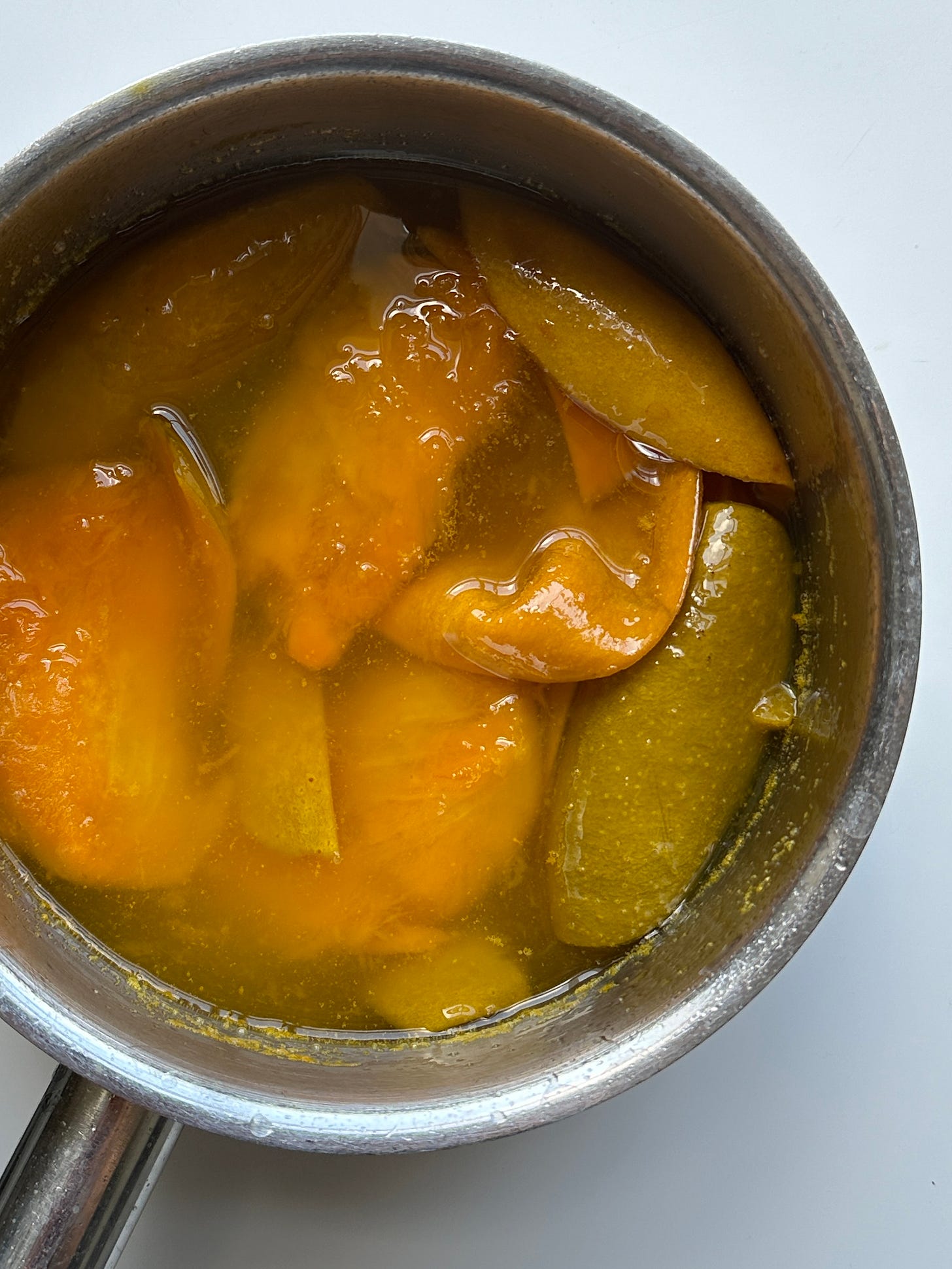
Without sucking the stone, it’s impossible to relieve the flesh and mango pit of its flesh fully. So, boiling the skins and stones in a syrup helps us get every last drop of mango essence. Adjust the sugar in the syrup to suit the flavour and the application. It would make an incredible base for sodas or cocktails. Click here for the recipe

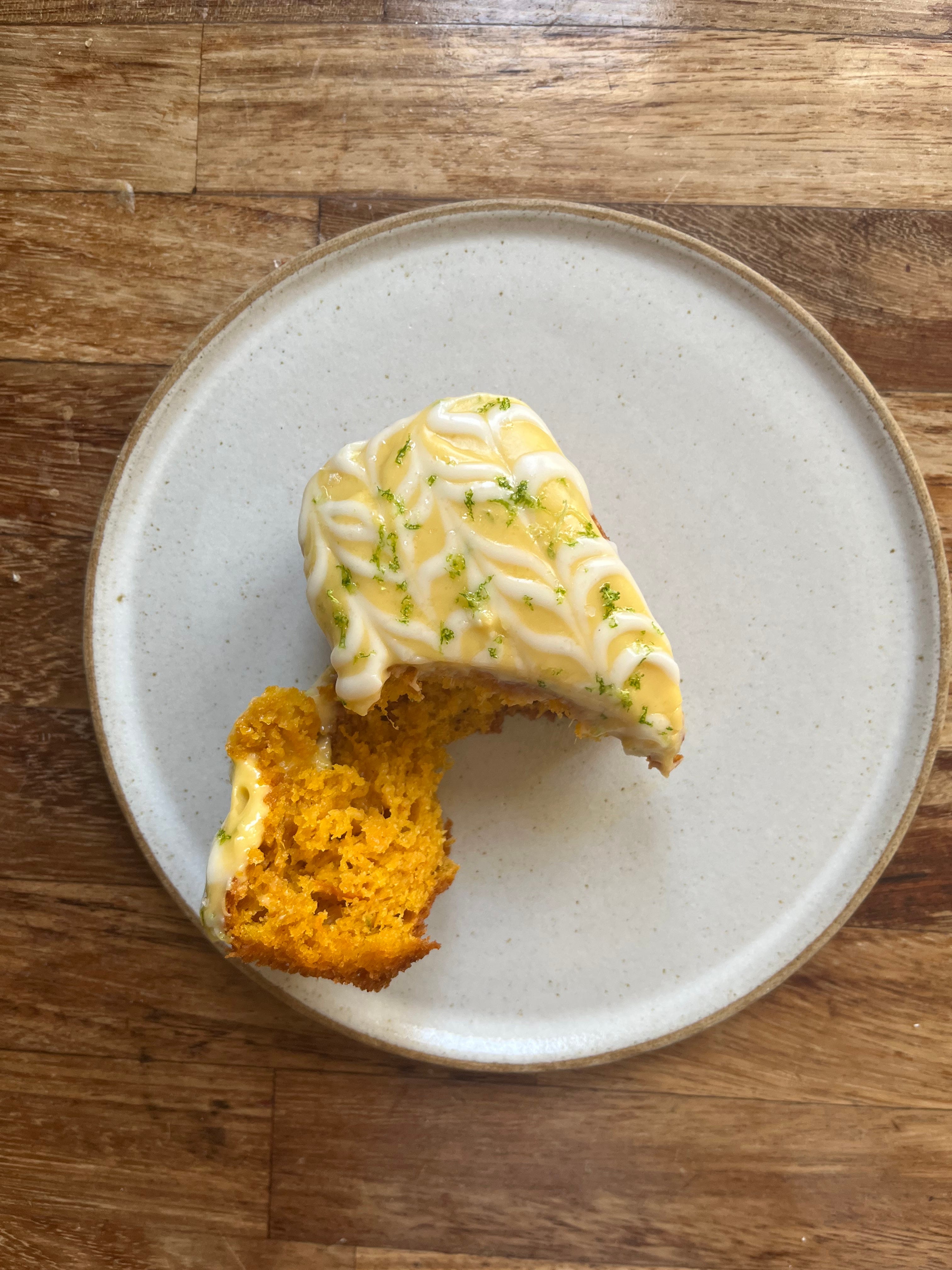
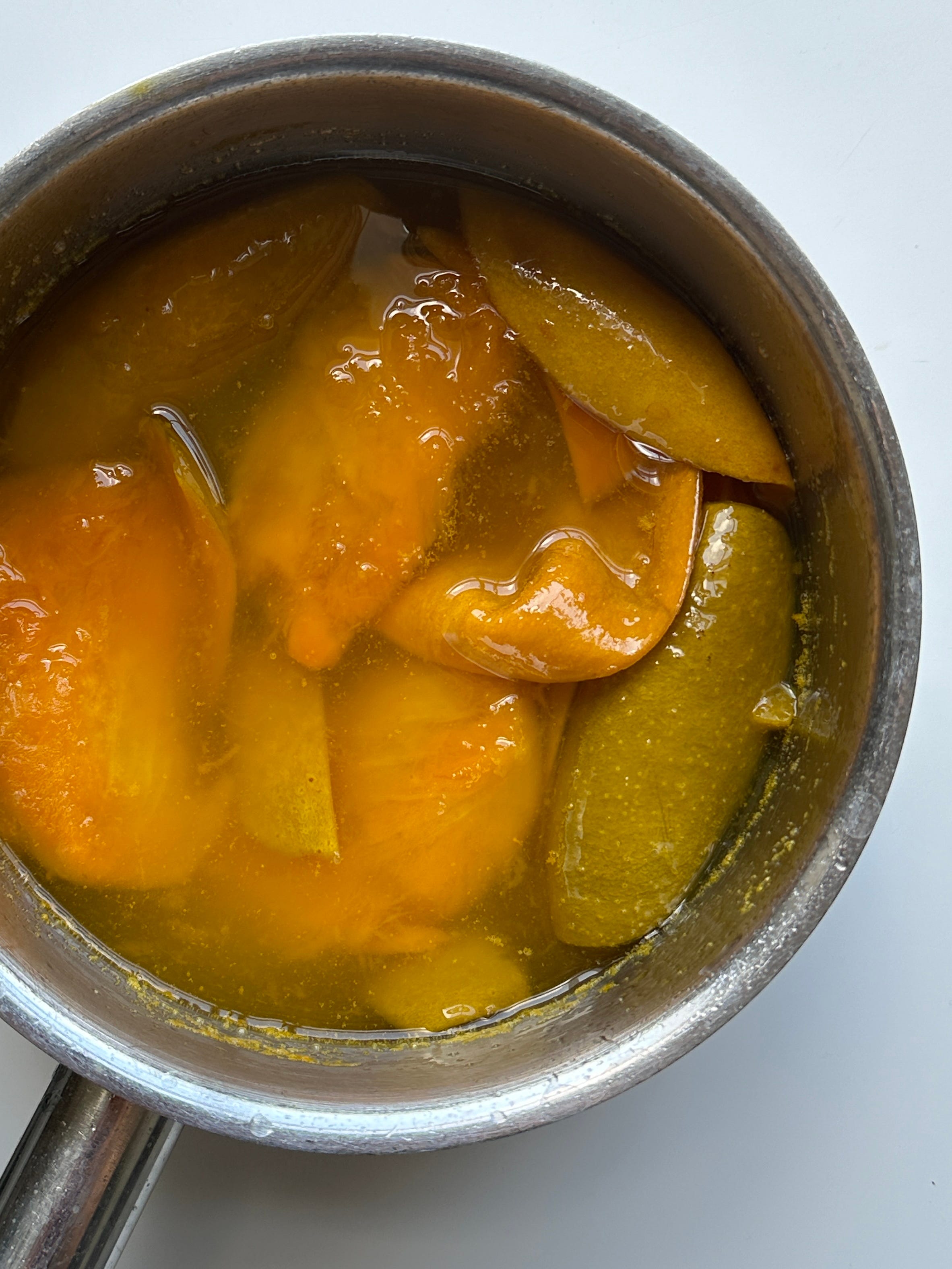
So, before we get on to today’s recipe, here’s a list of all the mango recipes you can find on KP+. From pavlova to salsa, with plenty of gorgeous guest recipes, take your pick:
Mango Curd (OLD)
Mango Not-curd - see below
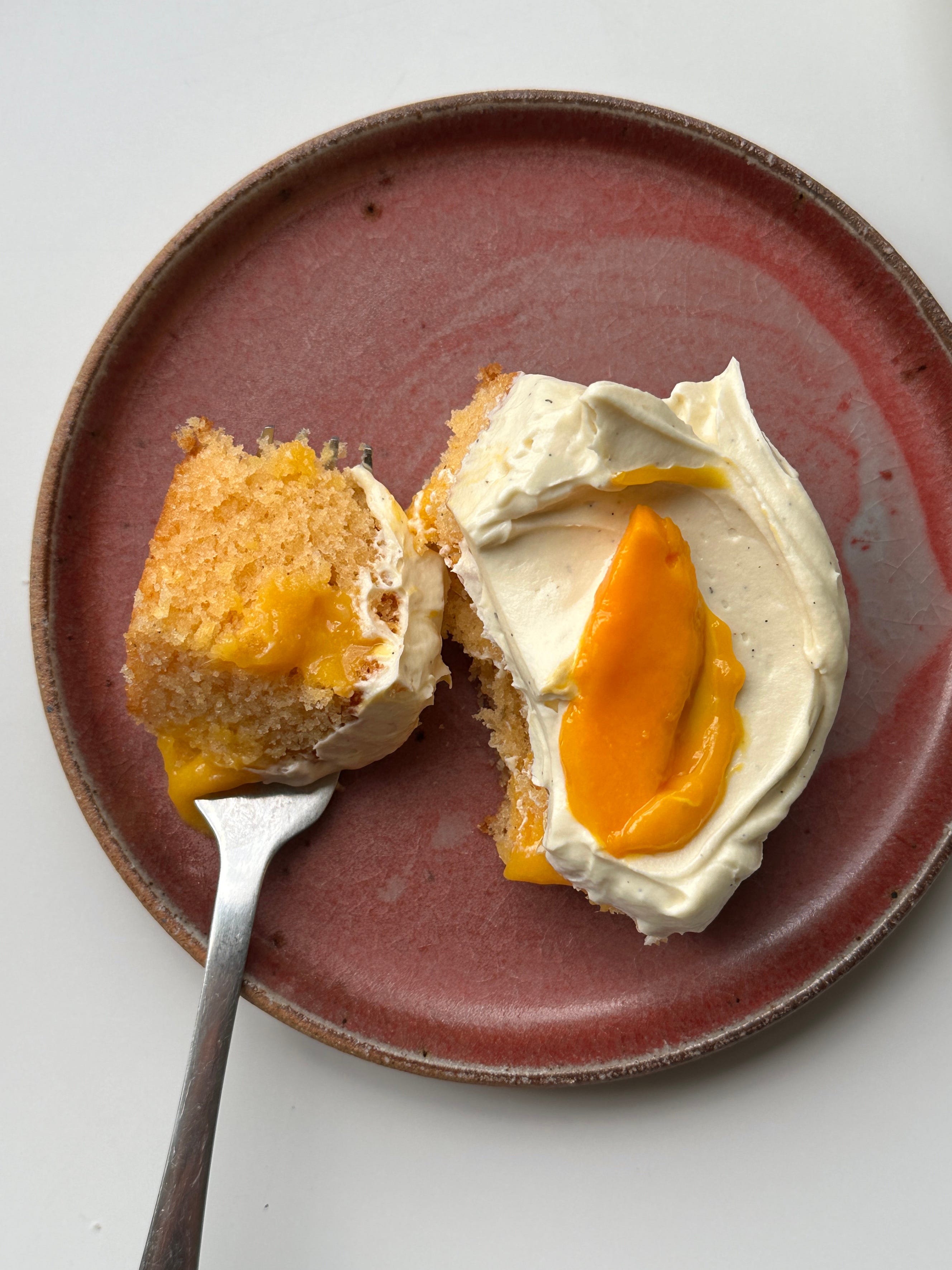
Vanilla buttermilk cake with mango curd and jasmine cream - see below!
White Chocolate Mascarpone Mousse with fresh mango by Octavia Lamb
Ok, onto today’s recipe!
Recipe: Vanilla Buttermilk cake with Mango and Jasmine Cream
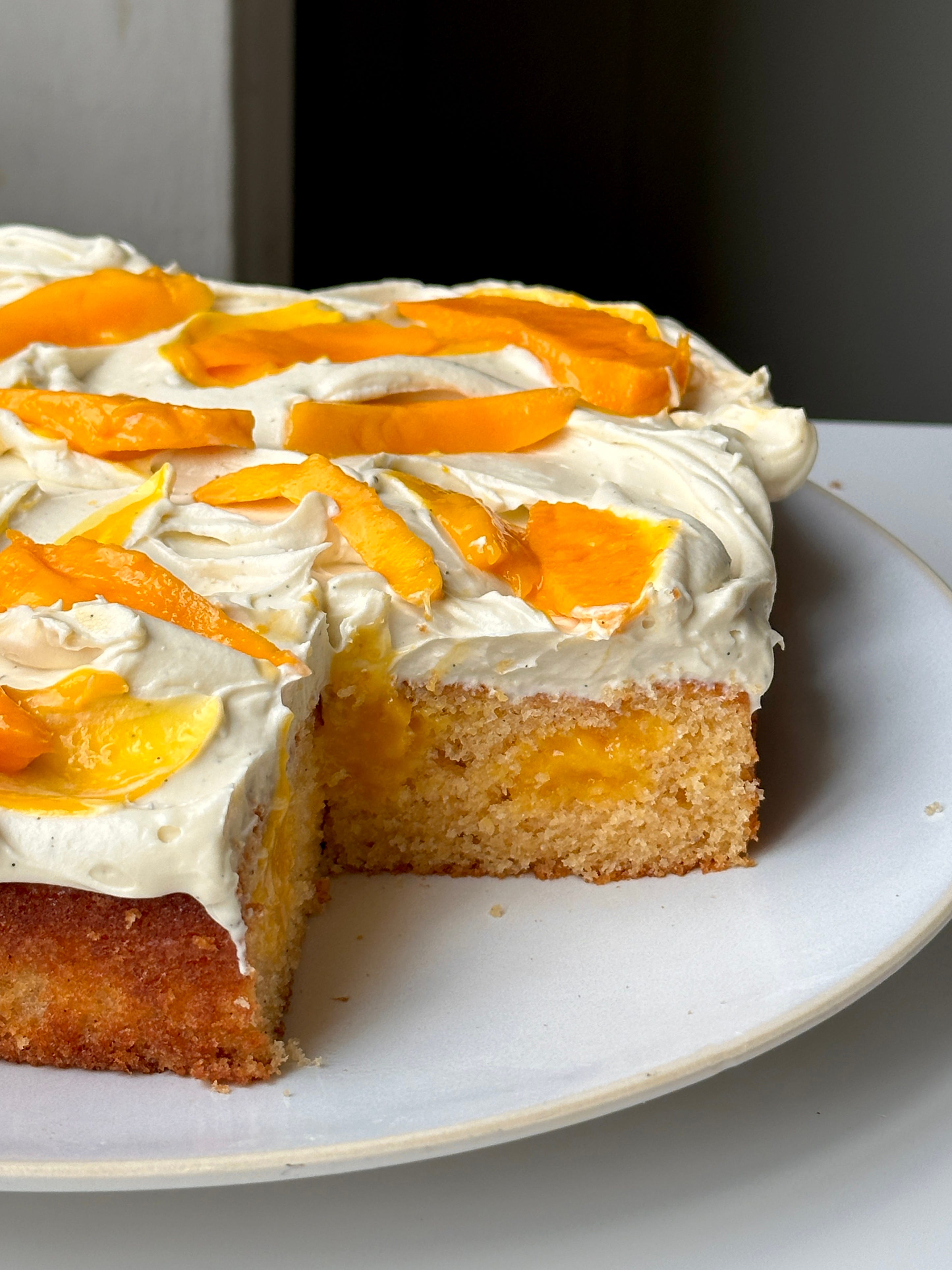
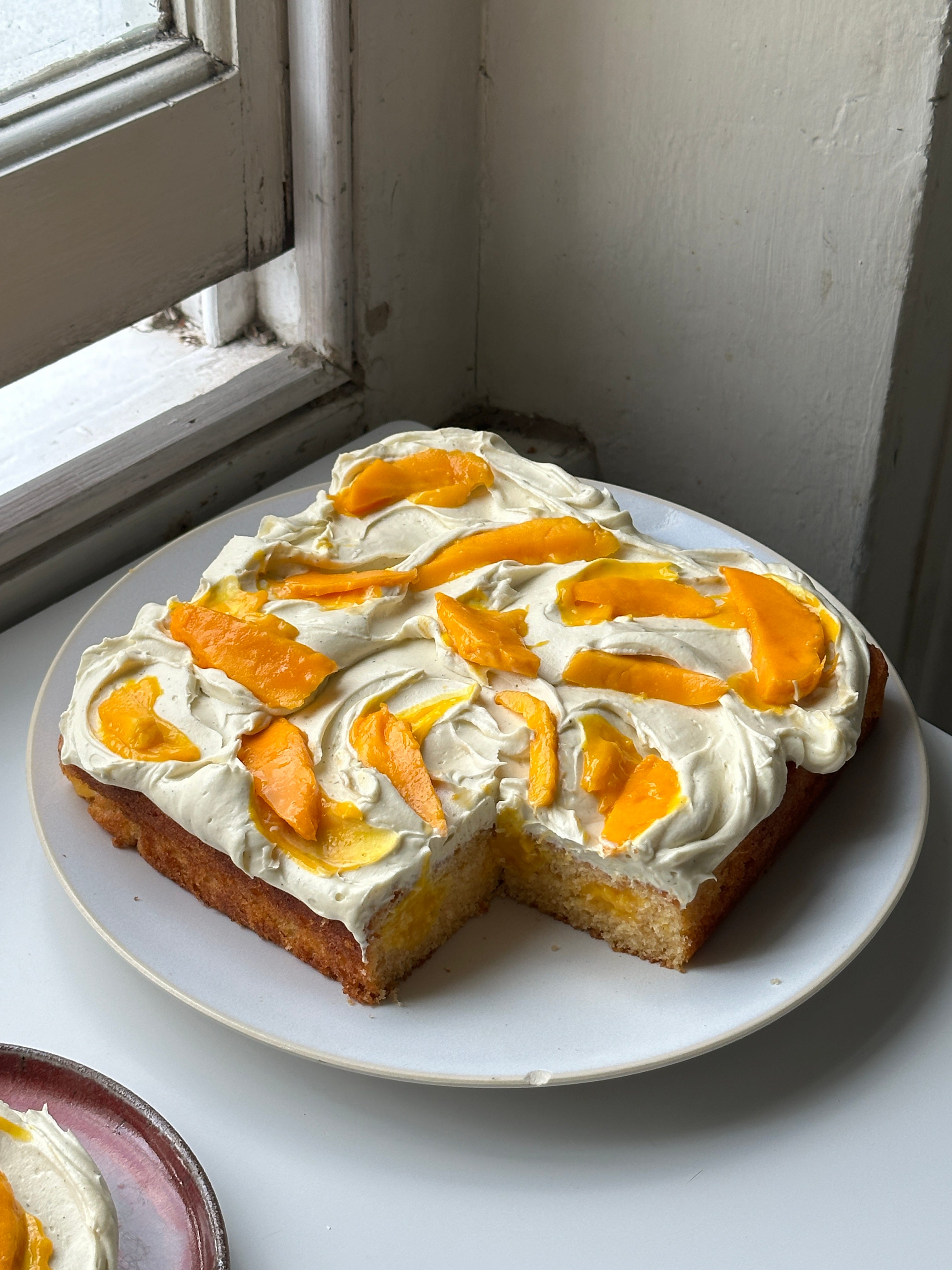
Jasmine tea works beautifully with Mango because of the floral, fruity and sweet green aroma overlap. A marvellous pairing. Piping mango not-curd into the cake gives each bite a delightful burst, and the cake itself comes together quickly. Each element in this recipe is great to eat, but it is certainly greater than the sum of its parts.
Ingredients
Vanilla buttermilk cake
100g Butter, soft
120g Caster sugar
Large pinch of salt
2 large eggs, about 100g
80g Buttermilk
2 tsp Vanilla extract
130g Plain flour
8g Baking powder
Mango Not-curd
220g Alphonso Mango puree
40g Caster sugar
40g Water
10g Cornflour (you may increase to 15g if your puree is very watery)
30g Butter
Pinch of salt
Jasmine and Vanilla Whipped Cream
300g Double cream
5-6g Jasmine tea
100g White Chocolate, chopped finely
1 tsp vanilla extract
Pinch of salt
Optional: Sugar to taste, if desired
To finish
1x Alphonso Mango sliced into thin, elegant strips of different lengths
Method
For the whipped cream, heat the cream with the jasmine tea. Bring to the boil and then take off the heat, cover and leave for about 1 hour.
Taste to check the infusion strength. Bring back to the boil then pour, passing through a sieve to catch the tea, over the chopped white chocolate in a heat proof bowl. Leave to stand for 1 minute then whisk until smooth, adding the vanilla extract and salt to finish. Leave to cool then move to the fridge to chill completely.
For the not-curd, whisk together the mango puree, sugar, water and cornflour in a saucepan. Heat on a medium heat until thick and bubbling. Boil for 1 minute then whisk in the butter and salt. Pour into a clean container and cover with baking paper or cling film to prevent a skin from forming. Chill completely.
For the cake, preheat the oven to 170c fan and line an 8 inch square tin. To make the cake, cream the soft butter with the salt and sugar for 2 minutes on a medium speed using a stand mixer until light and airy.
Mix in the eggs, scraping down the side of the bowl to make sure it is all combined. Don’t worry if it looks split - just keep mixing. Sift together the plain flour and baking powder then add into the creamed butter/egg. Finally, stir through the buttermilk to finish the batter.
Pour the batter into the prepared tin and bake for about 30 minutes or until a skewer inserted into the middle comes out clean. Leave to cool completely.
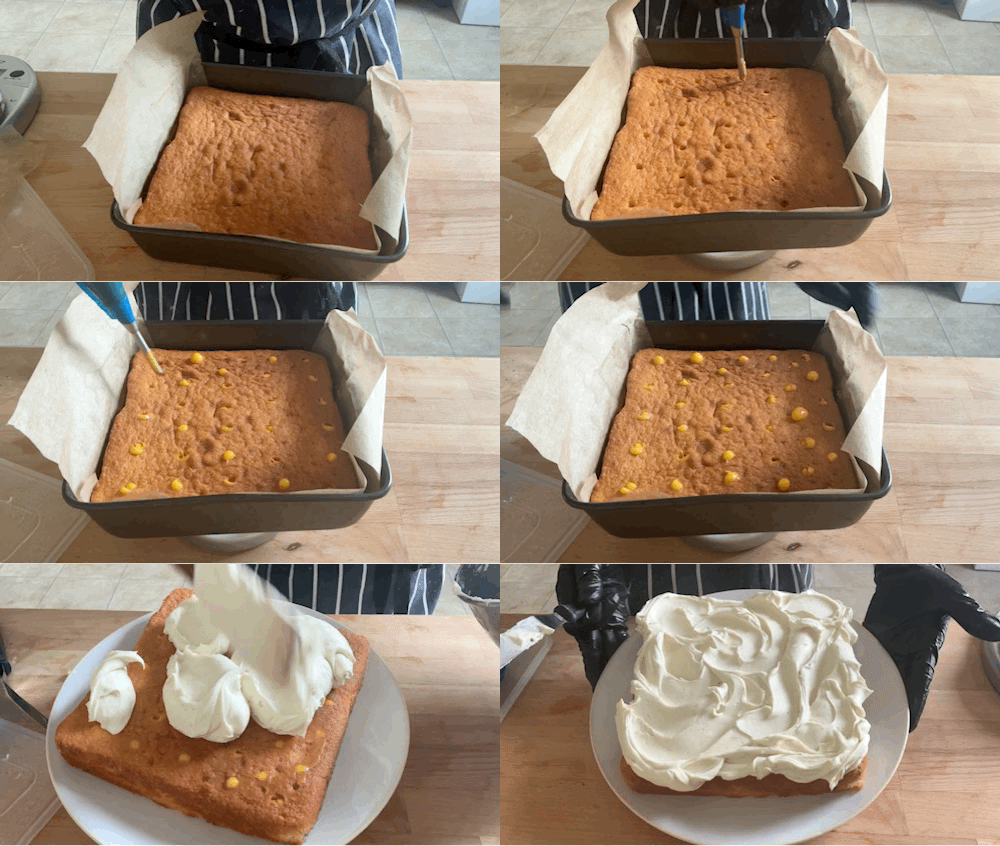
Stab the cake all over to about half way through the cake, then pipe mango curd into the holes - you shouldn’t need a tip, but a bismarck is useful. You want about 100-125g piped into the cake in little tiny pockets.
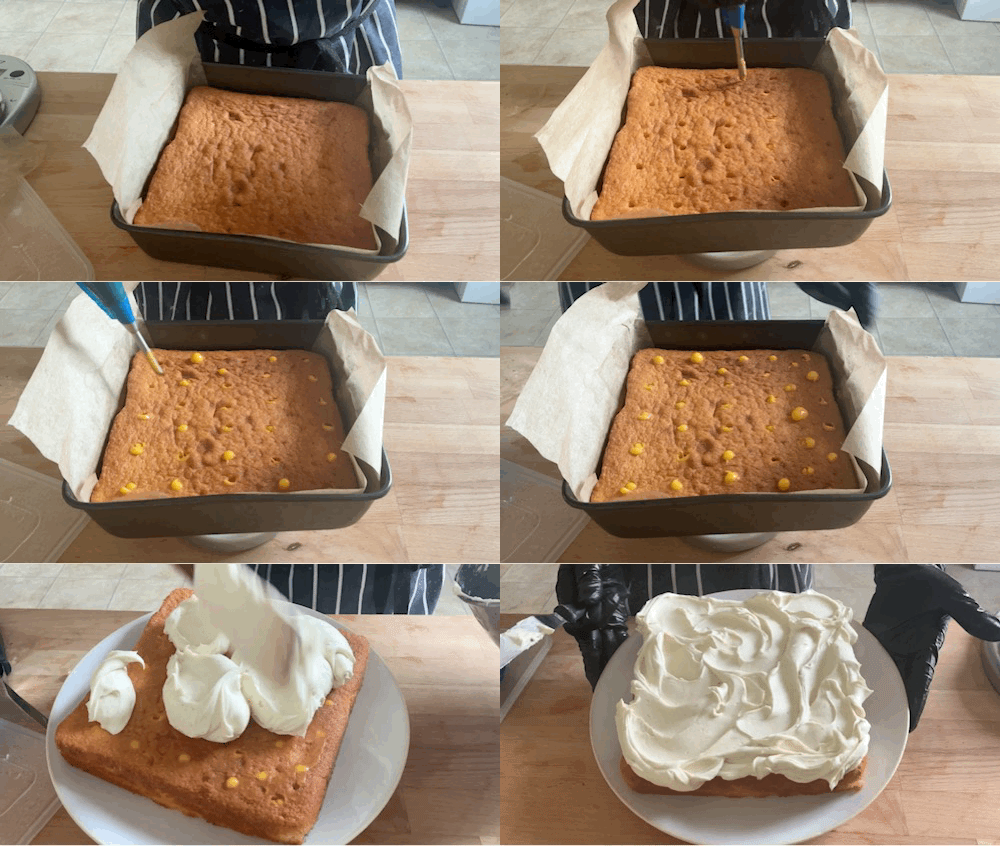
Taste the jasmine cream and see if you want it a little sweeter - add a tsp of sugar til it suits your taste. Whip the jasmine cream until lovely and thick, with thick, swoopy, flumpy peaks. Decorate with little dabs of curd and fresh mango. Store leftovers in the fridge, but bring to room temperature before enjoying.
Hello. Your cream element does not work. It does not thicken and eventually splits. It is too thin and does not function as a ganache or as a whipped element. I have followed your directions to the letter and I am a really experienced cook. Here is insufficient chocolate to make a ganache. I used valhrona ivoire] the milk dilutes the fat in he cream too much to whip as it reduces it to a lower fat content than will successfully whip up. Perhaps you could illuminate me on where I have gone wrong. I would be grateful for your help because this otherwise has proved to be a waste of about five pounds worth of ingredients.
love the title