
Kitchen Project #203: On Elderflowers
With Louis Thompson

Hello,
Welcome to today’s edition of Kitchen Projects. Thank you so much for being here.
Today, I am thrilled to welcome back pastry chef and writer Louis Thompson. What follows this intro is a beautiful musing on elderflowers, the glorious blooms of the elder tree and a recipe for sparkling elderflower fritters.
Over on KP+, I’ve been inspired by Louis’ writing and have developed a recipe for a cold elderflower cream cake with elderflower macerated strawberries. Click here to make it.
What’s KP+? Well, it’s the level-up version of this newsletter. By joining KP+, you will support the writing and research that goes into the newsletter (including the commissioning - and fair payment - of all the writers), join a growing community, access extra content (inc. the entire archive) and more. Subscribing is easy and costs only £6 per month or £50 per year. Why not give it a go? Come and join the gang!
Love,
Nicola
On Elderflower
We currently find ourselves smack bang in the middle of my favourite time of year, when everything bursts back to life. As an Australian, I have my own particular relationship with this time of year in London; where I’m from, seasons are longer and flatter. Moving to a colder part of the world with more barren winters and milder summers creates a double whammy effect: There is a need for colour and joy once escaping such a severe winter, and a gentle enough sun to allow more sensitive plants to flourish. Herein are the conditions for floramania.
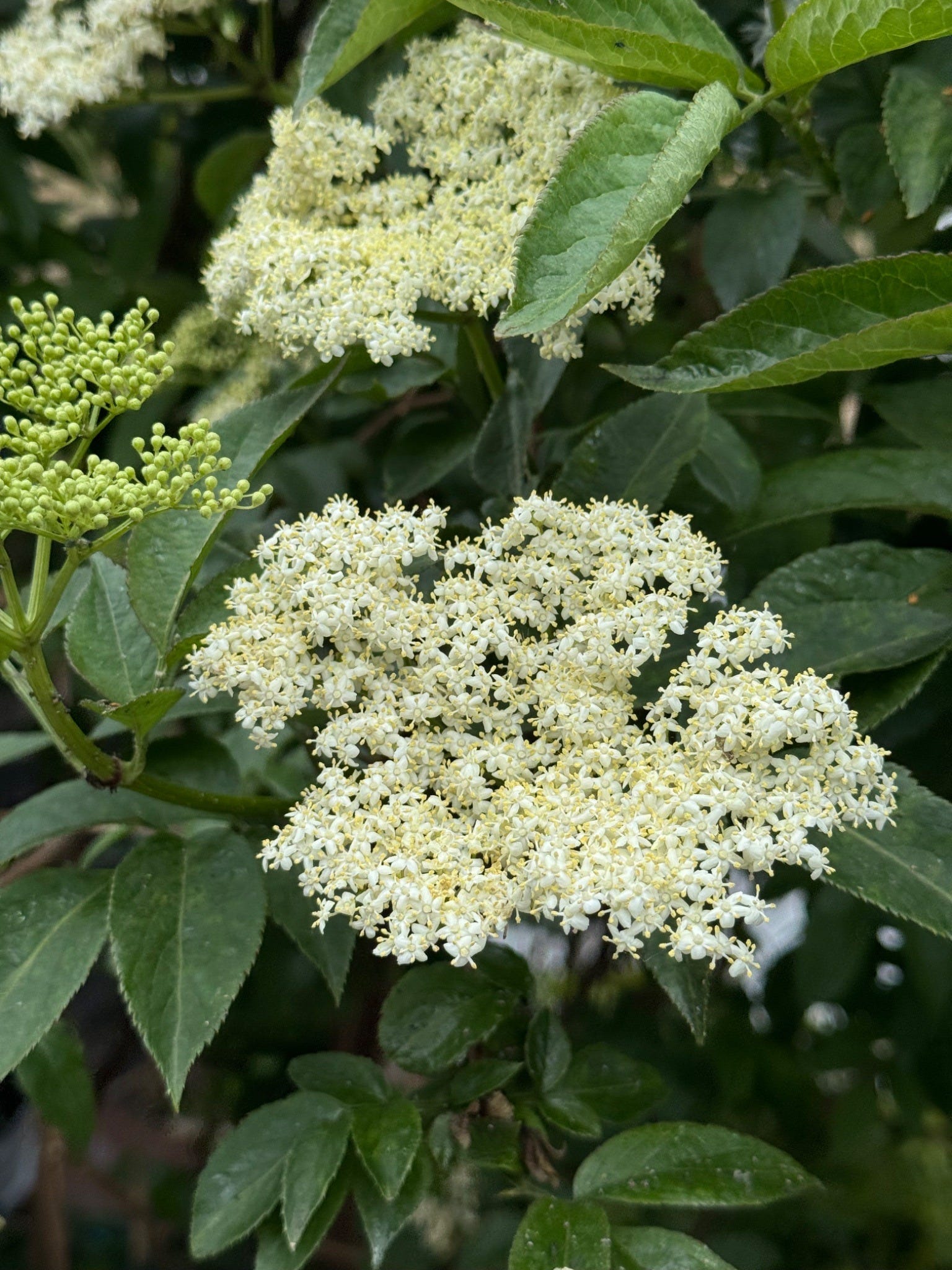
The extremity of a UK winter and the near-total dormancy it brings make the arrival of Spring feel like more than a pleasant change in the weather. It is an occasion to celebrate life itself. As a sun-loving Australian, I proudly declared Summer my favourite season unquestioningly for a long time; I want sunshine and long days and as much of it as I can get. But enduring my fair share of underwhelming British summers has taught me that is misguided. While Summer promises bounty, it is heavily burdened by expectation. Spring promises promise itself. When I see the first magnolias start to open, followed by cherry and plum blossoms, and shortly after the flood of elderflowers, wisteria, roses, and many many more it feels impossible to not just collapse into saccharine pagan-inflected joy. Arguably the queen of all these blooms is the elderflower. Ubiquitous in growth and effusive in fragrance, its place as the symbol of the season is hard to deny.
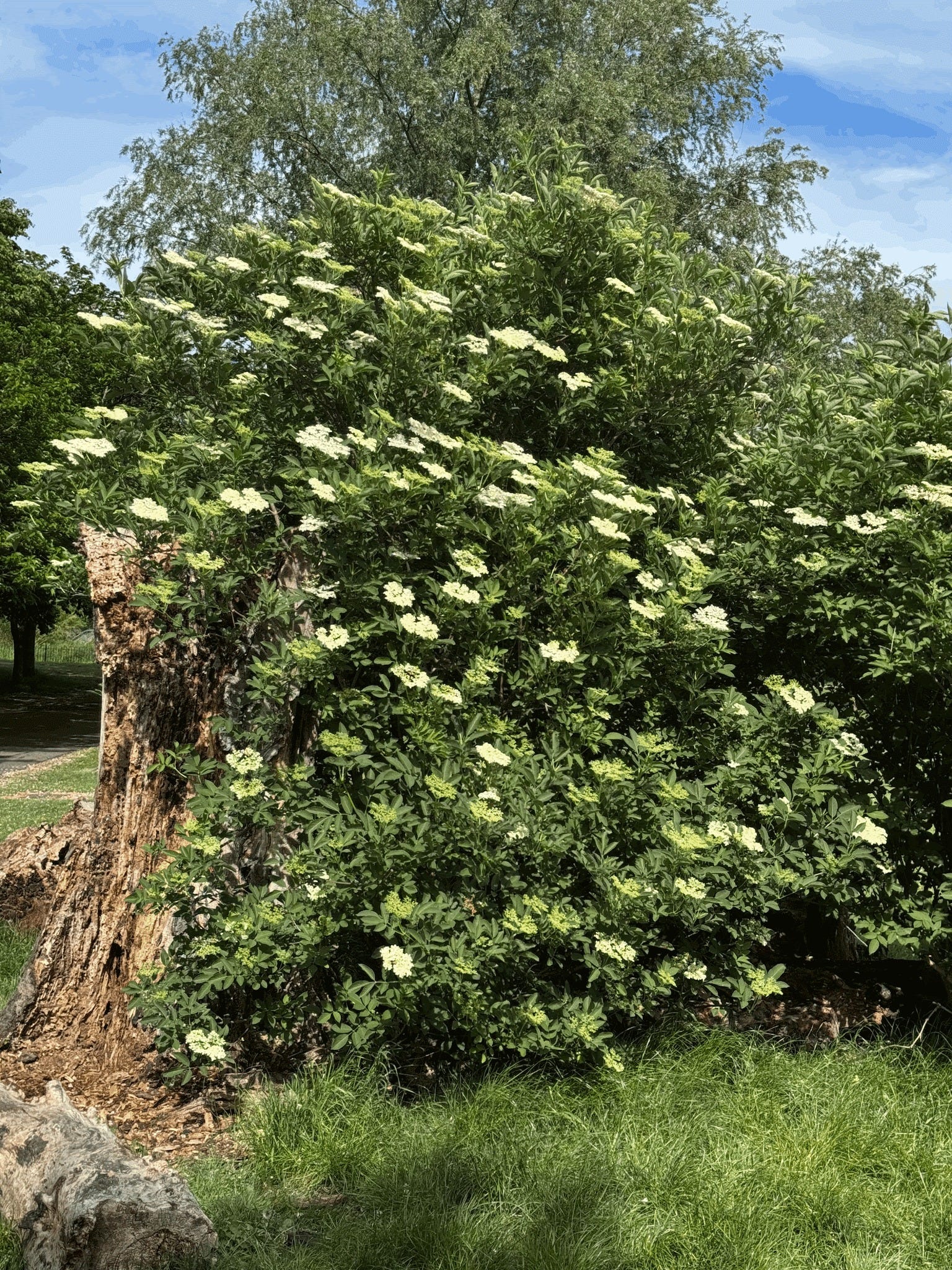
A true harbinger of British Summer, Elderflower is a cornerstone of the English culinary cannon. If you’re reading this newsletter, I’m willing to hazard a bet that you’ve probably made Elderflower cordial before. Or at least have read about it, heard about it, drank it. In the same way that a fish lacks awareness of the water it swims in, Elderflower’s status in English cuisine feels so natural and appropriate that it is somewhat ‘fixed’, going unquestioned. Today I’m here to prod and ask Elderflower for more. For an introductory guide, to learn about identification and the nuances of infusion, Nicola wrote a brilliant article here
This time of year isn’t without its challenges: it is also known as the Hungry Gap. This is a period in temperate climates in late winter and early spring where there is little growing which is available to eat. In this time, winter brassicas and other vegetables have finished growing, but Spring crops are not yet ready to harvest, delayed by the need for the soil to revitalise. While modern food systems have well and truly eradicated scarcity of this nature in our part of the world, it will always serve a cook to understand the climate and conditions which produce their food. With a stated commitment to cooking with seasonal produce, this is one of the most challenging parts of the year. While strawberries have just started to appear and loquats are readily imported by chefs and grocers alike, there is no fruit or vegetable on home turf that is truly ready to eat yet. At this time, the best things to eat are more unassuming and not typically commercially farmed: wild greens, leaves, and flowers. Simply put, it is the time of the flowers and leaves which precede and make possible summer fruit. These are not things you buy - they are things you forage.
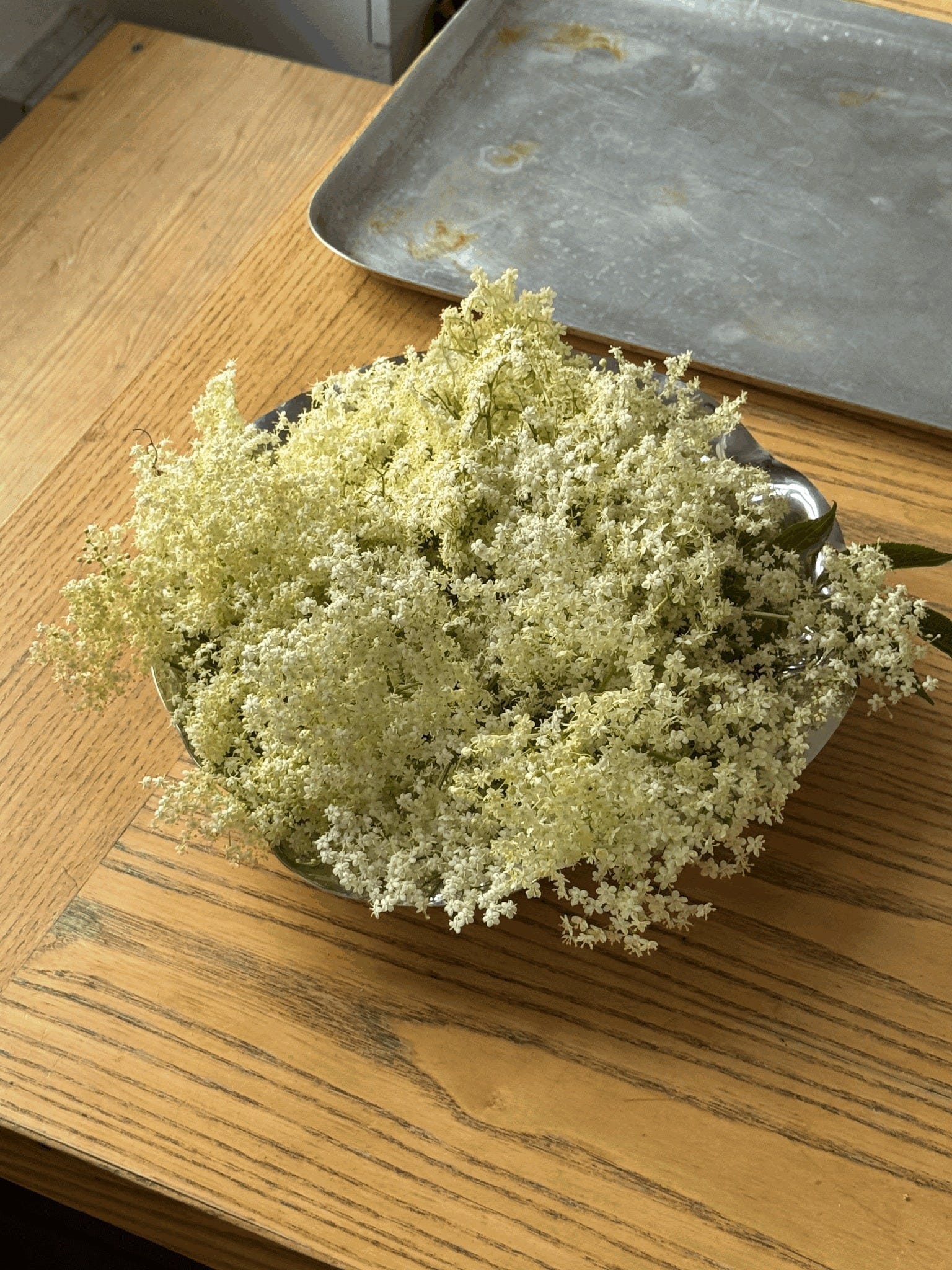
In my mind, foraging has a somewhat unglamorous association. There is a huge knowledge requirement both botanically and culinarily speaking, which for a lot of people (myself included) feels insurmountable and frankly, not worth it. Elderflower, however, bridges that gap. With thanks to its abundant nature, remarkable beauty, and cultural significance, it is, for all intents and purposes, low-hanging fruit. I’m not an expert, but an enthusiastic amateur in the foraging arts, and elderflower was my gateway.
As Sarah Johnson says in Fruitful, “a cook will learn a lot about food by stepping out of the kitchen and into the garden”. I have been totally blown away by how rewarding and simply enjoyable it is to gather your own ingredients. When I set out hunting for elderflower, I can feel millions of years of evolution converging in my body as I reach to grab just one more bloom. It’s nature’s Candy Crush: forget the weaponised dopamine incentive of infinite scrolling; those neurological systems are there to make you enjoy prancing around picking flowers.
We’re so removed from this reality that the phenomenon of plant blindness has become prevalent. Forget the fish-and-water metaphor; plants are the invisible medium we walk through. Plant blindness is a well-documented phenomenon, but it is easily remedied by simple awareness. Once you learn to start paying attention to the plants around you, the richness of detail on a simple neighbourhood walk can become nothing short of exhilarating. Learning to take note of plants and even identify some along the way has been one of the most transformative habits I’ve developed in recent years. The disparity between how common plants are and how little base knowledge the general population has about them makes learning to see them feel like learning to see any entirely new wavelength of light and colour. I’m still only just learning how little I know, and am continually amazed by what’s out there for me to learn. Naturally then, I have to wonder what more I can learn about Elderflower.
If we want to divorce ourselves from the English cultural context and step back to think about how we can cook with Elderflower, I like to zoom out and take a less culinary, more botanical approach. To answer the how, I first want to ask “what?” What’s so special about Elderflower? What are its attributes which make it itself? What is a flower? Simply put, flowers are a reproductive mechanism. They contain the ovary of a plant, which is fertilised by pollinators to then grow and eventually ripen into fruit. Old faithful Harold McGee, author of the Encyclopedia of Food and Cooking, identifies the primary means to achieve this as strong scent and bright colours. Their appeal then seems to be visual and aromatic - not corporeal. When trawling my library of cookbooks for what people had to say about Elderflower, it was virtually unanimous that the use of elderflower is to lend its flavour to other things. It went unquestioned that the destiny of elderflower was a pot of jam, syrup, custard or other, making only temporary stopovers in our food before being removed and discarded.
It’s not surprising that Elderflower has been relegated to the invisible land of infusion. The experience of flavour is understood to be the result of taste and smell working in concert. While taste buds on the tongue can only detect the ‘base notes’ of sweet, sour, salty, bitter, and umami, olfactory receptors in the nose can detect over one trillion (!) different aromas. Where taste is the bassline, aroma is the melody. Where taste is broad strokes, smell is the fine detail. Beyond that, to cement the role of aroma in flavour experience, many of these receptors are only accessible via the mouth, meaning there’s an entire wing in the architecture of our olfaction that functions solely to bring us flavour.
On KP+ today
Speaking of the invisible land of infusion, on KP+ I have developed a recipe inspired by Louis’ writing: Cold Elderflower Cream Cake with Elderflower Macerated Strawberries.


Layers of soft sponge soaked with elderflower cordial, whipped elderflower ganache and a gently whipped cream to round it all off. The strawberries are plumped in elderflower cordial and sit alongside the cake.
Expanding on the role of olfaction in food, the Oxford Companion to Sugar and Sweets tells us that “in general, taste donates and olfaction receives”. This refers to our stored understanding of the relationship between taste, smell, and flavour - through association, certain smells take on the qualities of tastes. Think of the ‘sweet’ smell of cinnamon, or the ‘salty’ smell of fryer oil. This isn’t some feeble trick of the mind either: the companion goes on to say that odours enhance taste qualities when there is parity between taste and smell. The addition of strawberry aroma to sweet food makes it taste more sweet, but the addition of strawberry aroma to peanut butter does not make it taste sweet. This explains why elderflower is generally relegated to traditionally sweet preparations.
Diving into the science of flowers and flavour made me reflect on my existing relationship with them. My interest in food and cooking has largely been propelled by a love of fruit. Produce has always been a rich seam not just of deliciousness, but beauty and fascination. While I once proudly preferred the summer months for all the fruit they bring, I have learned to embrace the multiplicity of life they sit within and find the same joy in the leaves and flowers which both precede and follow them. Fruit also has many characteristics in common with flowers; it uses bright colours, fragrances, and the promise of a sugar hit to draw in external reproductive assistance. Fruit and flowers are two stages along the same lifespan, separated only by maturity. Thinking about it this way, it seems obvious that we should encourage cross-pollination of recipes and techniques between the two. Flowers might not have the fleshy appeal of fruit, but they can still be ingredients unto themselves.
Looking past infusions, munching on petals is not necessarily all that common. Courgette flowers seem to sit most happily on people’s plates unquestioned, but there is a whole world of remixes, adaptations, and possibilities if we set our sights to broader horizons. Magnolia is an increasingly popular flower to use in cooking, not just for infusion but as a bite on its own; look to Nordic chefs to find the petals served fresh and raw, pickled, or sautéed. The late great Skye Gyngell made a name for herself through her reverence for the ingredients of the earth, and that certainly didn’t stop at flowers. Among many, many other applications, one of Skye’s signature dishes was a tulip salad with elderflower dressing, where tulip petals are dressed alongside delicate lettuce leaves to create a vibrant, peppery salad.
When researching for this newsletter, I consulted my foraging bible: Richard Mabey’s Food for Free (1972). In this book, there are two recipes given for elderflower: cordial and fritters. In Harold McGee’s treatment of flowers, he identifies three culinary applications: “as edible garnish, or cooked into aromatic fritters, or infused”. I am not willing to overlook the fact that the broad technique of ‘infusion’ is identified as an equal of a single foodstuff. Fritters are mentioned almost any time edible flowers are, but I don’t see this translate into real kitchens or frankly even real life. I decided to dig deeper and found that elderflower fritters are something of an ancient food, with the earliest recorded recipe dating to 1470 in Italy.
Many countries across northern Europe claim their own traditional fritter recipes, with one source even claiming that they are a Native American invention. It seems that across time we have consistently and independently arrived at the concept of a flower fritter, which (in my corner of the world at least) has apparently lapsed.
With such a rich history that is underrepresented in the modern engagement with elderflower, fritters are ripe for a renaissance. While specifications vary across recipes, the basic principle remains the same. A light batter is made with some combination of flour, liquid, and/or egg. In my experience, recipes had a broad range of textures from stodgy doughballs (the original recipe includes cheese) through to pancake, all the way to shattering tempura. I enjoy a lighter fritter, but with crispness and lightness as the sole criteria, you end up with something just like a pub chip, which isn’t what I want for my flowery dessert. The points of possible variation include leavening, alternative starch, the use of liquid, or the use of whole versus egg white and the ratio of liquid.
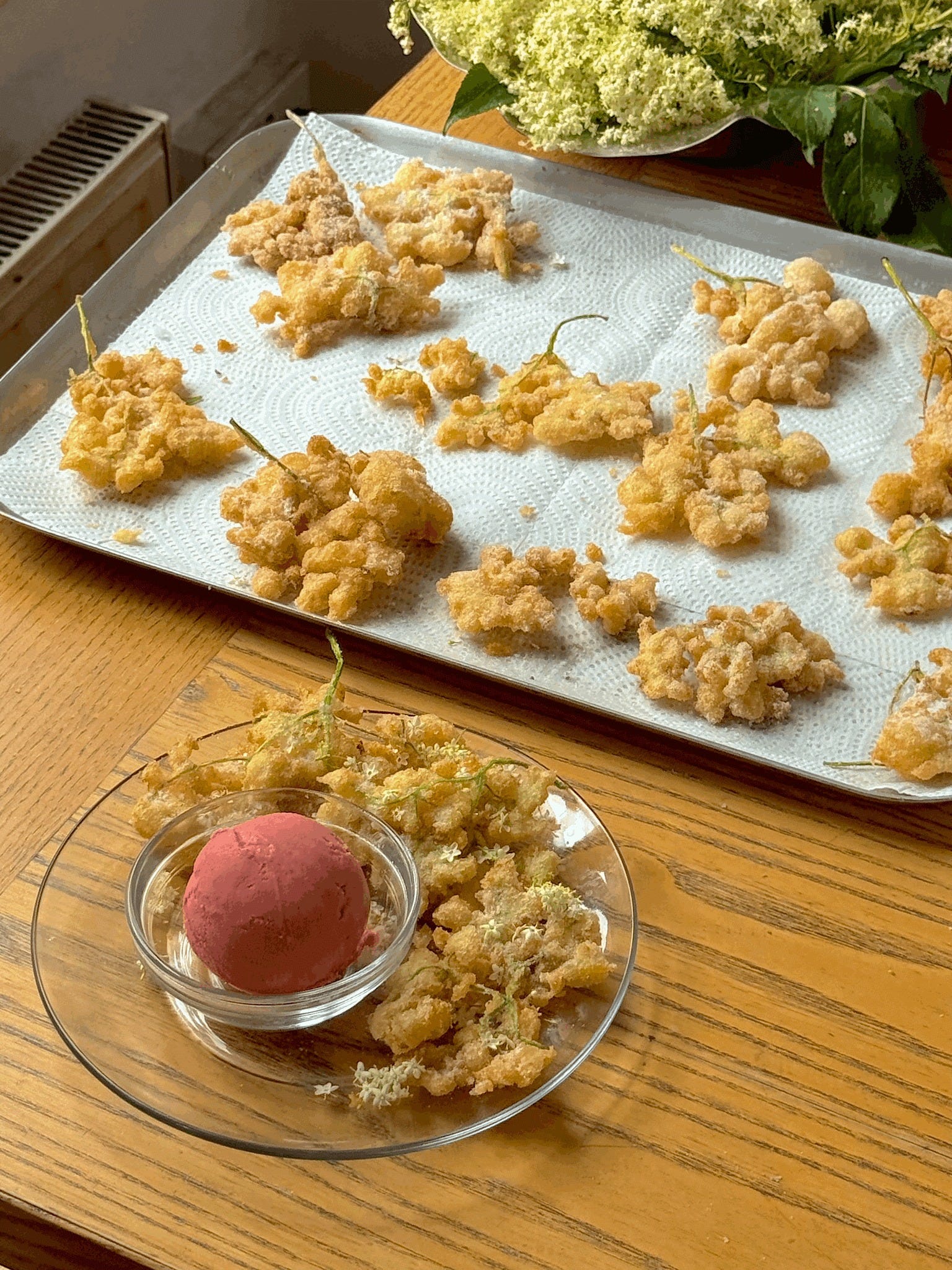
The recipe I have developed includes whole eggs for richness, as well as additional seasoning with elderflower cordial and lemon zest. In my restaurant experience, we used to make a fritter that was as light as possible with a combination of beaten egg whites, sparkling water, and 00 flour. It made for a beautifully delicate garnish, but I found the flavour lacking, with its leanness simply creating space for the flavour of… fryer oil. With the additional flavour of the yolk, zest, and cordial the fritter has an identity of its own beyond simply ‘fried thing’. This fritter reads more like a beautifully light and fragrant doughnut bite that is shockingly moorish.
RECIPE: Elderflower Fritters
Makes enough batter for about 15-20 large heads of elderflower.
Ingredients
70g all-purpose flour
30g cornstarch
1tsp baking powder
(or 100g self-raising flour)
1 egg, separated.
Zest of 1 lemon
Pinch salt
150g sparkling water
25g elderflower cordial (a sweeter cordial is preferred here, but its primary role is as ‘elderflower extract’ so sweetness isn’t too important)
Neutral oil for frying (I buy and use a 1L bottle and call it a day)
Method
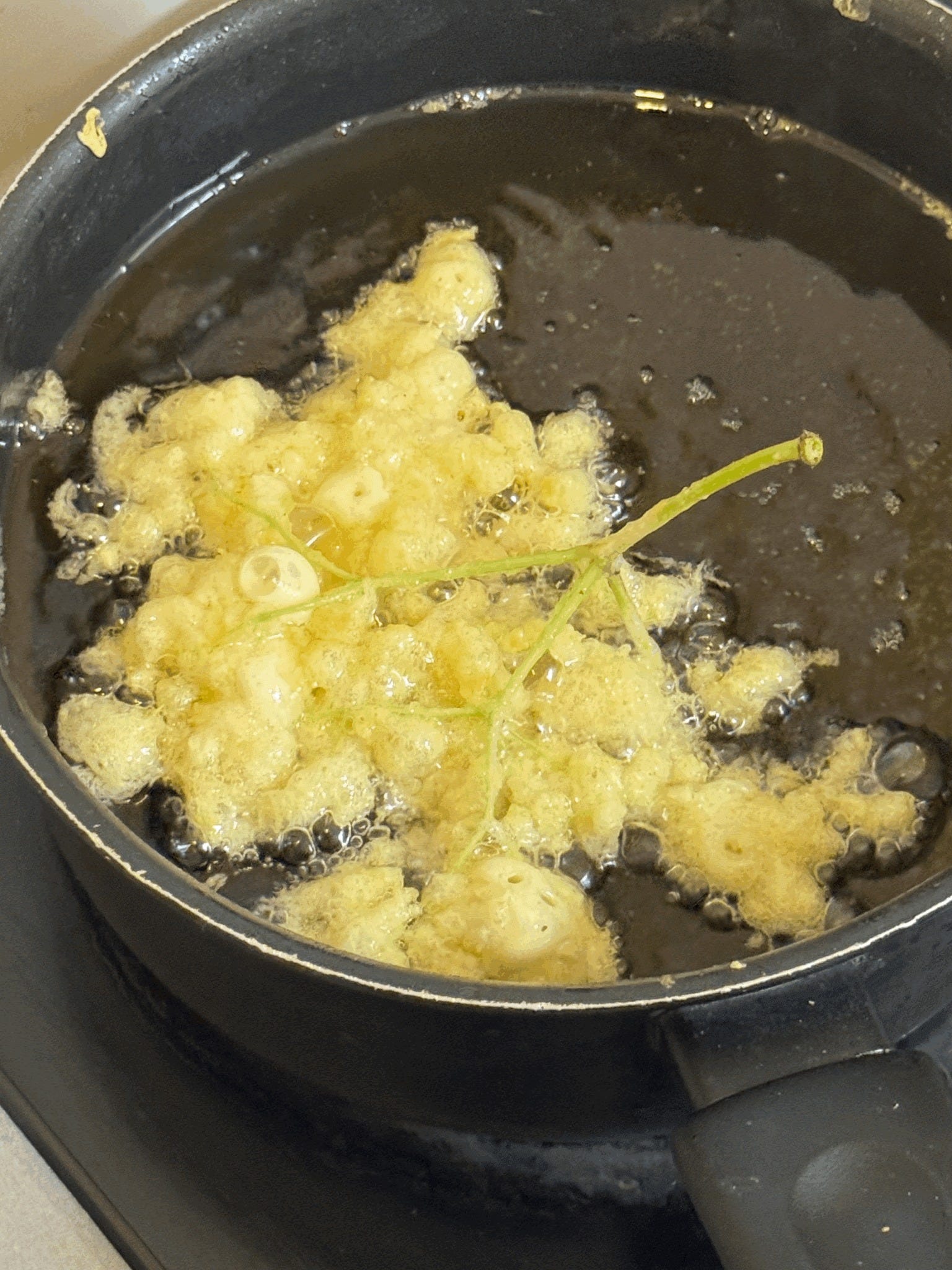
Fill a small saucepan with the oil to a height of ~5cm and set over medium heat. You are aiming for a temperature of 180C on a thermometer but you can test if your oil is ready by dropping a small amount of batter in and seeing if it fries.
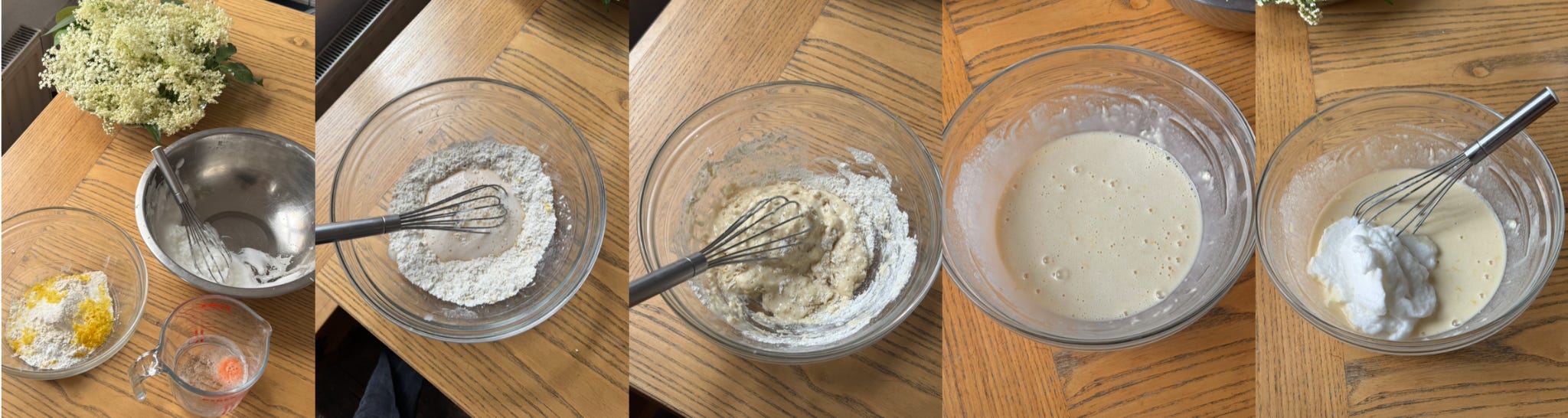
In a small bowl, whisk together flour, baking powder, salt, and lemon zest. In a separate bowl whisk together the yolk, water, and cordial. Make a well in the centre of the dry ingredients and pour in the wet ingredients in three parts, whisking well in between additions to prevent lumps. Whisk the white to stiff peaks and fold through the batter.
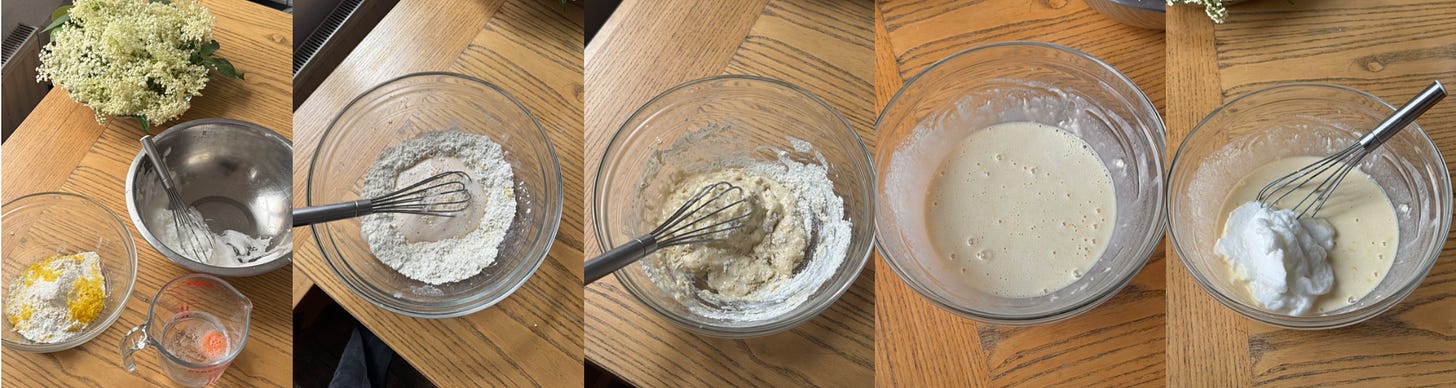
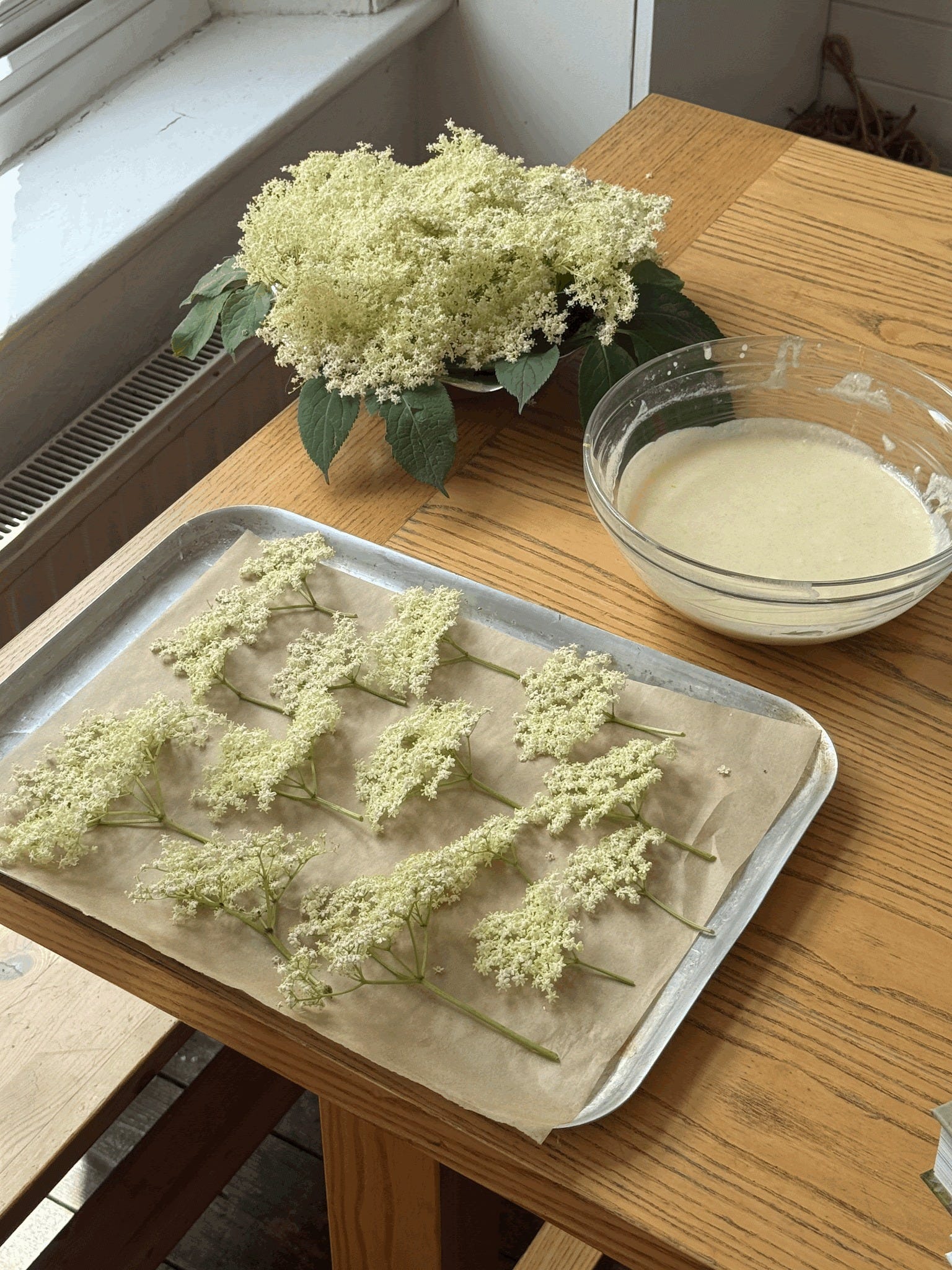
Take your heads of elderflower, preferably with an intact stalk for handling. Dip into the batter to submerge completely, dragging it against the side of the bowl and wiping it to remove excess batter. Don’t worry about being gentle here, the flowers can take it. You are aiming for a thin, even coating but as you fry each head you will learn your preference.
Submerge the heads in the oil, lowering them in head down using the stalk. Being careful not to splash hot oil on your hands, give the flowers a gentle shake as they enter the oil to shake off excess batter and achieve a beautifully defined shape.
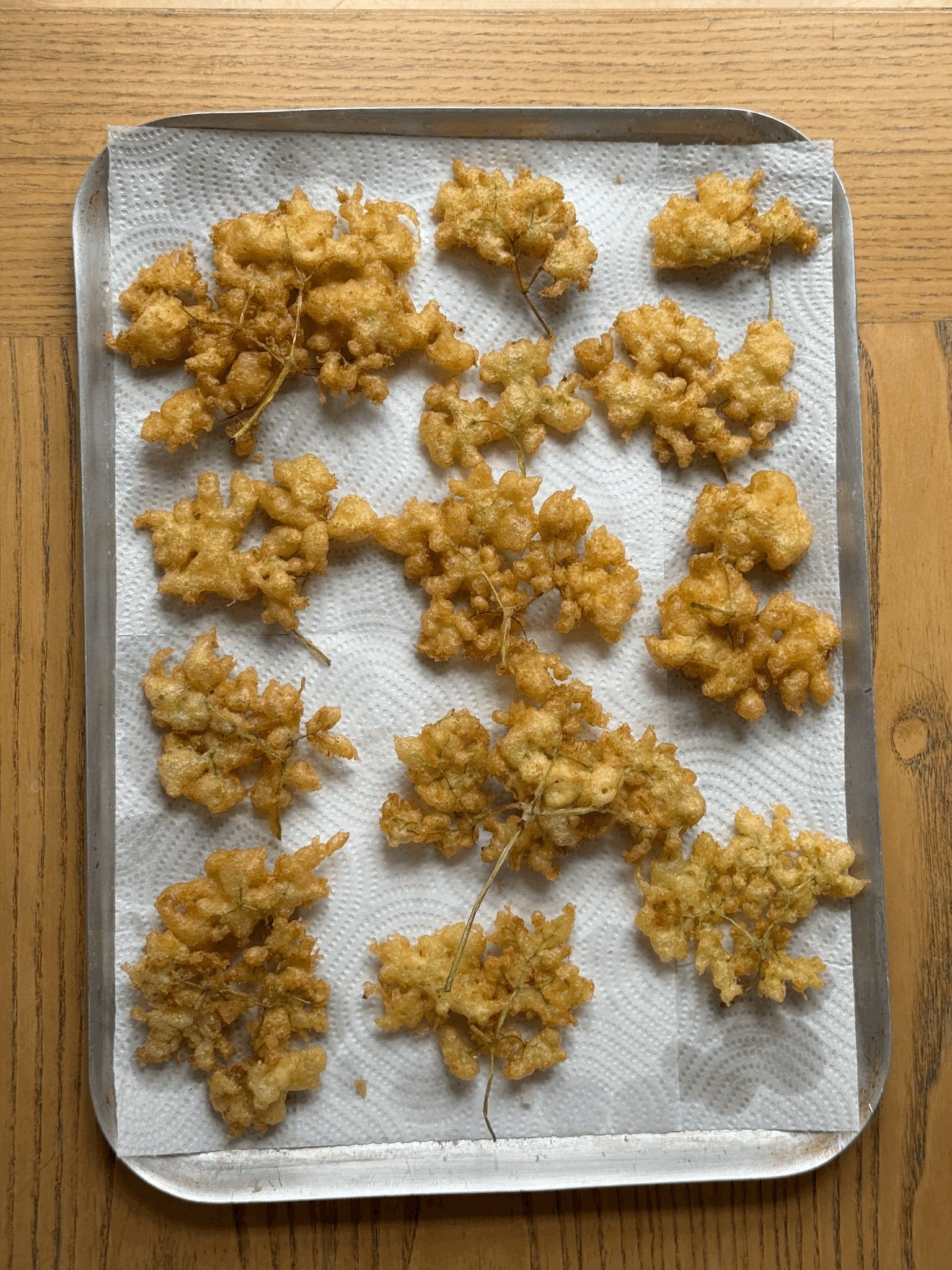
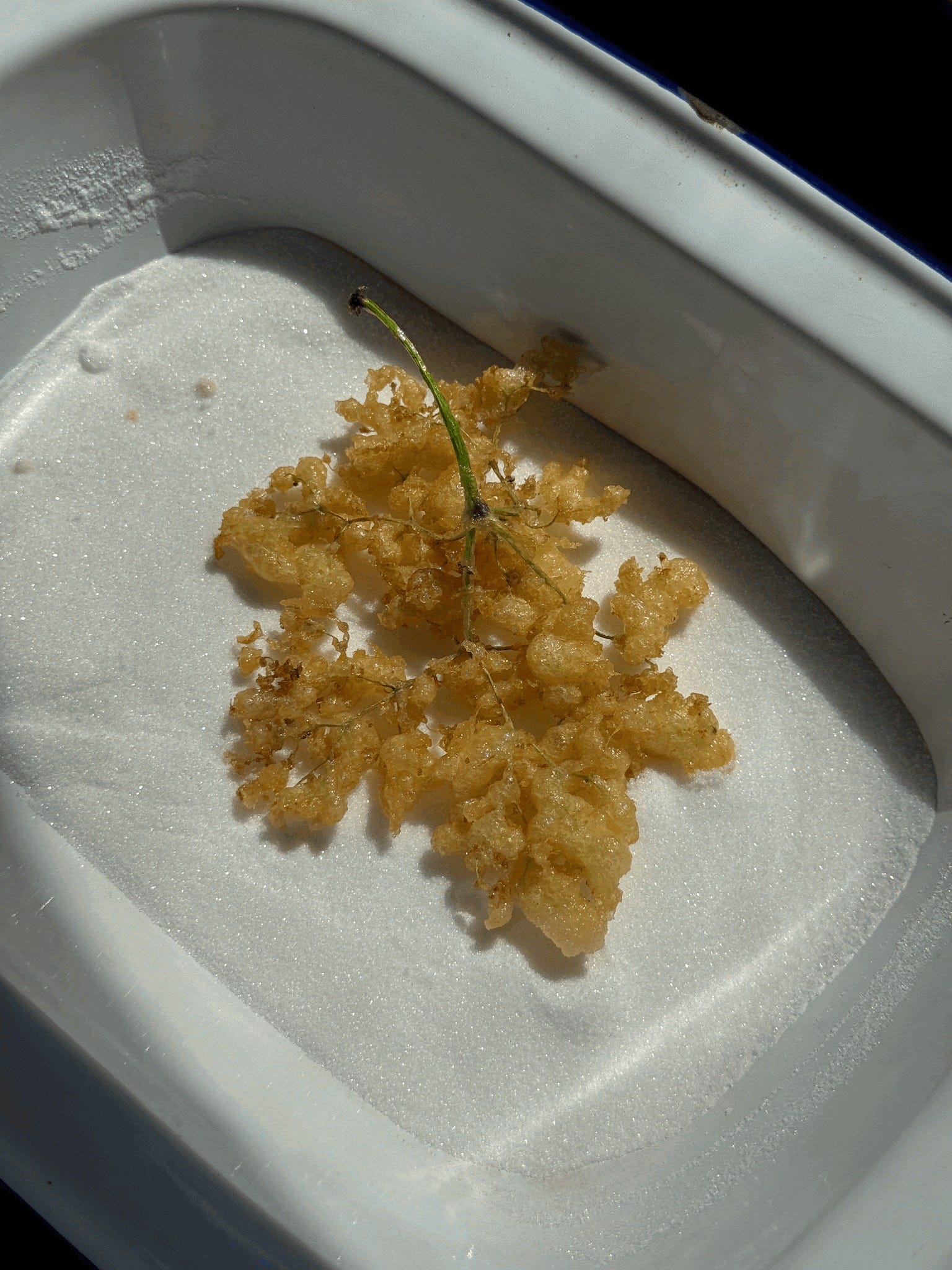
Fry for 2-3 minutes until light golden brown, flipping halfway to ensure even cooking. If you have a large head that likes floating, you can also press it down to fully submerge. Transfer the fritters to a plate lined with a paper towel to absorb excess oil. Toss each fritter in caster sugar and serve immediately. If you need to prepare them in advance, hold them in a low oven on a wire rack. The batter will also hold in the fridge for several hours, simply whisk to recombine if it separates.
Brilliant as always!
one of my all time favorite threats. thanks for the beautiful recipe Louis!