

I love baking to a theme. I’m not a big fancy-dress person personally, but for my cakes? I’m basically a stage mom. I’m all in.
Earlier this week, I had the pleasure of seeing As You Like It at the Royal Shakespeare Theatre in Stratford-upon-Avon. It was opening night, and we were tucked into the circle thanks to my best friend and cast member, Giles Cooper (aka Le Beau!). The production features an extraordinarily talented all-male ensemble, led by Jonathan Groff as Rosalind and Fisayo Akinade as Celia, and joyously directed by Daniel Evans, the RSC’s co-artistic director. It was edge-to-edge brilliant and heart-expanding in a way that only live theatre can be. It’s only on for another month, so you have GOT to go – I’m going again next week, and I can’t wait!
Such a special show and evening deserves a special cake (to be clear, this wasn’t a commission; it was an act of passion). So I boarded the train from London Marylebone with the help of Milli Taylor (also my fig-foraging partner), carrying a large cake box.
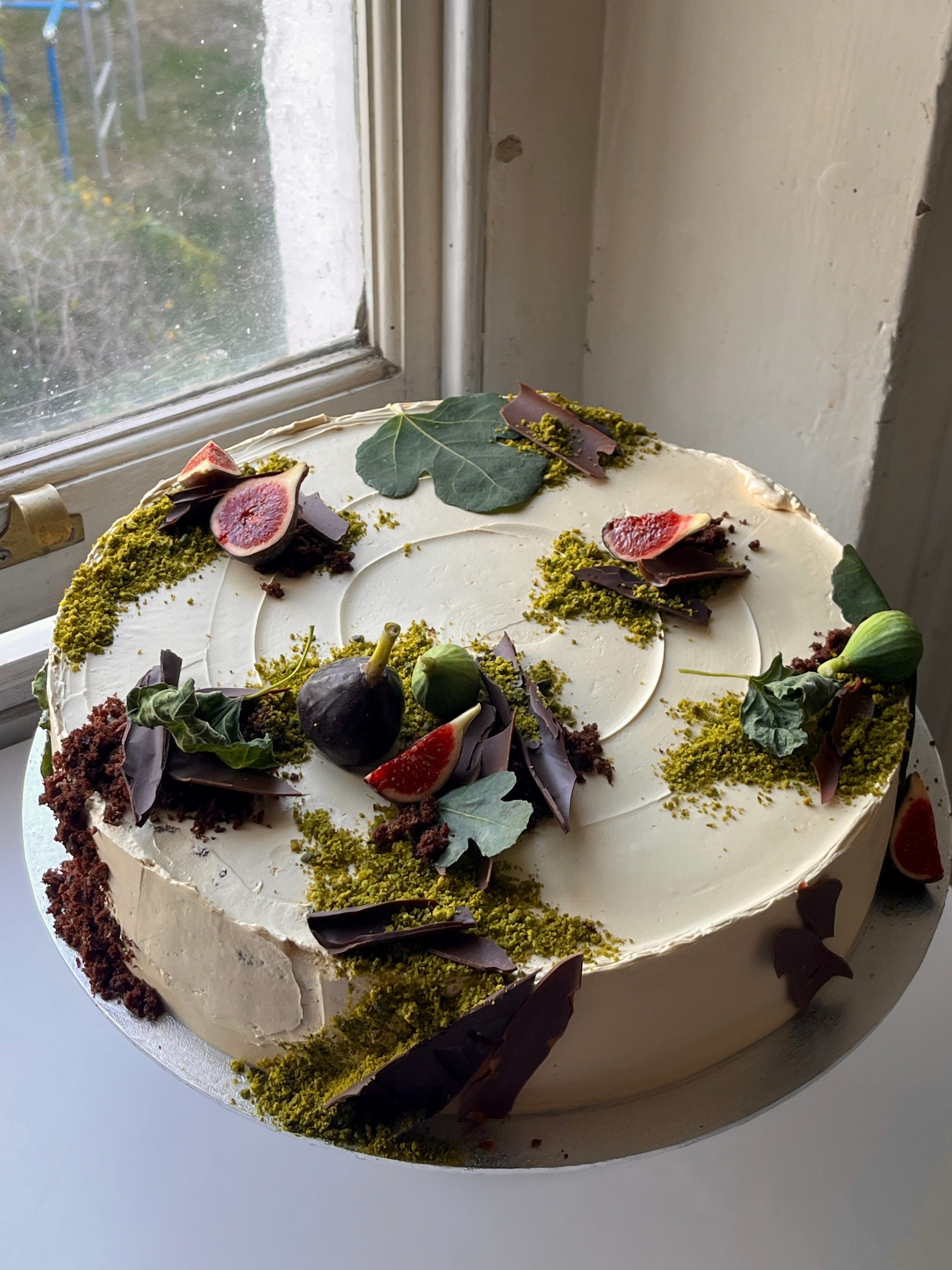
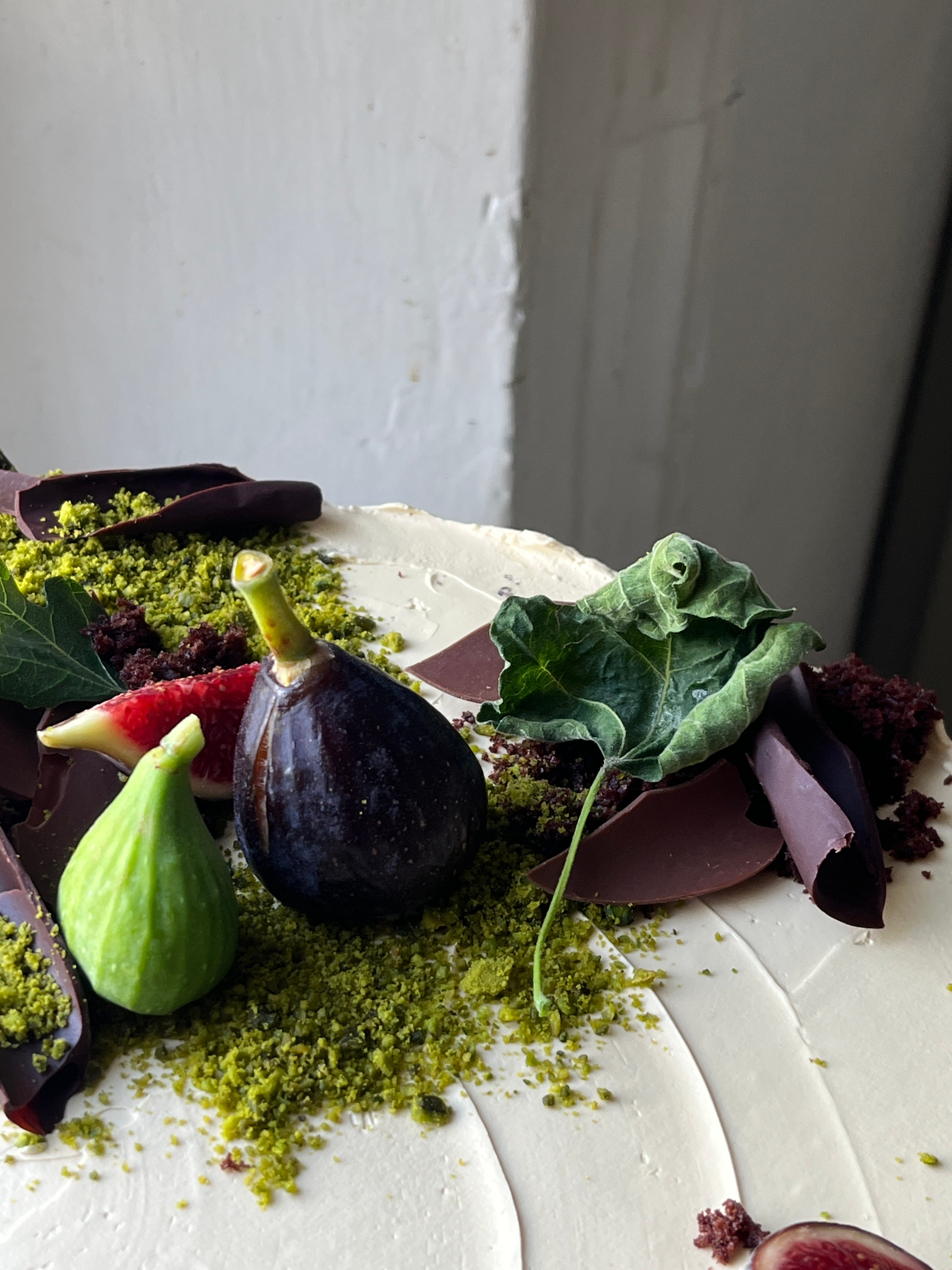
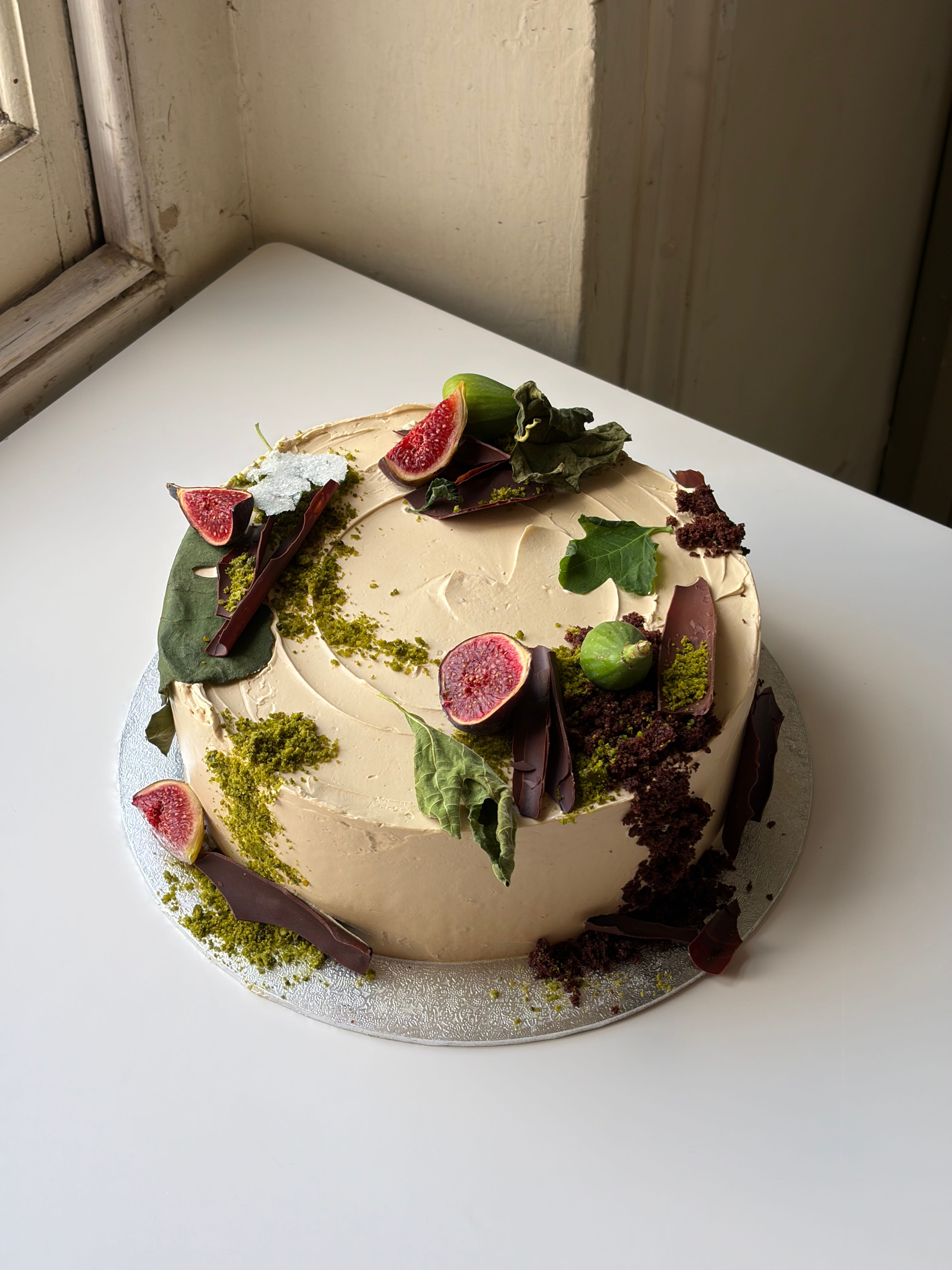
Inside was a cake inspired by As You Like It and the pastoral setting of the Forest of Arden, where the play and ensuing mayhem take place. I present to you… The Fallen Fig / Forest of Arden cake:
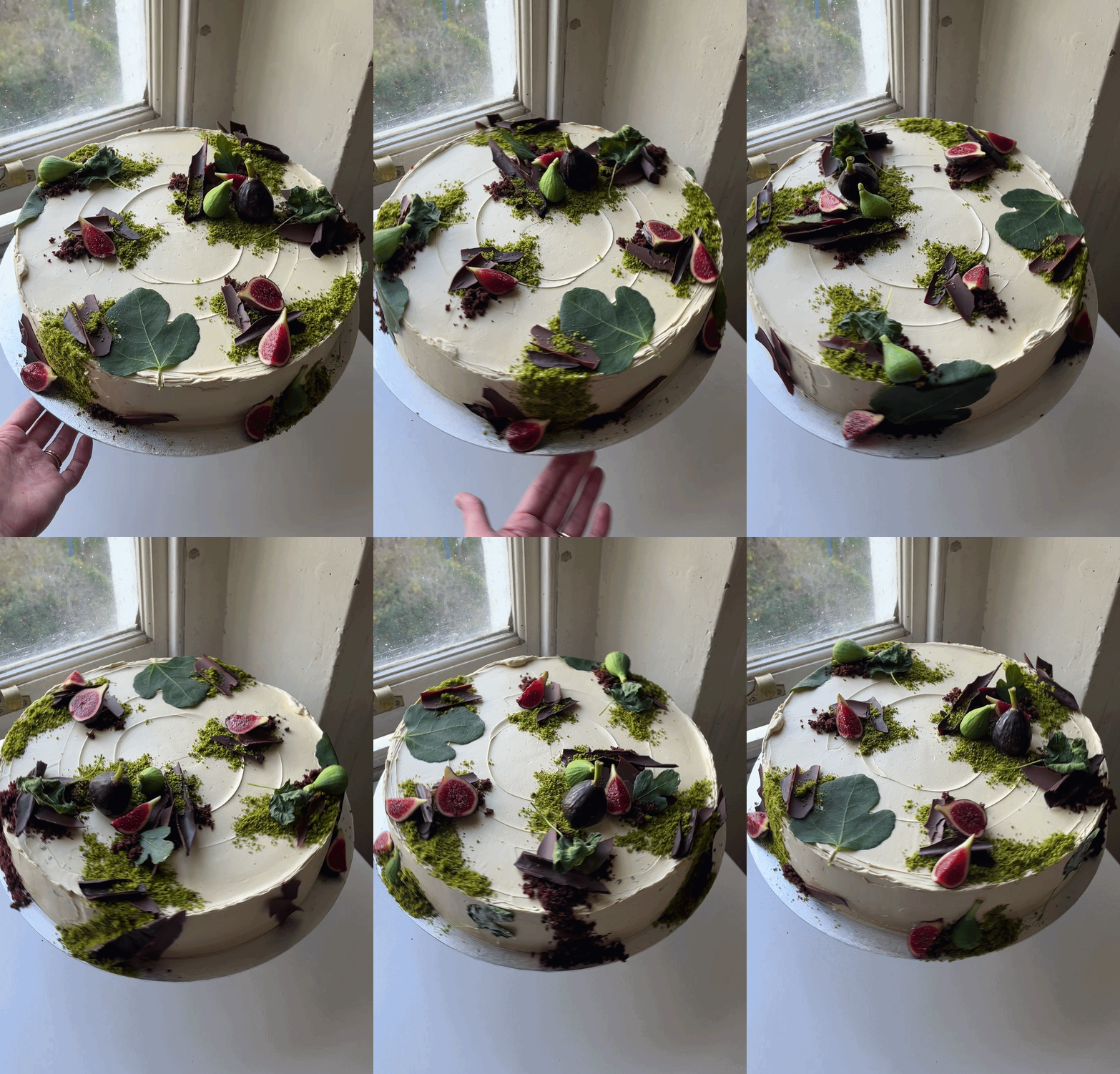
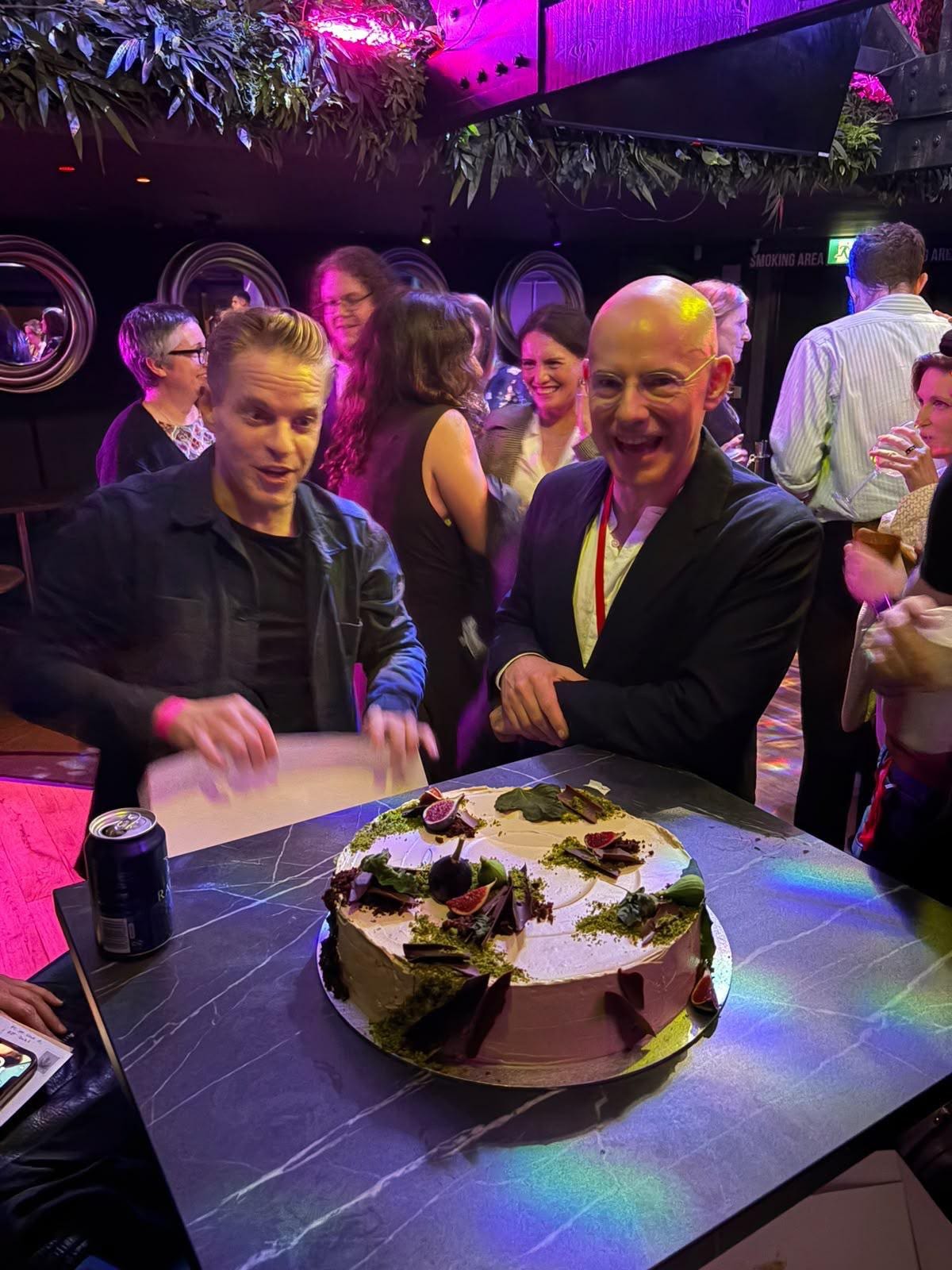
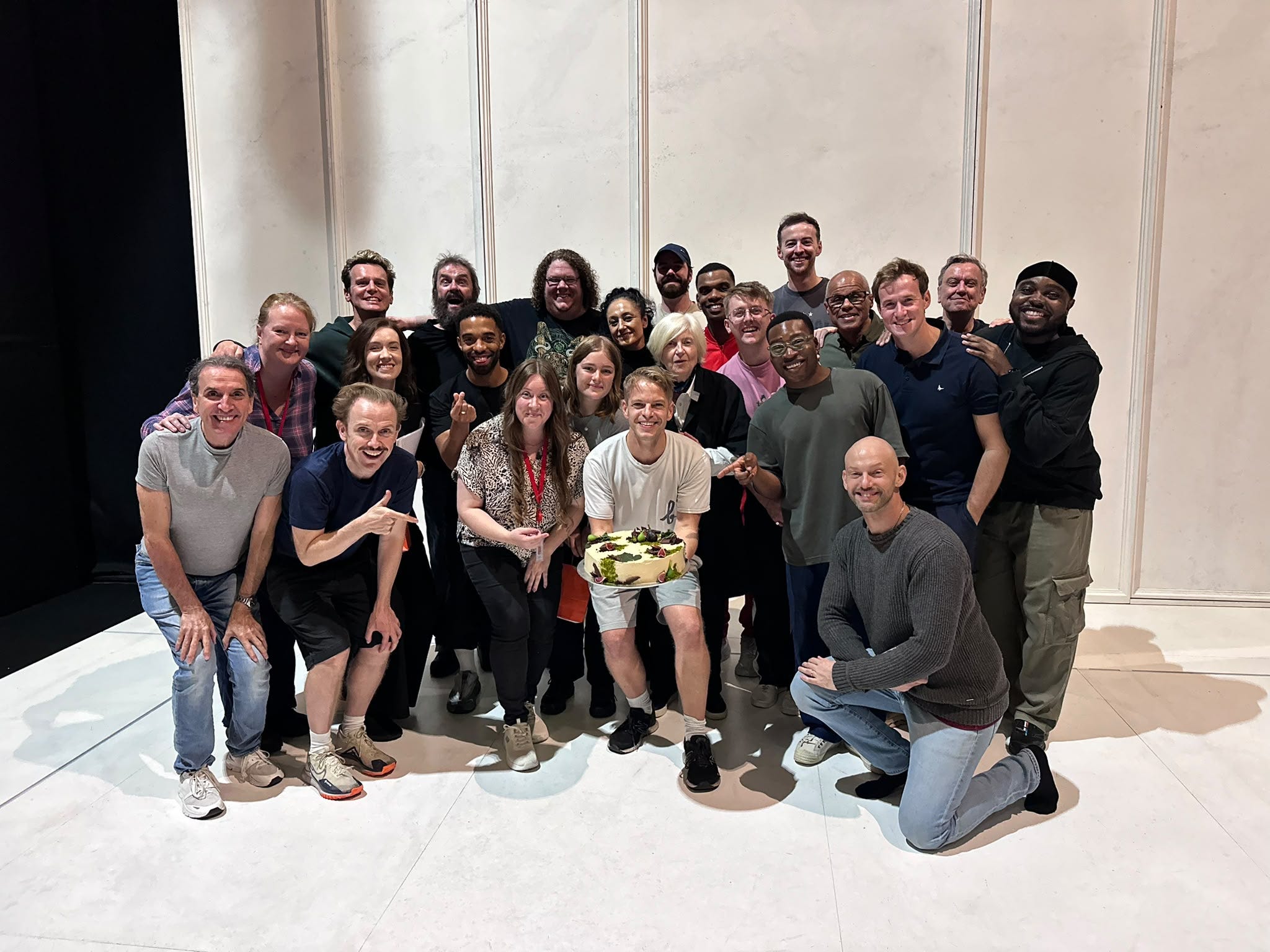
It combines layers of rich chocolate sponge, whipped salty milk chocolate ganache, jammy figs, pistachio custard, all bound together with coffee buttercream. It is decorated with luminous yet mossy blitzed pistachios, milk and dark chocolate bark, earthy chocolate sponge crumbs, akin to soil, and a variety of figs and fig leaves. Here it is in situ at the afterparty, modelled by Giles and director Daniel Evans in the foreground:
I’m happy to tell you it was absolutely delicious, and I KNEW that I needed to share the recipe with you. In this newsletter, I’ll walk you through the development process and each element, with useful links to the recipes that inspired the final version (as really, most layer cake recipes just gather together delicious things from the archive!). I will also include the full recipe and method at the end for KP+ subscribers.
Figs and Fig Leaves
I decided on this cake’s flavours somewhere over the Atlantic as I flew back from the US. Thanks to Milli Taylor’s recent recipe for Frangipane Fig Tart (check it out! It’s a wow!), I knew that, with a bit of effort, I could still find great figs somewhere in London. And anyway, Shakespeare is always banging on about figs (though, annoyingly, not in As You Like It, which instead invokes Acorns, Medlars and Grapes), so it felt safely on theme.
The fig leaf (read all about it here) also has the benefit of an undulating shape, rousing scent and green hue that are perfect for drumming up a forest atmosphere. As for sourcing, I find that fig trees are EVERYWHERE once you start looking, and I helped myself to a few leaves from branches that overhang the pavement near my house in North London. I went for smallish leaves, and a few tiny ones, so I’d have an assortment of sizes and shapes to choose from.
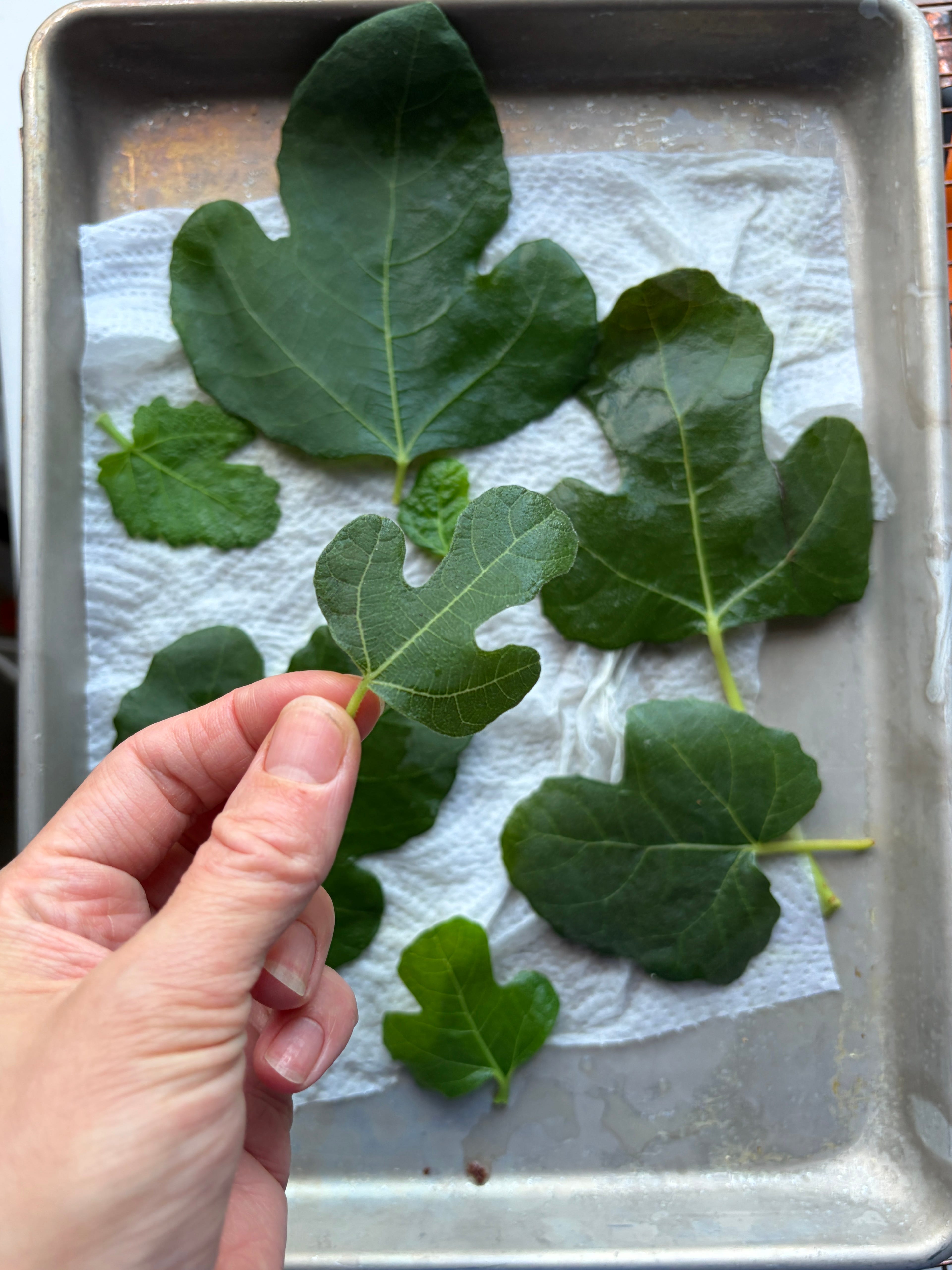
To prep them for the cake, I washed them, blanched them in boiling water for about a minute to make them non-toxic, then laid them on kitchen paper to dry. Wondering if I should dry the waterlogged leaves, I put a few in a low oven. They crisped almost immediately (DUH!!!), but I actually LOVED the way they looked. It felt in keeping with the forest-in-transition atmosphere.
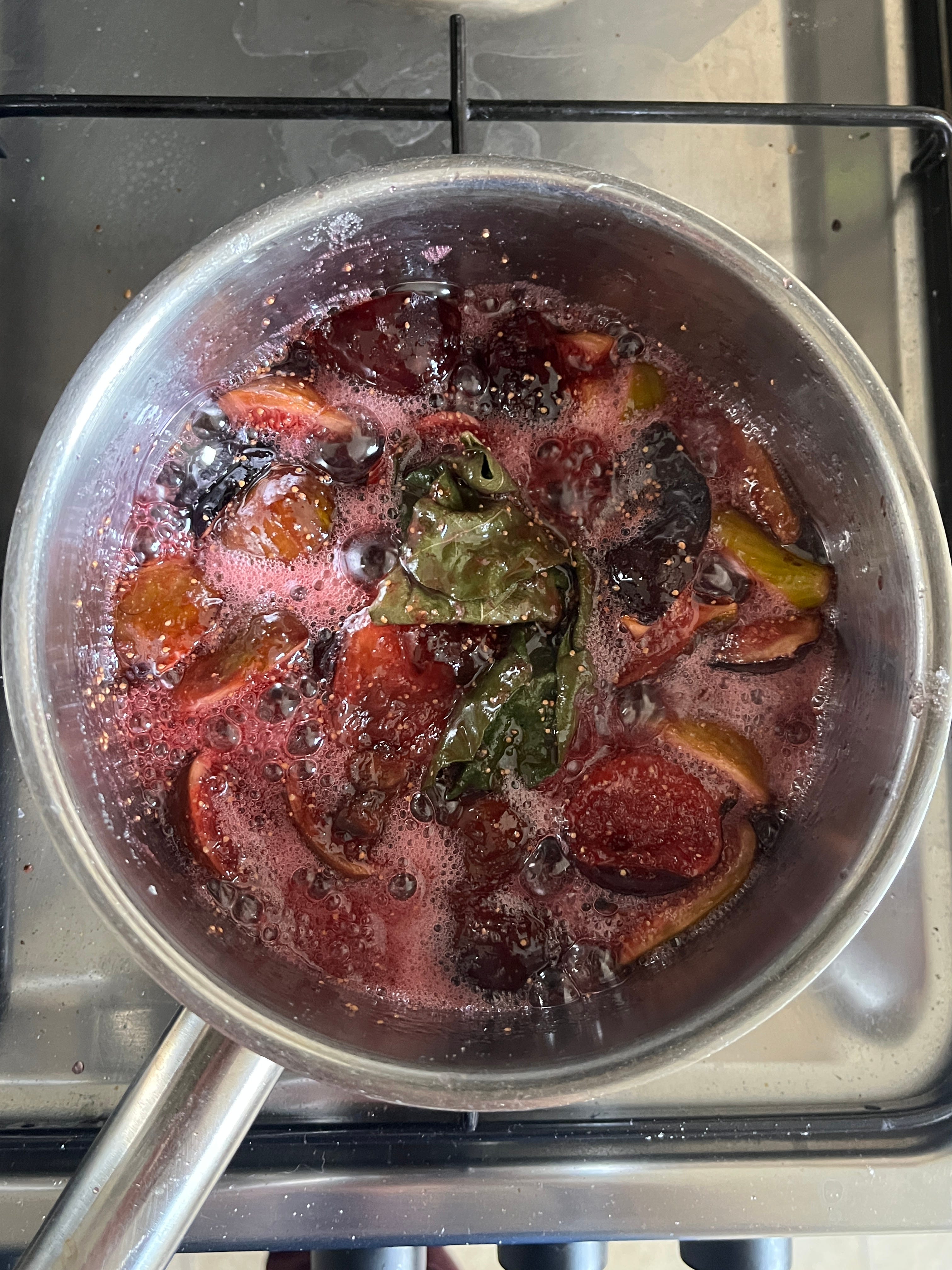
As for the fruit, I made a 1.5-hour round trip to Natoora in Sloane Square, needing 100% certainty about fig quality. They had two delicious varieties (£34/kg for French figs and £21/kg for Spanish figs!) – I ended up with about 1kg (ouch), a mixture of both varieties and carried them home carefully. I made most of it into jam (roughly 50% sugar to fruit weight + lemon juice), adding a fig leaf to impart extra green flavour during cooking, and saved a few for the top.
The next morning, before I started decorating the cake, we walked around our local park and came across a beautiful sight indeed: A fig tree practically heaving with ripe figs. And not just ANY ripe figs, delicious ripe figs that outclassed the ones I’d tracked down the previous day.
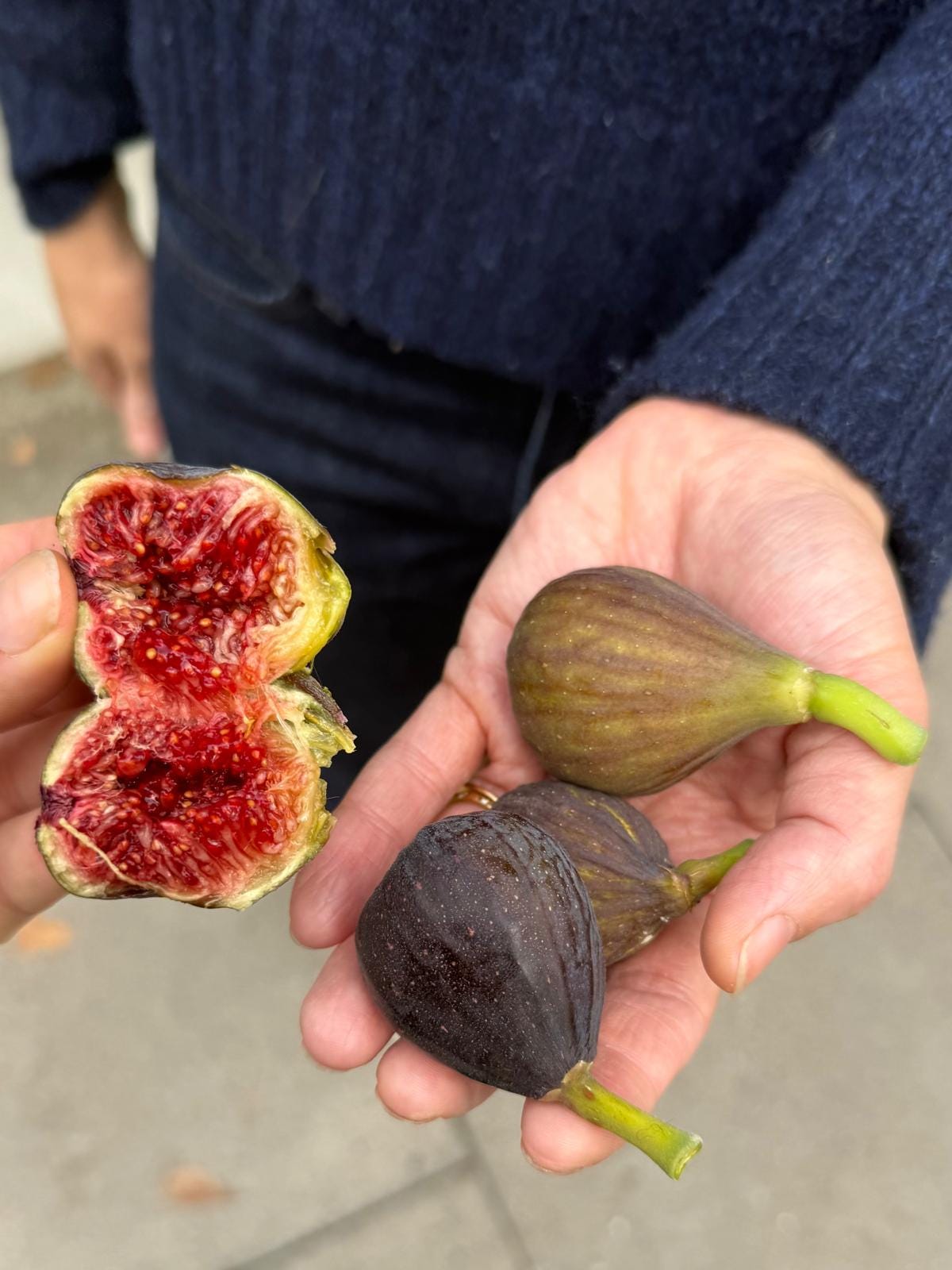
Though the quality of the figs in London may be considered a canary in the climate coal mine, I was seriously impressed by this fortuitous encounter—never thought I’d be gobbling jammy figs picked seconds before on a London road! Also, on the good advice of Milli, I picked several unripe green figs (a good idea from Milli Taylor) to decorate the cake.
Sponge + Fillings + Buttercream


I’d always envisioned a damp chocolate sponge (inspired by this recipe, baked in trays then cut to size) for this cake, evoking earthy, grounding soil (but delicious) and knew it would suit the raisin-y notes of figs. Then it was about connecting the dots between them – when you build a cake, you want flavours that are both distinct and harmonious. I decided on pistachio (easy friends to both chocolate and fig), salted milk chocolate (same-same but different from the sponge!), and coffee. But what form should these flavours take?
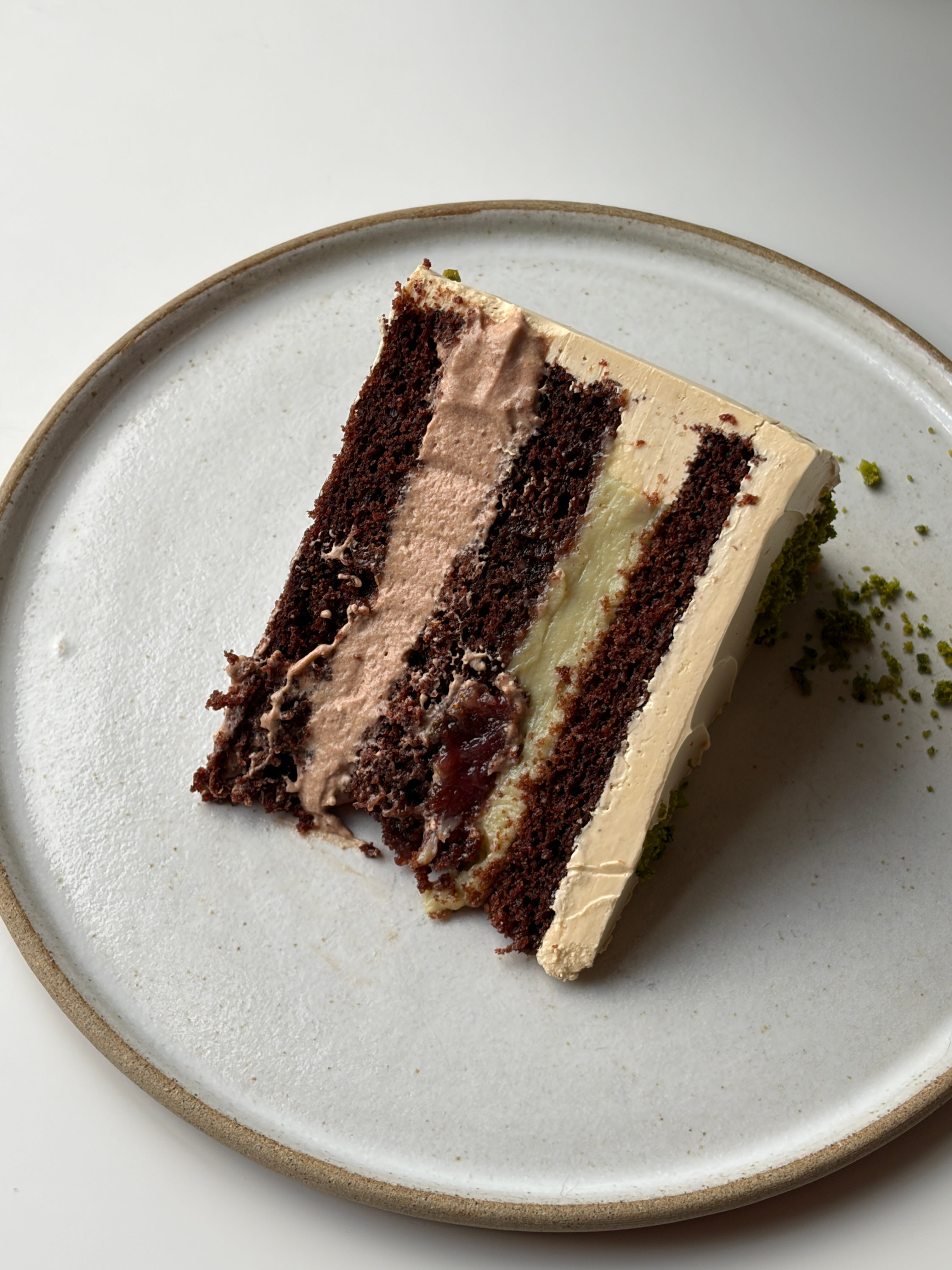
For the pistachio, I decided on a rich custard akin to the one in my pistachio gateau basque recipe, which would nestle into the jammy figs (more on that in a sec). The salted milk chocolate would come in the form of a whipped ganache (approx half chocolate to double cream, then salt and brown sugar to maximise the seasoning) whilst I’d adapt a classic Swiss meringue buttercream with extra salt and a shot or two of double espresso (you can use this April’s Baker recipe for inspo, though my recipe below has different proportions).
When you make fig jam, how you cut the figs at the start has a huge impact on how they cook. Unlike some jams which break down completely as you cook them (raspberries, rhubarb, etc. I’m looking AT YOU!), the fig stays relatively intact thanks to the skin. Of course, it gives a little juicy flesh to the jam, but you get pretty large pieces in a loose, jammy sauce, hence my calling these ‘jammy figs’ rather than ‘fig jam ’, which I know is maybe pedantic. I’ll give you options in the recipe, but I like mixing halves and quarters into the jam so you get a mix of textures, and when you eat the cake, you feel like youare getting proper mouthfuls of fig. You can always cut the figs down with scissors if you change your mind as you assemble!
Assembly
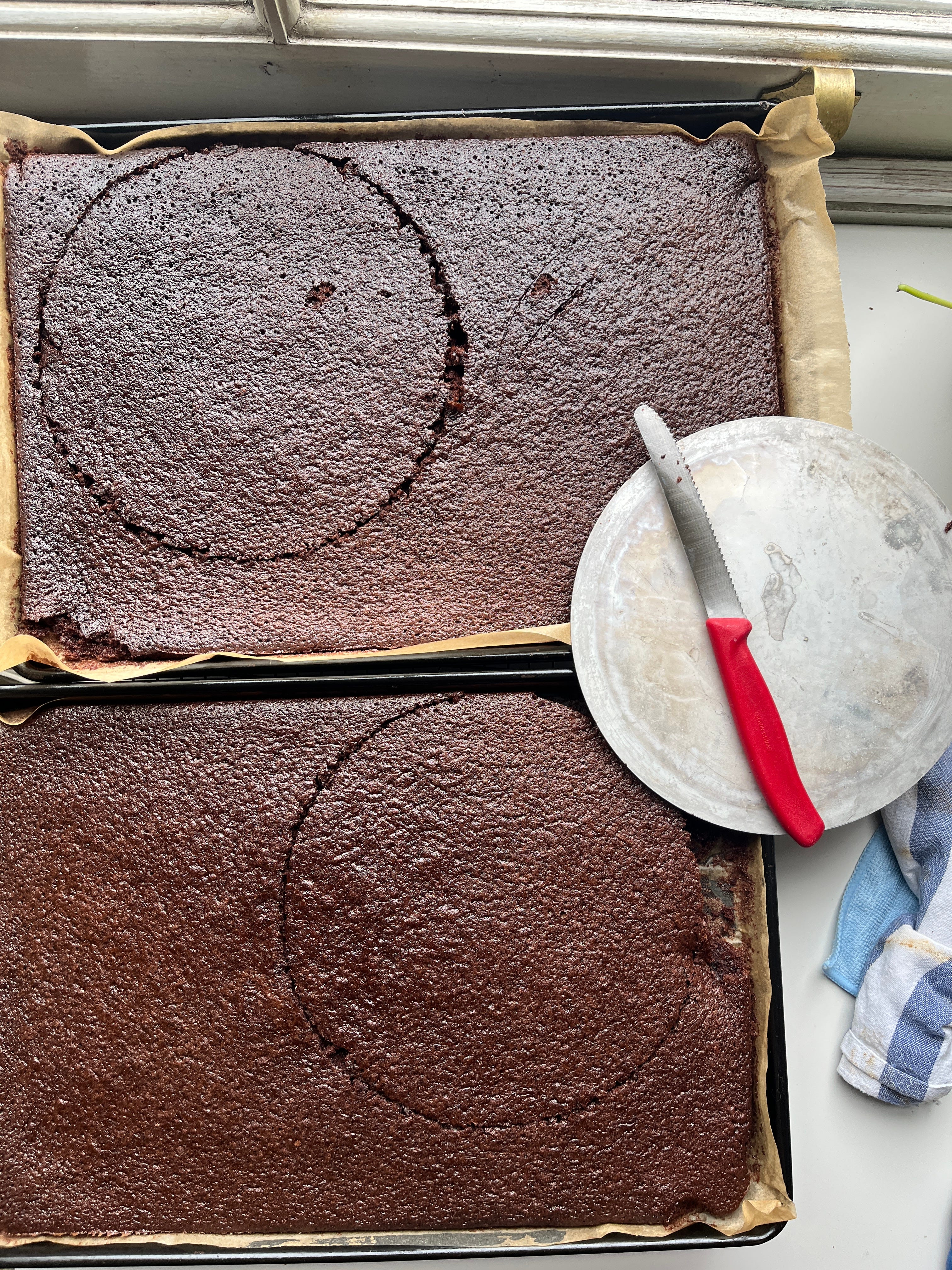
I knew an opening-night cake needed to be plentiful and feed a crowd (I think we must have gotten at least 40 small slices), so I chose a 13-inch (33cm) cake on a 15-inch (40cm) cake board. Of course, I have no 13-inch cake tins, so I baked the sponge, as described in the previous section, in separate trays to about 1.5cm high, then laid them together and used a 13-inch cake board to cut out various circles and place them together, like a puzzle. My thanks go to Louis Thompson for pioneering low-wide-large profiled cakes and inspiring this method and the styling of this cake!
In the recipe below, I’ve scaled it down to an 8-inch cake, but kept the layer thickness the same, so it has a more proud stature than the larger, lower cake.
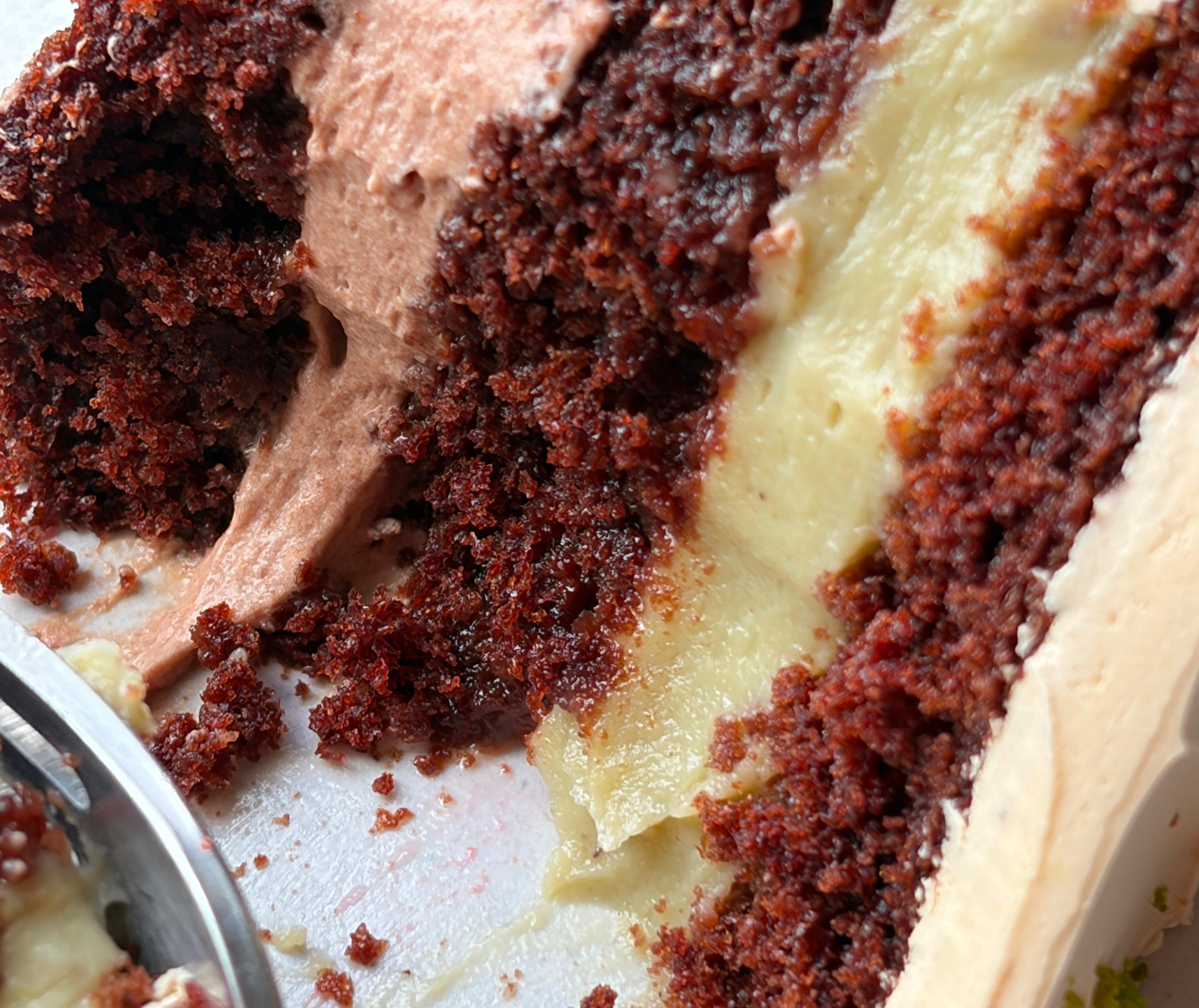
For assembly, I wanted the fillings to be about the same thickness as the sponge; how delightful is a cake where sponge and cream match in perfect stripes?! This meant piping a proper ring of buttercream around 1.5cm tall, then filling to the brim.
Also, equipment PSA: I can’t believe it’s taken me so many years, well over a decade, to invest in a proper, spinny, smooth cake turntable. I bought one a few weeks ago, and it has genuinely made decorating cakes about 1000x easier. It also doubles up as a gorgeous revolving cake stand, or revolving *whatever* stand, so I really think you should invest!
Decor
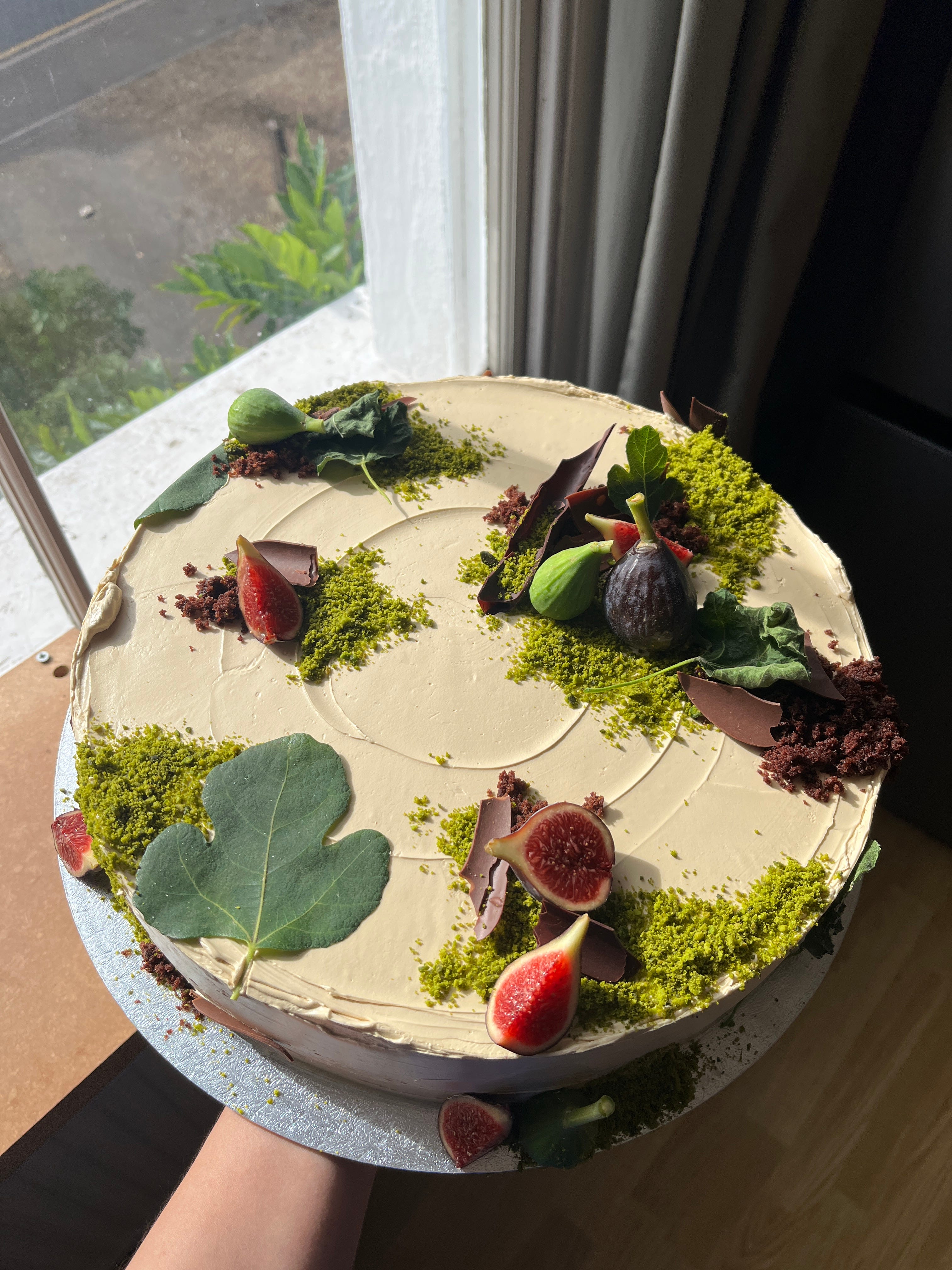
While delicious (I did a tasting spoon of all the elements… IYKYK!!!) I knew that this cake would really come into its power with the decoration. I opted for a mixture of tempered chocolate bark, which is actually very easy, blitzed bright green pistachios (Iranian are phenomenal!), cake crumbs from trimming, fig leaves (dried, sugared AND blanched) as well as halved figs and unripe green baby figs. I left plenty of negative space on the cake to let the eye rest, but carried the design down the edges to give it an organic feel.
RECIPE: Fallen Fig / Forest of Arden Cake
This makes 1 x 8-inch cake. For the 13-inch version, which feeds 40+, you need to double the quantities below and use three 38 x 27 cm trays to bake the cakes, aiming for 22-24 minutes at 160c fan.