
Kitchen Project #182: Sachertorte
with Camilla Wynne


Hello,
Welcome to today’s edition of Kitchen Projects. Thank you so much for being here.
Today the brilliant Camilla Wynne is back to tell us the origin story (and then lend us her own) on Sachertorte, where two chocolate sponges meet apricot jam in a classic medley.
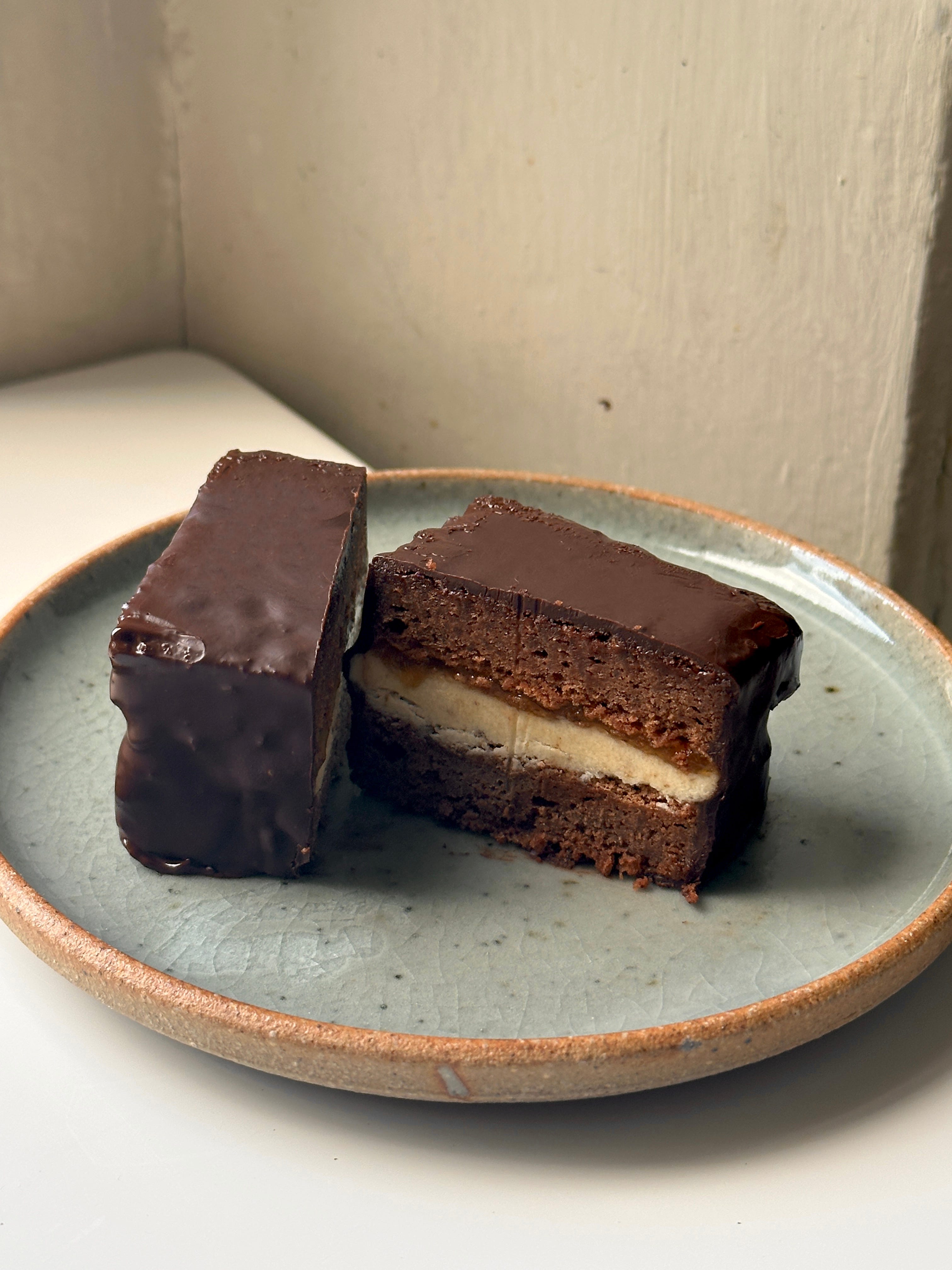
Over on KP+, the delights, as ever with Camilla, continue, with a variation on the theme: A make your own ‘Mc-Vienna Treat’ Japan's answer to the Sachertorte, via McDonalds. It’s sachertorte, but in cube form, with a whipped espresso tinged filling and a rich glaze. Click here for the recipe.
What’s KP+? Well, it’s the level-up version of this newsletter. By joining KP+, you will support the writing and research that goes into the newsletter (including the commissioning - and fair payment - of all the writers), join a growing community, access extra content (inc., the entire archive) and more. Subscribing is easy and only costs £6 per month or £50 a year. Why not give it a go? Come and join the gang!
Love,
Nicola
On Sachertorte
My band was invited to play a festival in Moscow in the mid-2000s, but it was no small feat to arrange. To obtain entry visas I think I went to the consulate in Montreal at least half a dozen times, starting to feel like it was Groundhog Day before I met the happy conditions of it both being actually open during opening hours and having all of the bits of obscure and necessary paper to apply.
For some unknown reason our guitarist was booked on an earlier plane than the rest of the band and left in the middle of the night after our set at a festival somewhere in Austria. We arrived at the airport in Vienna at noon only to find that our flight had actually been booked for the day before. After all that, we would never make it on time. Disappointment reigned until our tour manager convinced the festival to send the guitarist back with our guaranteed fee. Meanwhile, I found the airport outpost of Hotel Sacher (yes! The eponymous lodging!) and ordered a slice of Sachertorte served with an absolute pile of whipped cream.
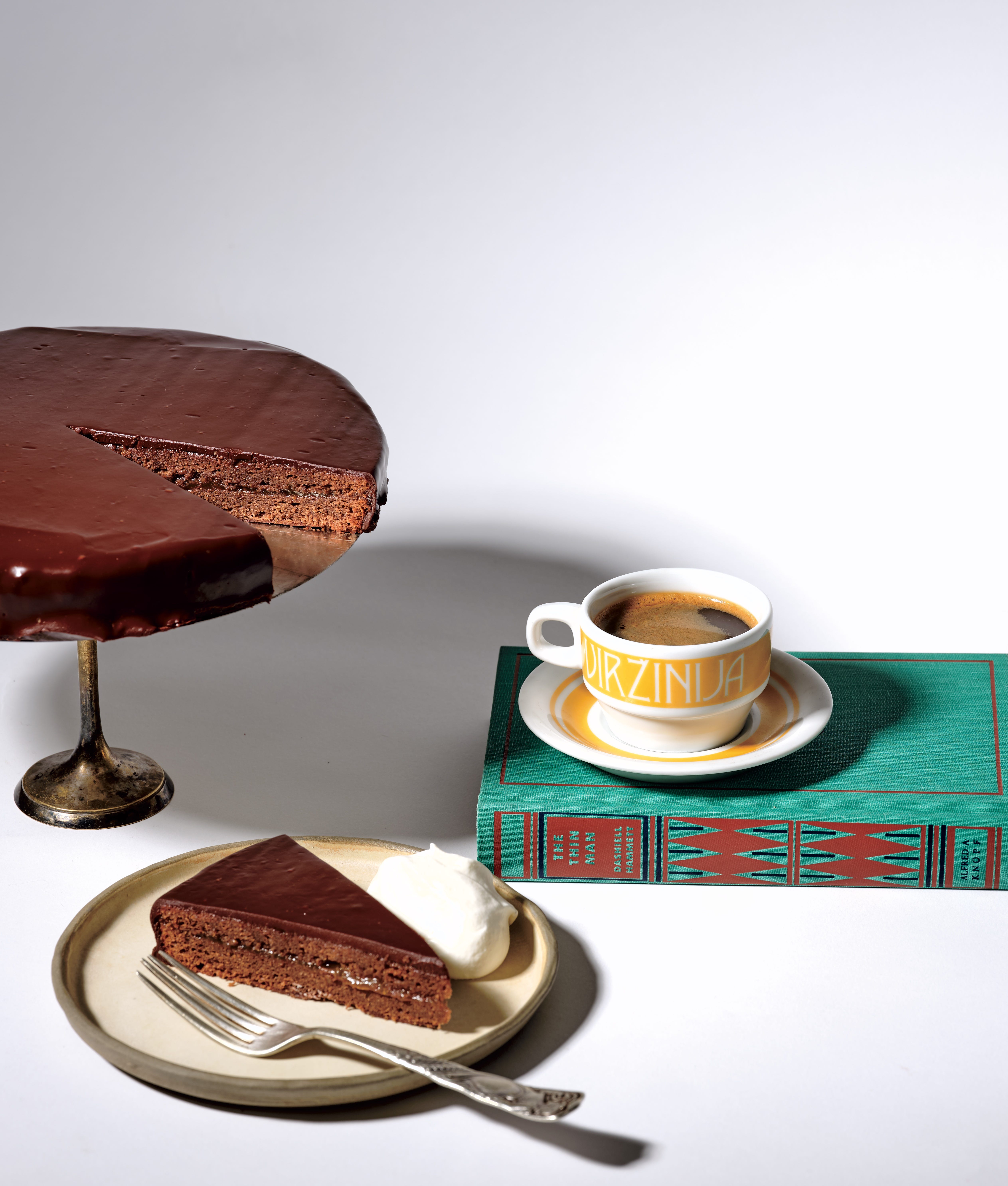
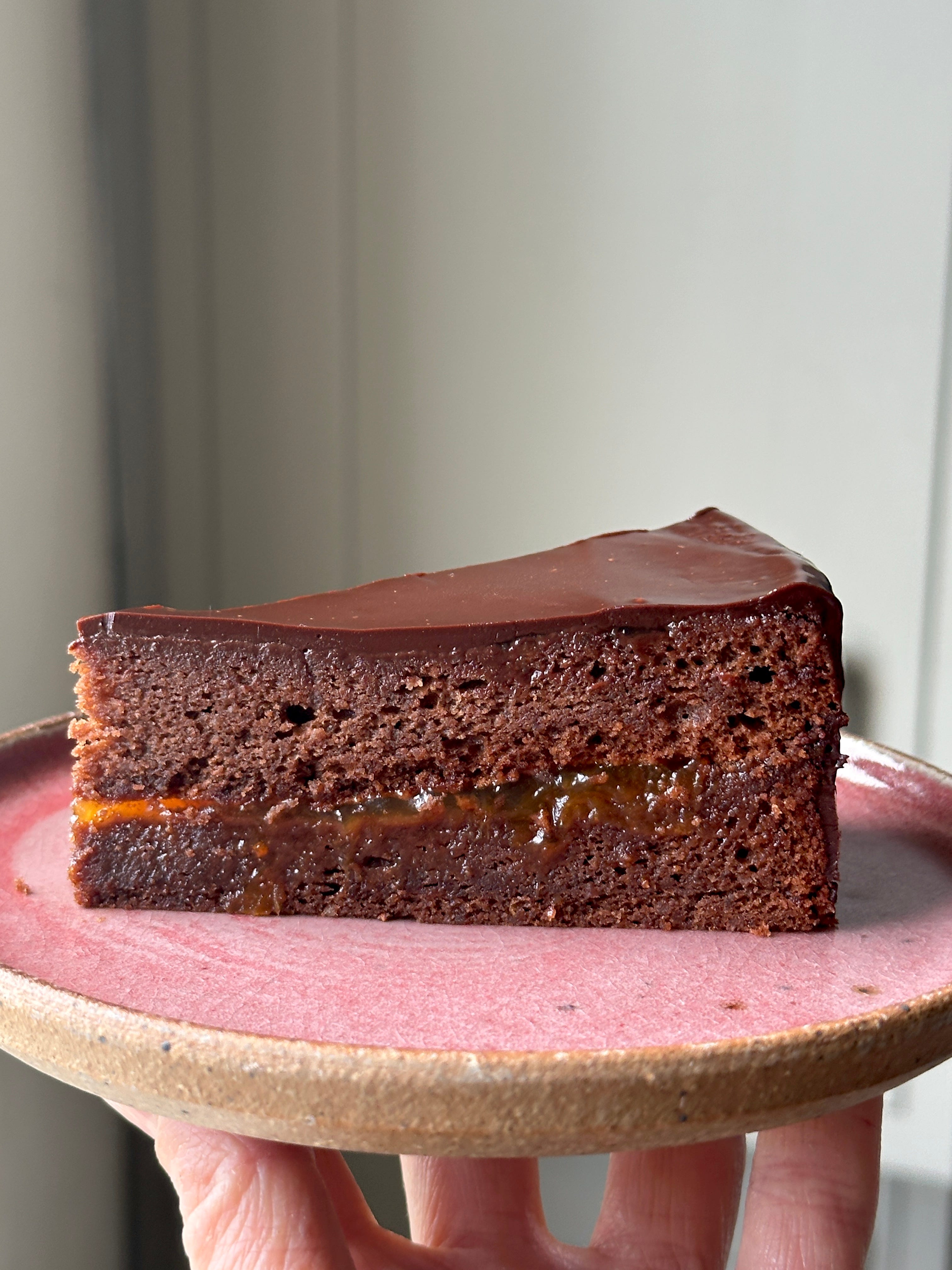
I’d had Sachertorte before. A chocolate sponge coated in a thin layer of apricot jam and a shiny chocolate glaze, it was at least at one time one of the most famous chocolate cakes in the world. A lover of classic European desserts, I’m sure my granny made one, but the memory is eclipsed, no doubt by her superlative Dobostorte. And I distinctly remember piping the signature “S” onto a shiny glazed cake in pastry school. But I’ve never been that huge a fan of chocolate—and even at that the Sachertorte can be, in modern terms, a rather unassuming cake. To quote Nigel Slater, “Many people find its elegant simplicity something of an anti-climax.”
That said, I couldn’t resist trying the real thing. Or was it the real thing? I’m not referring to the fact that I enjoyed mine in an airport outpost. Hotel Sacher ships the cakes all around the world. But while the recipe remains a closely guarded secret (though, hilariously, the hotel offers an admittedly inaccurate recipe on their website), two different establishments lay claim to the true original. Truly, one of the best things about testing Sachertorte recipes is that when someone tells you they wish there was a layer of jam in the middle of the cake, you can tell them there was an epic lawsuit to that effect.
The first story of Sachertorte’s creation goes that in 1832 Prince Metternich, Austria’s minister of foreign affairs, requested the creation of a special new dessert for a fancy dinner he was hosting. “Let there be no shame on me tonight!” he yelled (in German). The day of the dinner the head cook called in sick, and it fell to a second year apprentice, 16 year old Franz Sacher, to create a shameless cake. Thus was born the Sachertorte, at least according to Franz’ son Edouard, who some say invented the story to appeal to the imperial nostalgia of the Viennese.
Edouard, after all, had a stake in the Sachertorte’s legendary status as the owner of Hotel Sacher in Vienna. Whether the fame of the hotel spurred the fame of the cake or vice versa, it was certainly a symbiotic relationship.
The origin story offered by Franz Sacher himself is rather less exciting. He said that he created it for a catering business in Bratislava in 1840. Snooze! Though The Oxford Companion to Sugar and Sweets points out, “There is a certain logic to this. The cake is custom built to hold up to the stresses of catering. It need not be refrigerated and the glaze keeps it from drying out—the main reasons that the Hotel Sacher has been able to maintain a flourishing mail order business in the confection ever since the 1900s.”
But none of that is particularly controversial. The cake was wildly popular—even more so than the Linzertorte. It was in the 1920s, when the family was doing poorly, that they were forced to sell—the hotel to one owner and the recipe to another, both of whom unsurprisingly wanted to call their cake the original Sachertorte, much like an NYC outpost of Ray’s Pizza.
In 1938, just as the Nazis were marching in, the hotel was awarded the winner in the trademark dispute. After the war, however, Demel, the legendary Viennese café and owner of the recipe, brought the case to the Supreme Court. The argument hinged on whether the original recipe had a layer of jam in the middle or not. Though it was concluded that the original recipe had just one layer, the hotel could still call their two-layer cake the original. Demel responded by calling theirs the Ur-Sachertorte (translates to: original Sachertorte)! What a move.
Making the Torte
I obviously began my recipe development by going back to my variation on my grandmother’s recipe, which I published in my second book Jam Bake. Like my grandmother, I used ground almonds, a common torte ingredient that makes for a rich, moist crumb. Tortes are typically denser and shorter than cake, often using ground nuts or breadcrumbs instead of all wheat flour.
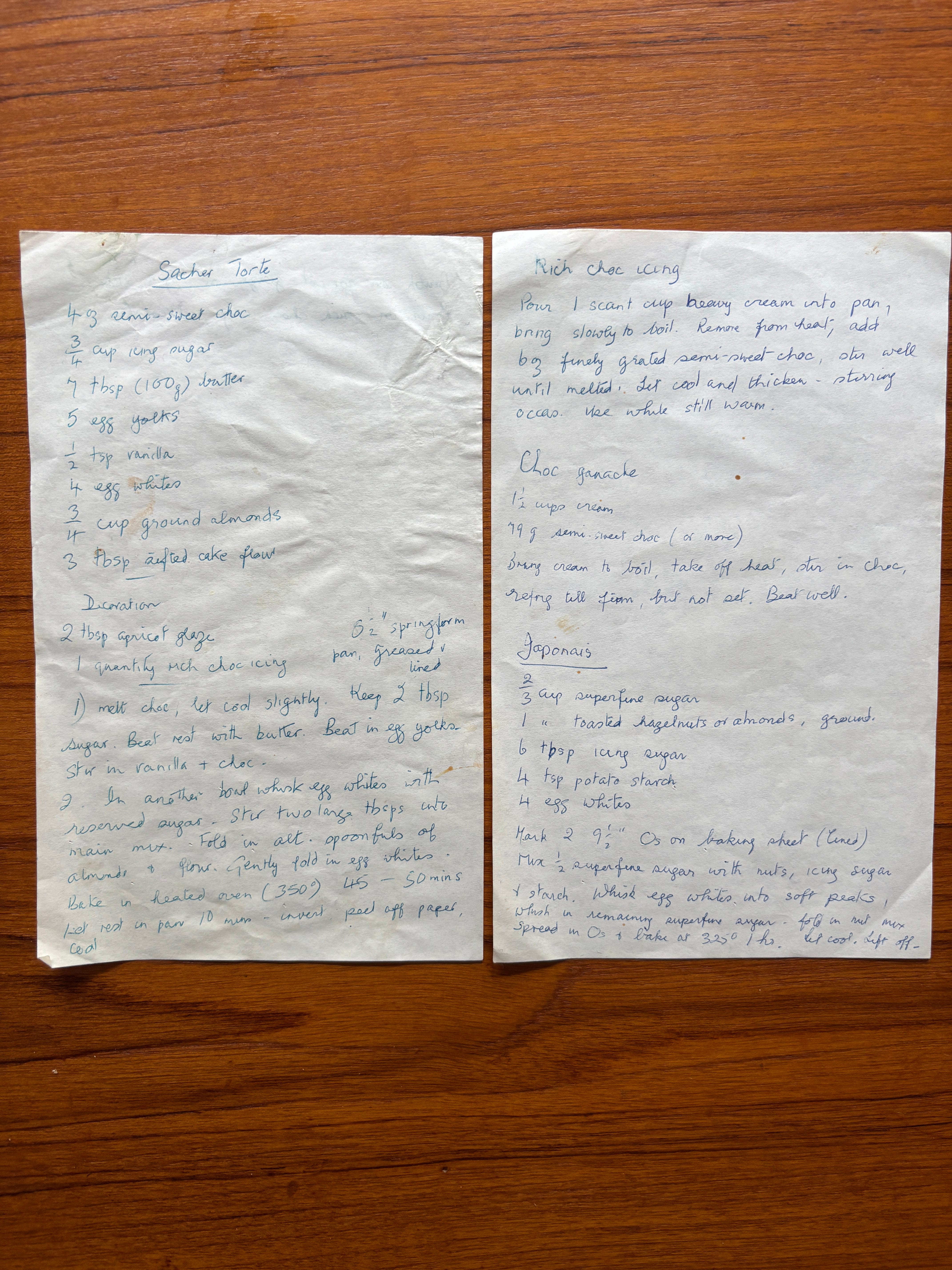
Turns out that’s not standard, though. The Austrian Food Codex, which has supplied definitions, compositions and standards for Austrian foods since 1891, stipulates that it must be a chocolate sponge covered in apricot jam and chocolate glaze. It can contain nuts, but only if the name of the cake is modified to disclose that fact. Almond Sachertorte, anyone?
Otherwise, my recipe was fairly standard—a batter enriched with melted dark chocolate, the eggs separated so the whites might be whipped to act as leavener. Baking powder was only invented in 1843, which is before the invention of the torte no matter whose story you subscribe to.
What of Texture?
It’s important to understand the Sachertorte as a keeping cake. Though many may presume the cake is made dry so that coffee houses might sell more coffee, the truth is that the drier a cake is, the longer it lasts (unless it’s been soaked in alcohol, fruitcake style). A pile of lightly sweetened whipped cream served on the side is thought to mitigate the dryness (though the director of the Hotel Sacher notes that it can also be served with Champagne, which would equally moisten the palate—at a cost.)
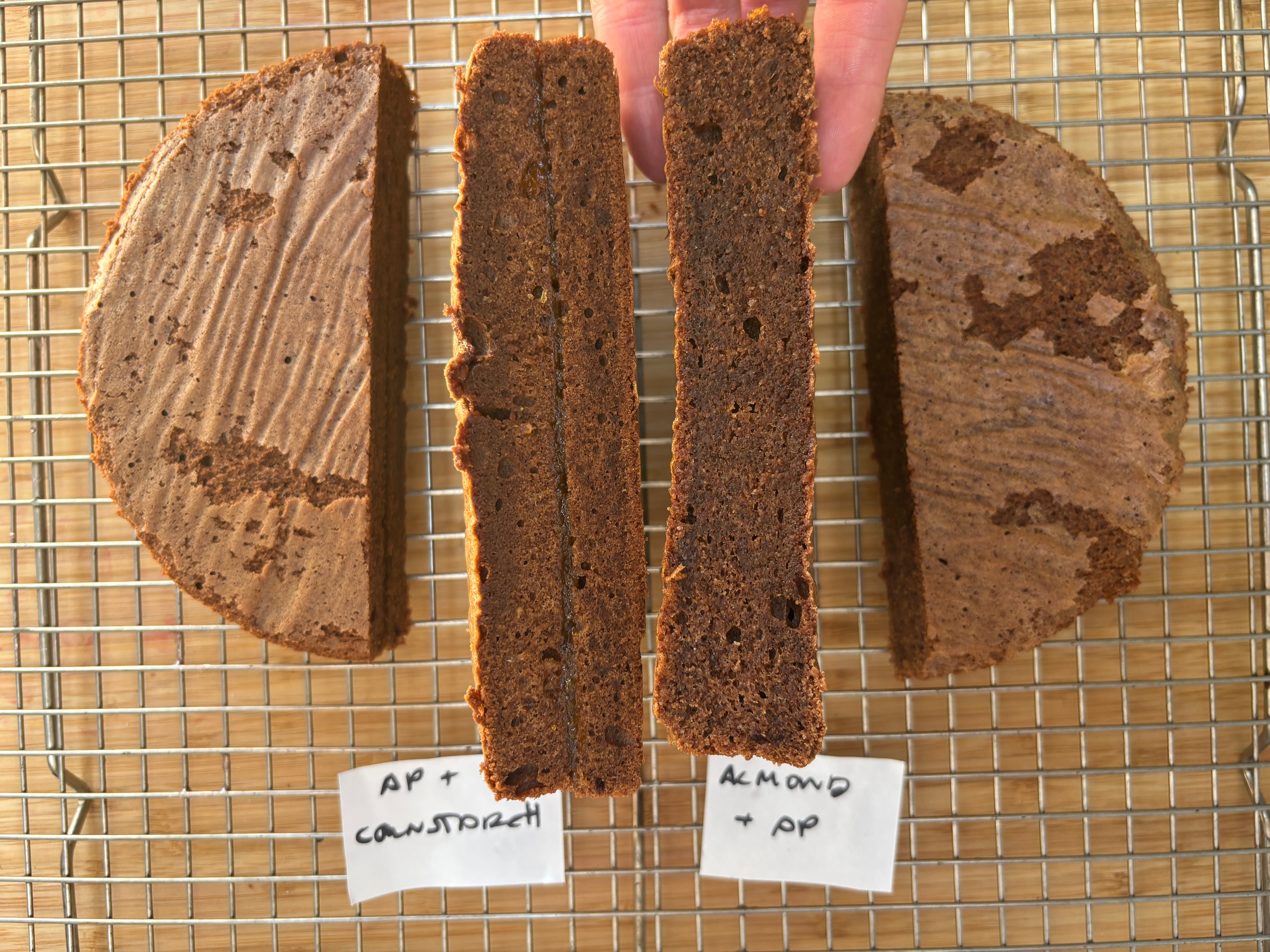
Rich ground almonds obviously create a plusher crumb, and at the risk of seeming pedestrian, I do prefer this version, but in the spirit of hewing more faithfully to Sacher’s version (and the Codex!), I tested using flour—though I have given you both options in the recipe that follows.
In her Sachertorte deep dive, Felicity Cloake notes that cake flour is likely used in the original, but not the cake flour we would find in North America or the UK. Apparently a good substitute for what you’d find in Vienna is all-purpose flour mixed with a little cornstarch.
Subbing about 15% of the flour for cornstarch made for a tender crumb—at 10% it was too dry. I slightly increased the butter and chocolate in my original recipe to make up for the lost almond fat.
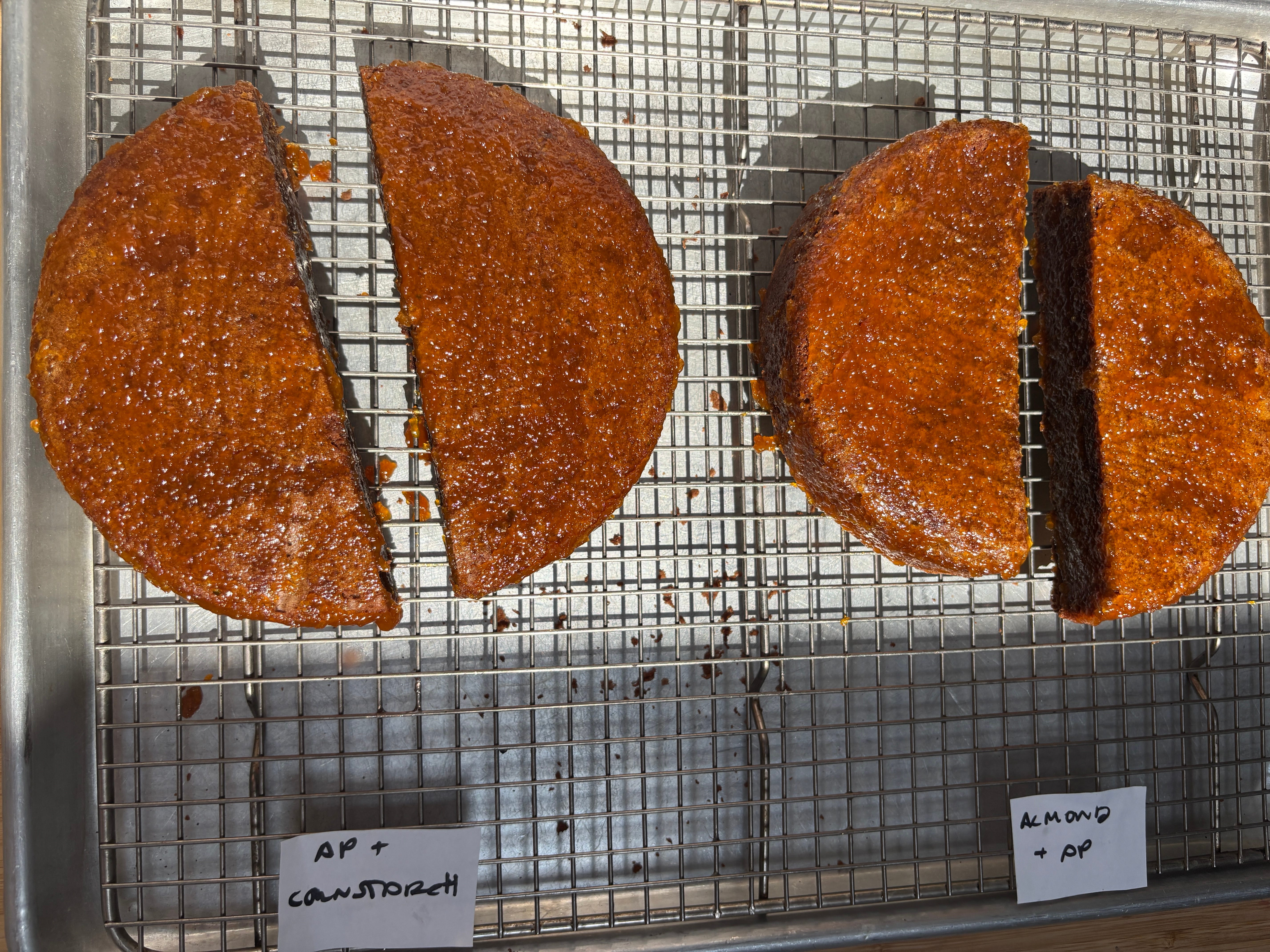
The great legal question of whether the jam goes in the middle as well as on top also affects texture significantly, as does the manner of application. An added layer of jam in the middle of the cake lends more moisture, which I like texturally, but it also threatens to outweigh the chocolate flavor, which some may find upsets the balance. Again, preferring fruit to chocolate, this is fine by me.
The jam is applied to the top and sides of the cake, locking in some moisture, but of course a warmer, looser jam will absorb more readily into the cake, softening it, while a jam warmed just enough to be spreadable will only serve to seal in the moisture already present. A commenter on Cloake’s Guardian piece mentioned his grandmother’s secret to the best Sachertorte, which was to heat the jam with water before applying, for maximum moisture absorption. Some also brush the cake with a rum syrup, which adds another layer of preservative.
The Jam in Question
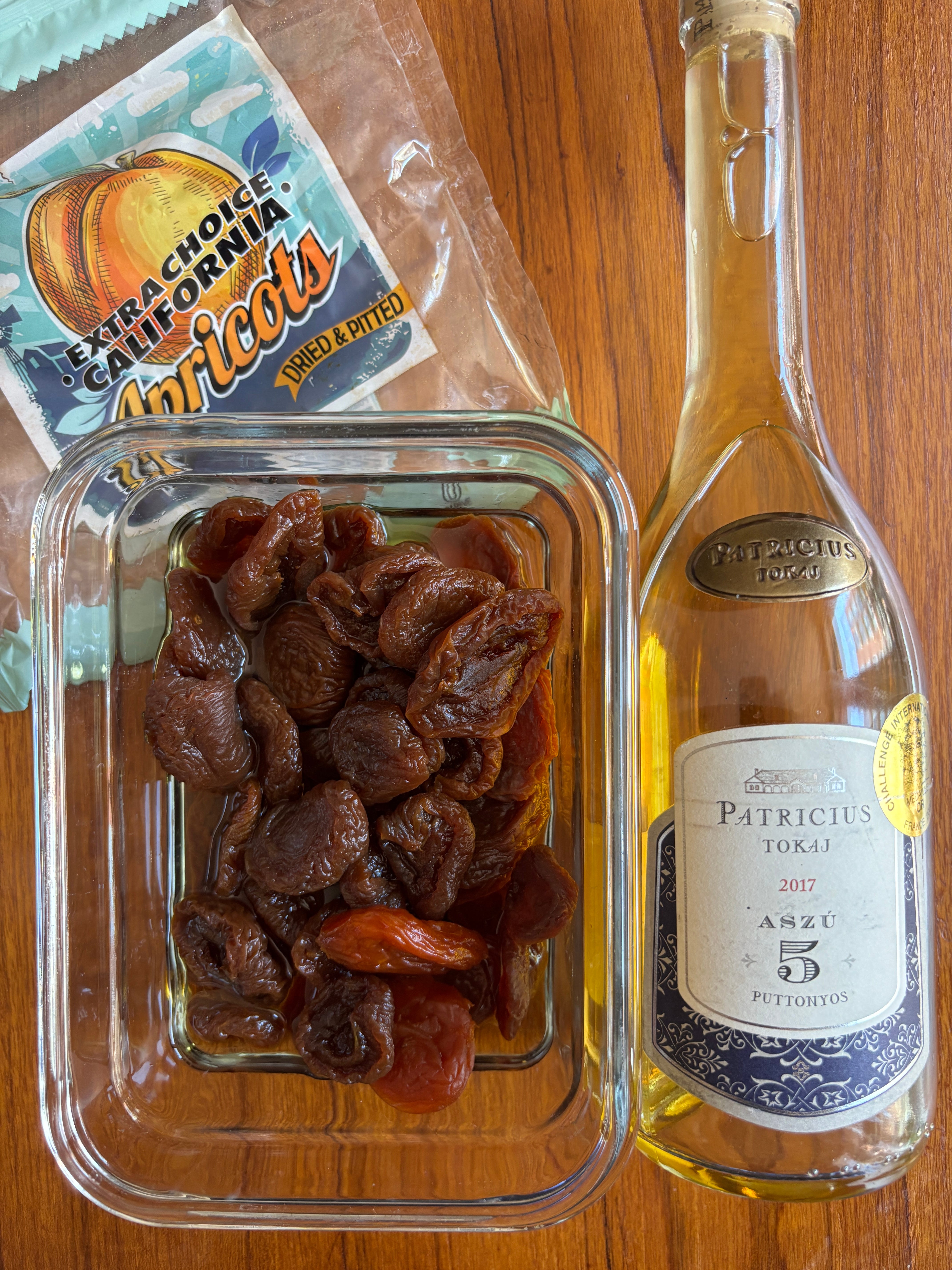
A smooth apricot jam is traditionally used in Sachertorte, though you can warm and sieve a chunkier one. A smooth texture is important, as the jam coats the whole cake, which is then bathed in chocolate glaze, which you don’t want a bunch of apricot chunks poking through. In Jam Bake, I used my Dried Apricot & Verjus Butter, which is nice because, as it’s made of dried fruit, you can make it anytime you have a Sachertorte craving even if you don’t have apricot jam in the house and apricots aren’t in season. You know me—anything to avoid store-bought! (Just kidding, feel free to use a quality store-bought jam if you must.)
Looking back, however, I wondered if acidic verjus was the right addition in this context—perhaps it lent too much acid to the already acidic chocolate? Having been recently gifted a bottle of nice tokaji, a new apricot butter emerged. A beautiful sweet wine, it adds preservatives in the form of both sugar and alcohol, as well as a complex flavor that both complements and reflects the apricots. Now, I know tokaji is Hungarian not Austrian, but considering they were once collectively known as the Austro-Hungarian Empire, I thought close enough.
That said, you could substitute another sweet wine, such as sauternes or baumes de venise. Even rum could be fun to try out if you’re a fan. Can’t hurt to brush the cake with a little of whatever you’re using before applying the apricot butter, either.
And to Encase?
I have to say, the most fascinating bit of testing here was the chocolate coating. Many modern recipes employ what basically amounts to ganache, an emulsification of chocolate and cream, but the original was likely made of chocolate and sugar syrup. I also read about someone who added lukewarm water to melted chocolate until the consistency was right. A simple glaze of chocolate and melted butter is common as well.


My Sachertorte in Jam Bake is a ganache made with cream thinned with a little rum for flavor and touch of honey, an invert sugar, to keep the ganache soft and silky. But clearly it’s as unfaithful to the original as my ground almonds! I decided to test all four coatings and rate them on the basis of appearance (do they make a uniform coating that’s shiny and sleek?); taste; pourability (aka the ease of glazing); and preservation (how well does the coating hold up over many days at room temperature?).
For my first attempt for the sugar syrup-based glaze, I used the recipe from the Hotel Sacher website. A cockup indeed! Cooking a heavy syrup for five minutes (minutes! No other indication!) is a fool’s errand, only good for promoting immediate crystallization once the chocolate is added. Instead, for future tests, I simply thinned melted dark chocolate with hot simple syrup until it was pouring consistency. The same went for the water-based glaze.
For the butter glaze, I settled on 30% butter, right in between Cloake’s 40% and Nigel Slater’s 10%.

Now as you’ll see above, ultimately what you use depends on your ultimate plan with regards to your torte. If you plan on keeping it for over a week, butter glaze certainly wins. Even after 12 days in high summer, it tasted good, just developing a few little beads that I think were cocoa butter rather than mold (I hope). The syrup glazed fared worst in terms of longevity, looking a bit like the Crypt Keeper on day 12. Perhaps I should’ve used a heavier syrup, but I feel the result would’ve been too sweet. Consider these photos of the cake through the days:
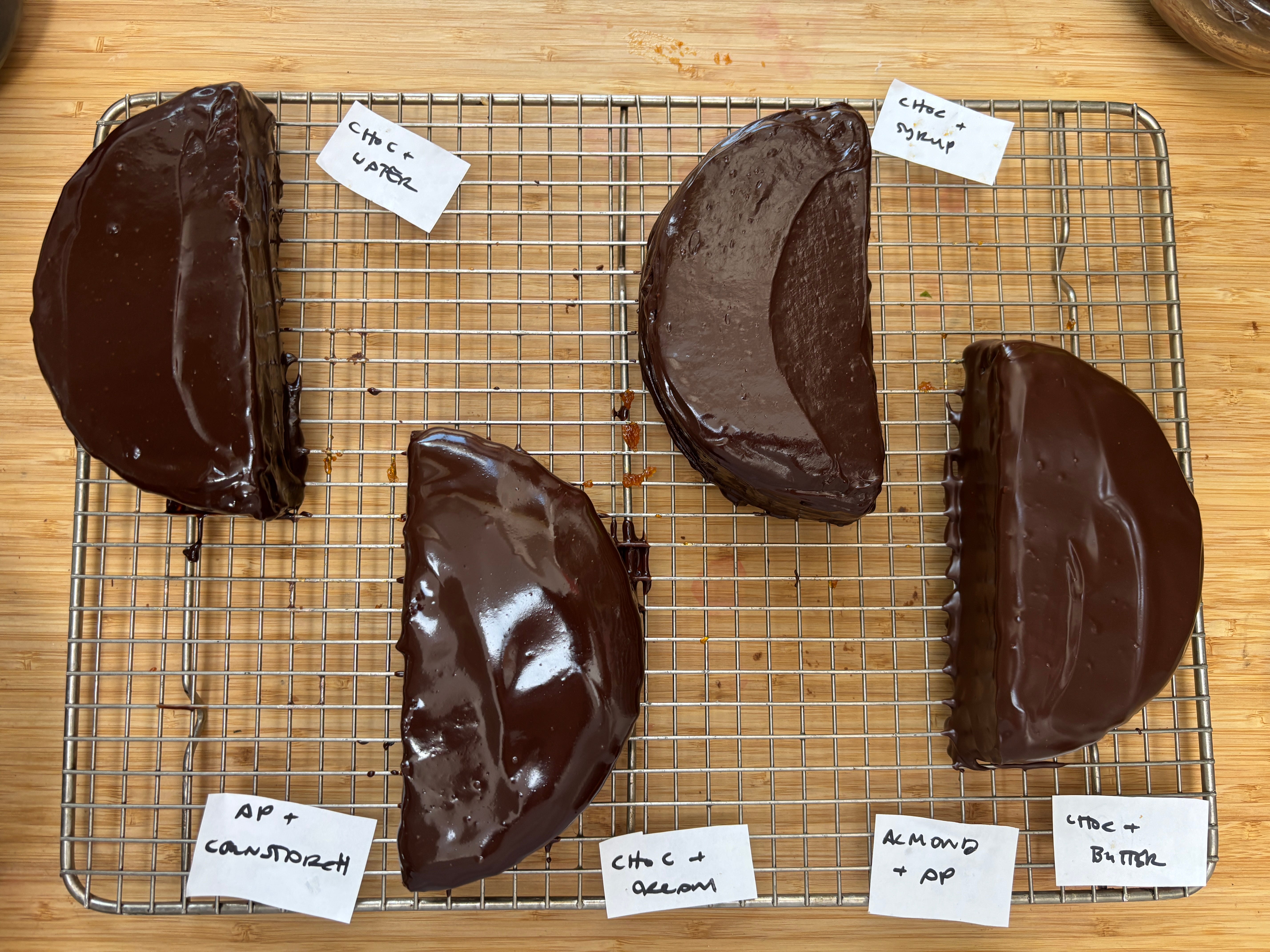
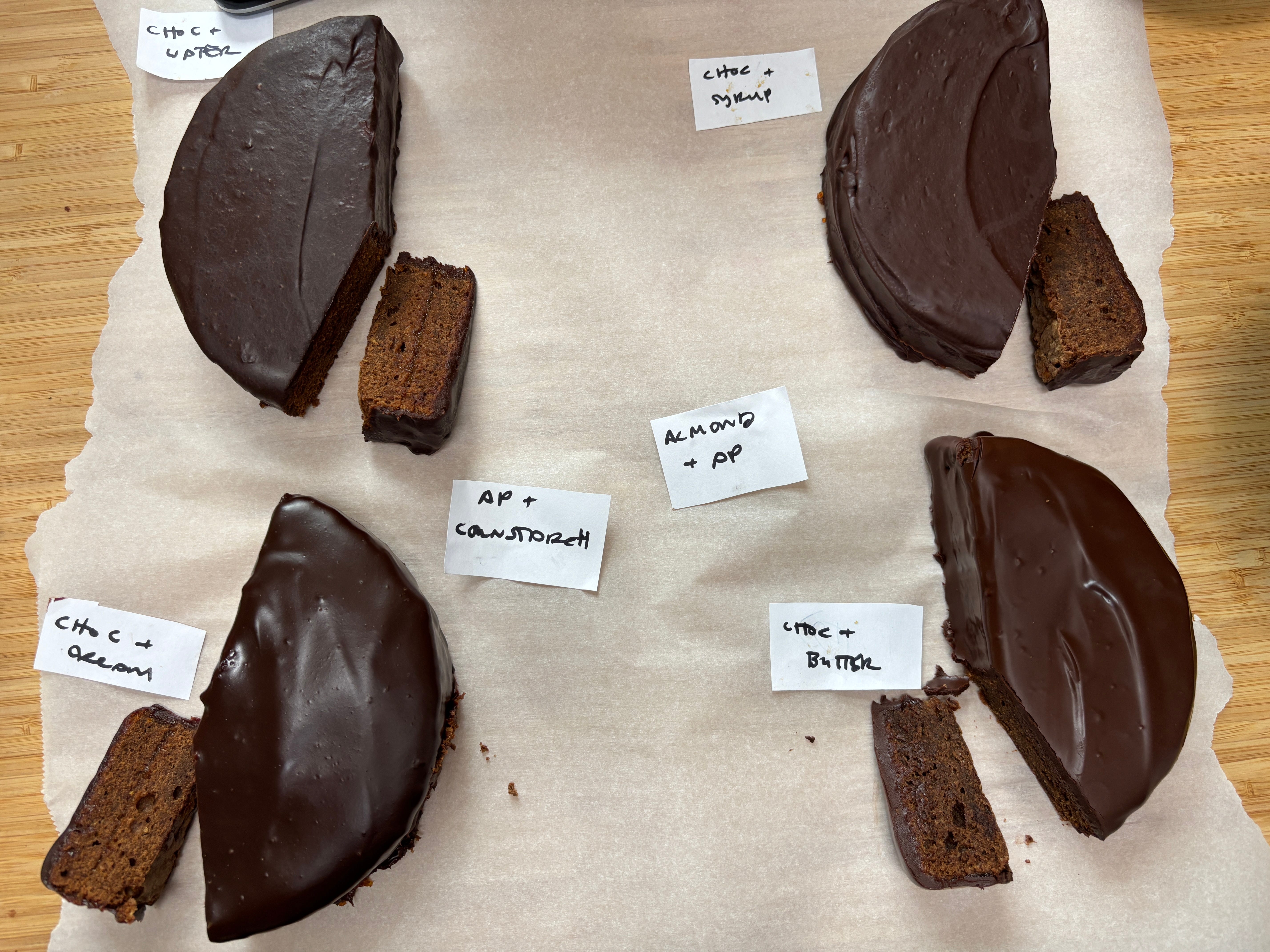
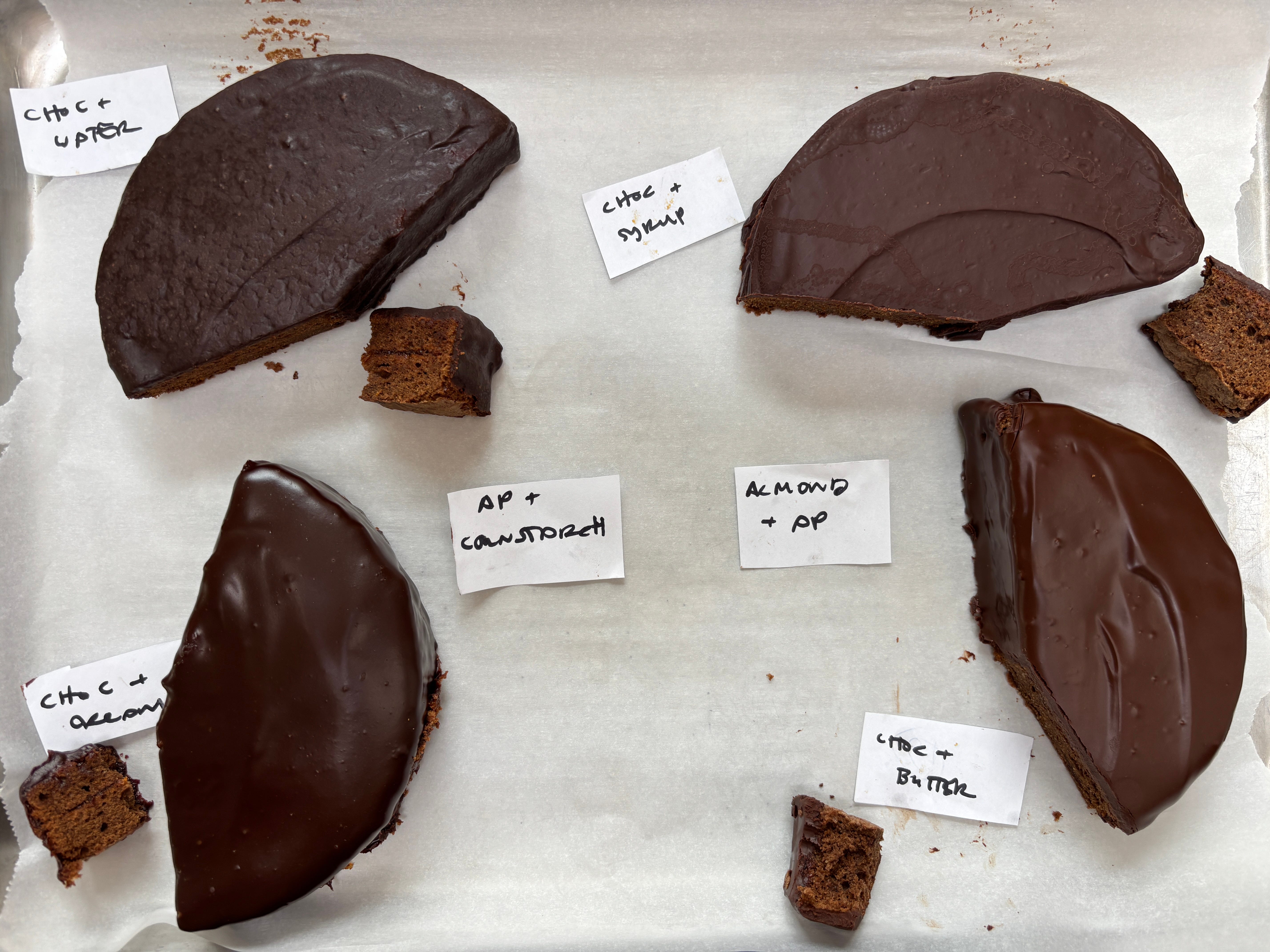
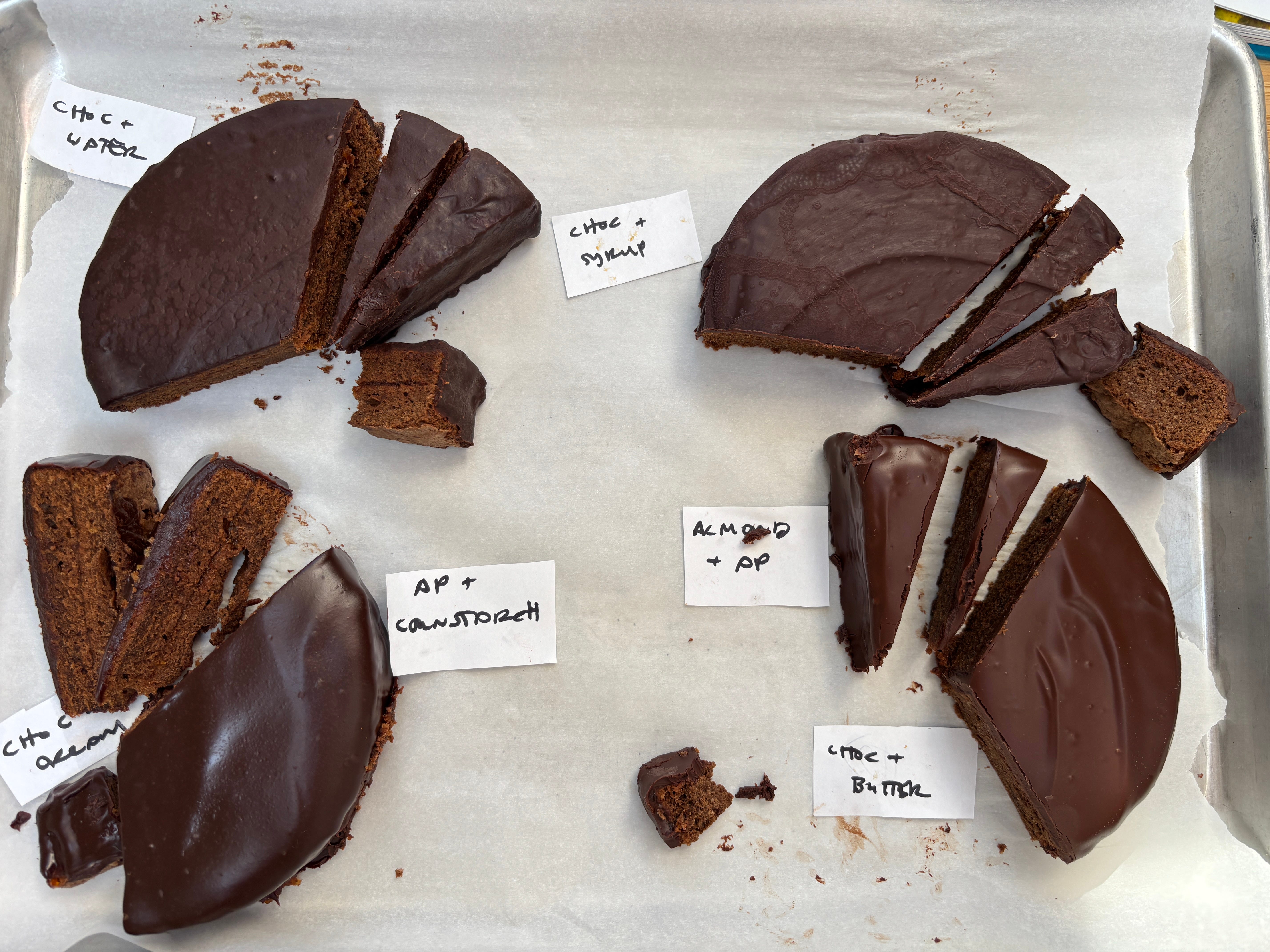
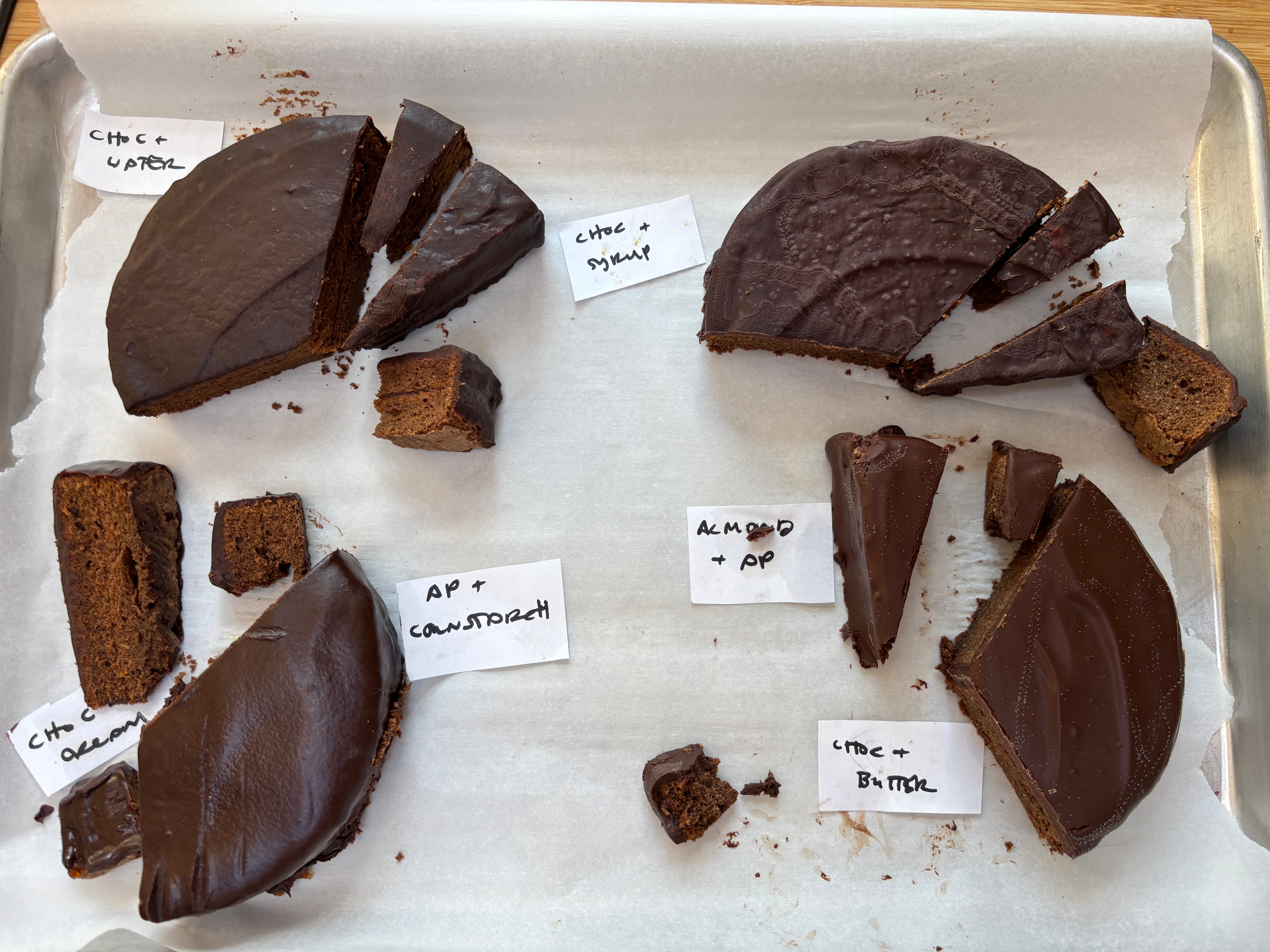
In terms of looks, if you like your tortes shiny, butter or cream is the way to go. The water and syrup both dried down to a rather unappealing matte, while adding fat had the same result as feeding omega 3s to an animal for a shiny pelt. The cream glaze actually stayed glossy until day 12, but the taste became unpleasantly funky.
Every now and then it is good to put your beloved recipes up to the test, to make sure they’re really good rather than just a habit or a product of sentimentality or laziness. I’m happy to say that, at least in my opinion, my granny’s original chocolate glaze scored highest in all categories but preservation, though it did hold up for longer than I expected.
As for piping, the cursive ‘Sacher’ or ‘S’ may be what definitively marks it as a Sachertorte… but I don’t ever do it!
Unconclusively
Ultimately, unless you subscribe rigidly to the Codex, a Sachertorte is a bit like life—choose your own adventure. There are a few good options for every element. Nut allergy? No problem, the more orthodox flour and cornstarch version is excellent. Store-bought apricot jam? Sure, ok. Butter- or cream-based glazes both have their virtues. From there, the general idea of a Sachertorte might take you anywhere!
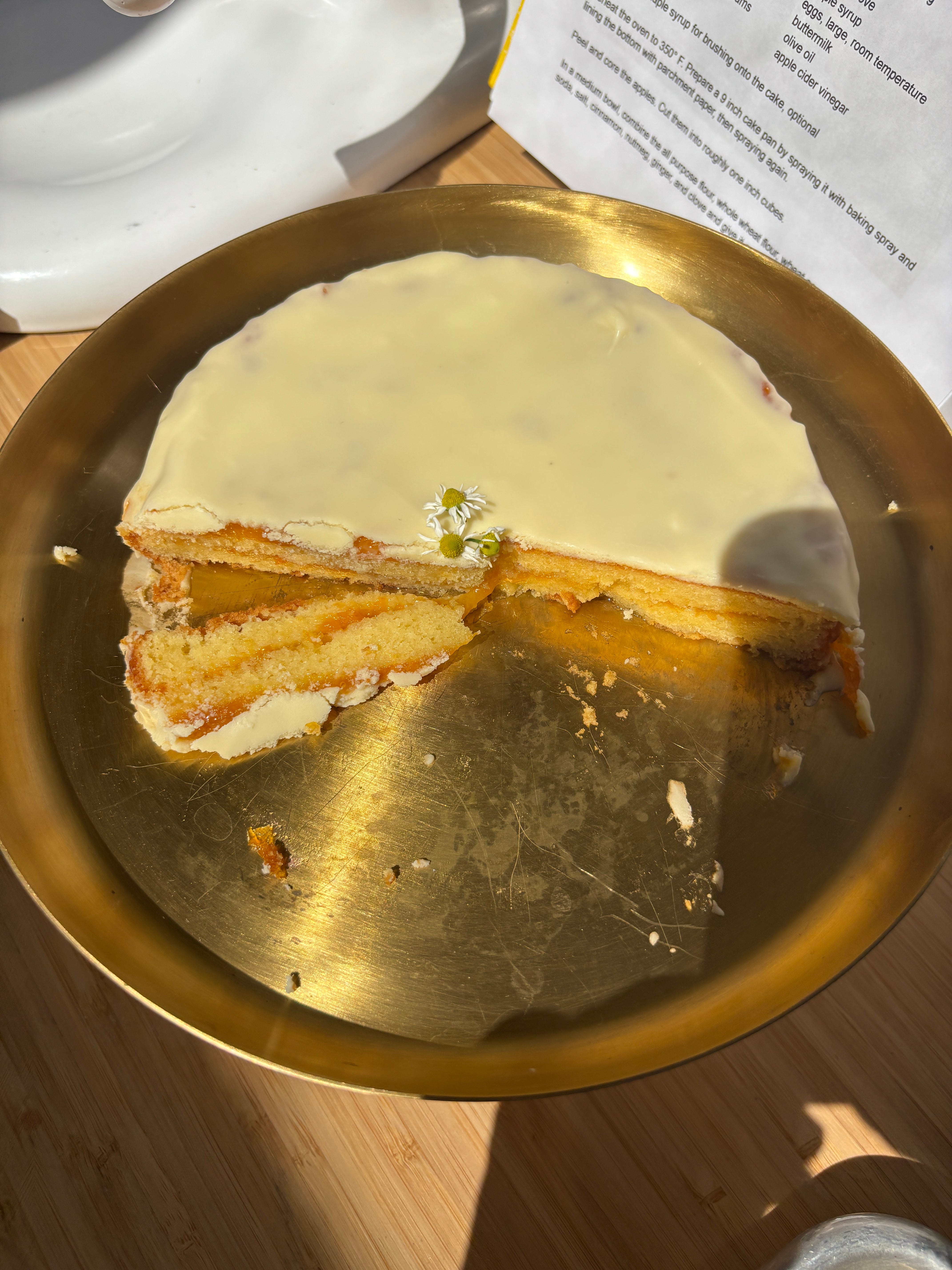
I tried a white chocolate version sweetened with honey and coated with apricot, honey and chamomile jam, with a fresh chamomile flower as minimalist décor (though you could also use a bunch to create the signature “S”).
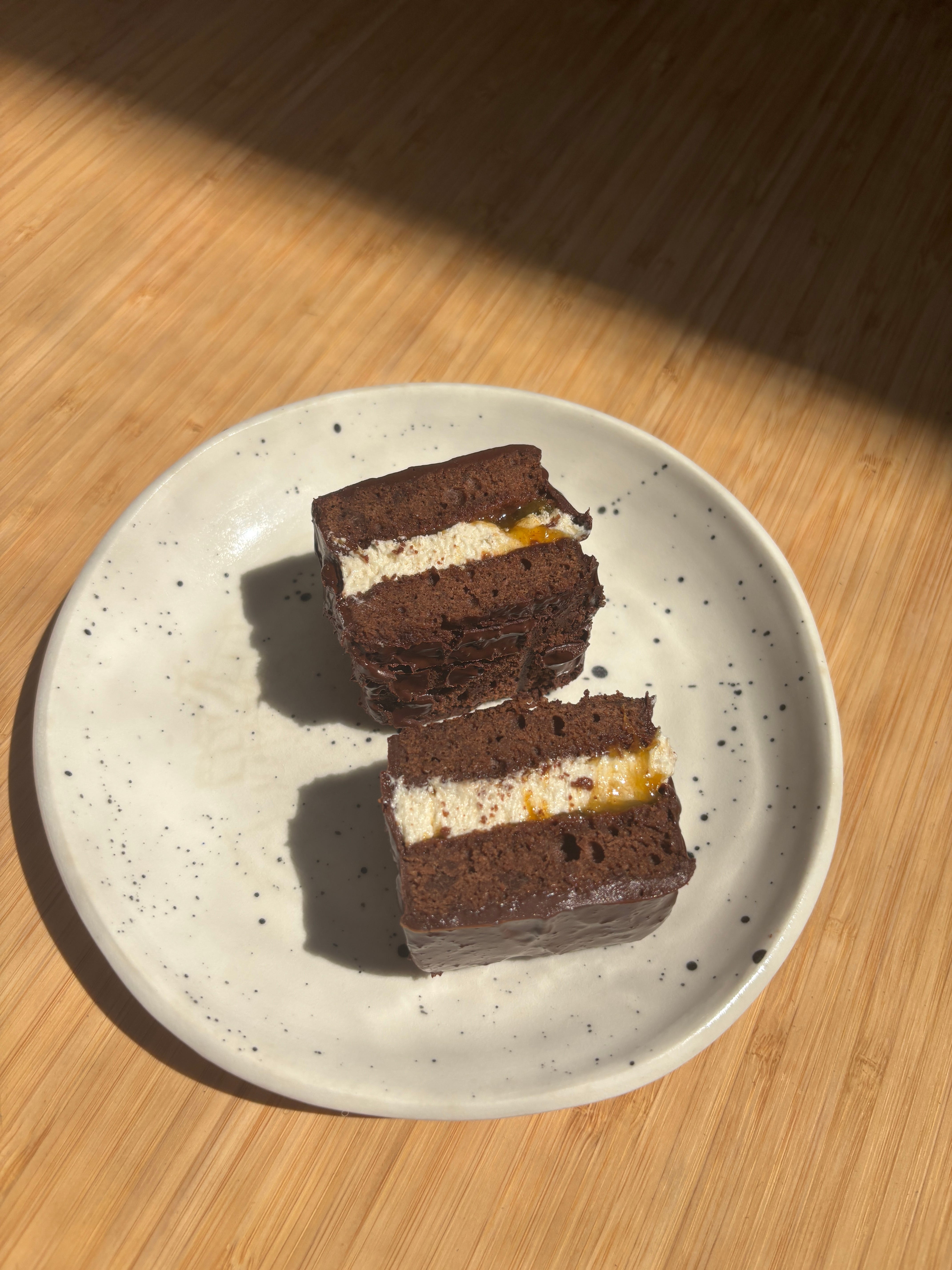
In my research, I came across Japan McDonald’s version of the Sachertorte, which was sold under the moniker Mc-Vienna Treat! That got me thinking about what the torte has in common with our modern day convenience store snack cakes, and I created my own. I baked the batter more thinly in a rectangular pan, sandwiched it with whipped cream buttercream and apricot jam, cut it into snack-sized portions and dunked it in chocolate. It might not really be Sachertorte—but no one is truly sure what is, anyway.
RECIPE: Sachertorte
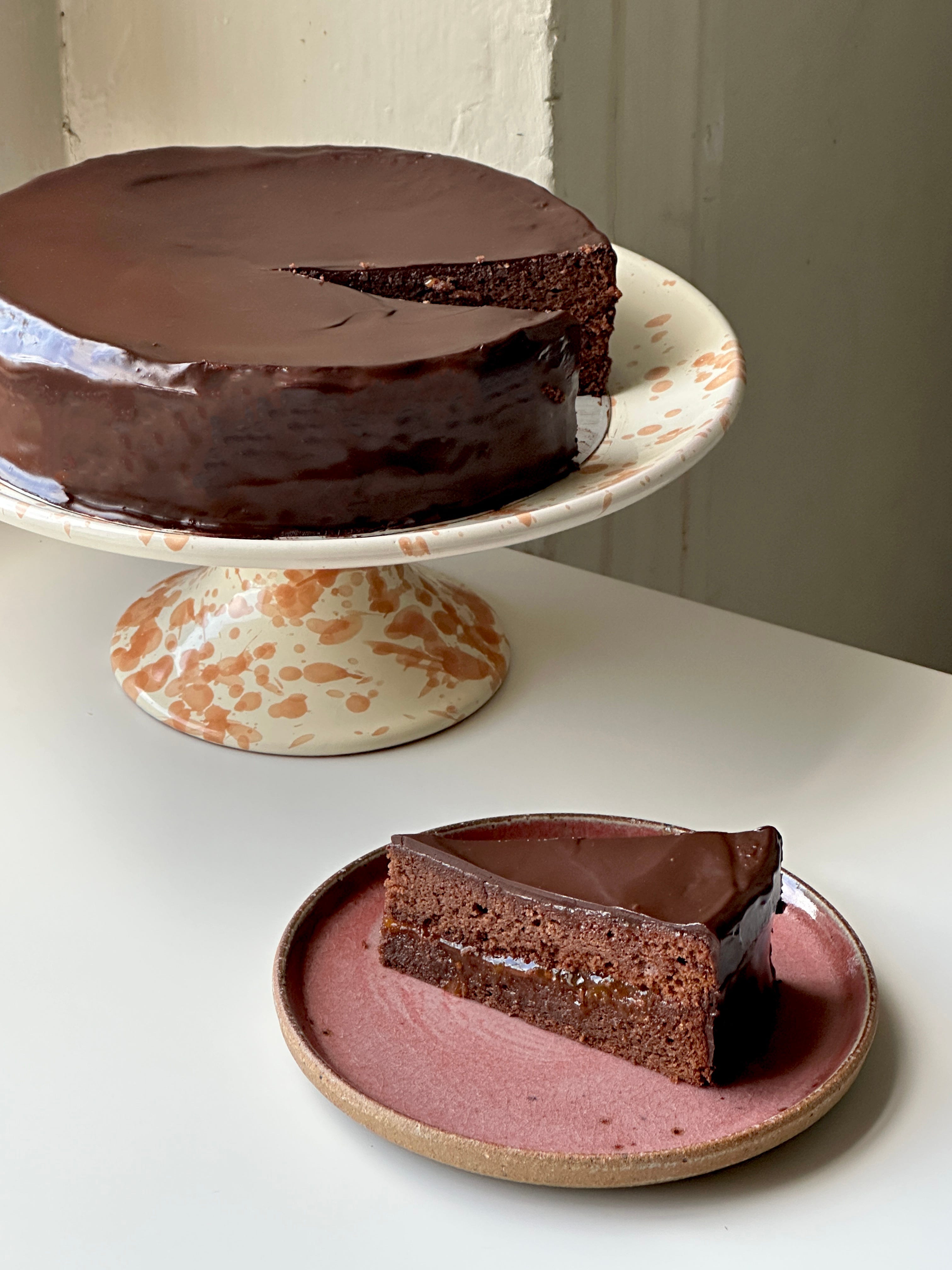
Dried Apricot & Tokaji Butter
Makes around 400 g
Ingredients
112 g dried apricots (preferably Blenheims)
75 mL tokaji + 1 tsp (or sub your favorite sweet wine)
150 g sugar
150 mL water
1/4 tsp citric acid
Method
Combine apricots and 75 mL tokaji in an airtight container and allow to soak overnight, shaking now and then.
Puree the apricots, which should now be very plump, having absorbed nearly all the liquid, in a blender, thinning with some of the water if necessary. Transfer puree to a wide pan and add sugar and water. Heat on medium-high and boil, stirring frequently and gradually reducing the heat as the mixture thickens and sputters.
The fruit butter should thicken enough that you can draw a line across the bottom of the pot with your spatula that takes a moment to close back up. Put a spoonful on a plate and wait a few minutes. If the fruit butter slumps and spreads, it’s not done. We want it to sit in a stoic mound, like a mountain. As well, look at its edges. When enough water has yet to evaporate, there will be a ring of transparent liquid that forms around it. When this ring is absent or just razor thin, it’s done. This should all happen quite quickly as it’s a small batch.
When the fruit butter is ready, remove from heat and add the citric acid and remaining tsp of tokaji. Fruit butter will keep in the refrigerator in an airtight container for at least 3 months.
Choose-Your-Own-Adventure Sachertorte
Makes 1x8-inch cake
For cake:
125 g dark chocolate
110 g unsalted butter, room temperature
5 eggs, separated
110 g sugar, divided
75 g all-purpose flour
15 g cornstarch*
¼ tsp salt
*Alternatively, use 90g almond flour, reduce AP flour to 25g and omit cornflour
To finish and glaze:
150 g Dried Apricot & Tokaji Butter (or smooth apricot jam)
190 g whipping cream*
175 g dark chocolate,melted
1 tbsp tokaji
1 Tbsp honey
*If you only have access to double cream, use 150ml double cream, 40ml milk
Method
Preheat oven to 350°F/160c Fan/180 conventional. Grease an 8-inch round pan and line the bottom with parchment paper.
In a heatproof bowl set over a pot of simmering water, or in the microwave in 30 second bursts, melt chocolate. Set aside.
In a large bowl, cream butter and 80 g sugar until light and fluffy. Beat in egg yolks one at a time. Stir in melted chocolate until combined then fold in flour, cornstarch (or almond flour) and salt.
Whip egg whites until frothy, then gradually add remaining sugar and beat until stiff peaks form. Fold third of the whites into the chocolate mixture to lighten it, then gently fold in remaining whites.
Scrape into the prepared pan and bake until the cake begins to pull away from the sides of pan, about 25-35 minutes, and a toothpick inserted in the center comes out clean. Cool for 10 minutes on a wire rack before unmolding and peeling off parchment. Cool completely.
Cut the cake into two layers using a serrated knife (if you like a more pronounced apricot flavor—if not just cover the intact cake). Gently warm the apricot butter in a small pot or in the microwave. Spread the bottom layer evenly with apricot butter, spreading all the way to the edges. Place the top layer, then coat the entire cake top and sides in a thin layer of apricot butter.
To make the glaze, heat the cream until warm in a small saucepan set over medium heat or in the microwave. In a medium bowl or large measuring cup, combine warm cream, melted chocolate, honey and tokaji. Whisk until smooth and emulsified.
Set the cake over a wire rack with a rimmed cookie sheet underneath. Pour the glaze over the cake, using an offset spatula to help it flow evenly over the sides. If your kitchen is even moderately cool you can allow it to set where it is, otherwise carefully transfer it to a serving platter and refrigerate at least half an hour to allow the glaze to set.
Serve slices accompanied by a mound of unsweetened whipped cream and a cup of strong coffee.
Sachertorte will keep at room temperature for at least 5 days.
Some varieties of apricots you can still find in Austrian villages make a very aromatic jam, sweet by itself and at the same time so sour that your teeth hurt. I suppose most of the sourness of these apricots is contained in their thick skin, which completely disintegrates during cooking. With these apricots, there is no need to add any pectin or citric acid - unfortunately the more modern, industrial varieties of apricots don’t have much taste, so manufacturers “build” the taste using sugar and citric acid. The only acceptable industrial jam you can get in a supermarket in Austria is the limited edition Staud’s Wien Marillen aus dem Venusberg Garten der Familie Schauer Willendorf Wachau.
The first time I had sachertorte, it had a raspberry filling--from Saraghina Bakery in Brooklyn. Changed my life! The blonde version here looks equally fantastic. Might have to give that one a go.