
Kitchen Project #166: Torrijas (Spanish French Toast)
Bread + milk, what's not to love?

Hello,
Welcome to today’s edition of Kitchen Projects. Thank you so much for being here.
Today, I am very excited to tell you all about Torrijas. It’s probably one of the things I look forward to most when eating in San Sebastian, and I couldn’t WAIT to get home and deep dive into this gloriously sticky cousin of French toast.
On KP+, I’ve created a torrijas adjacent wet cake in the form of a Torrijas Tres Leches with a caramelised, brulee’d top. It has all the spicing of Torrijas with a gorgeous, dramatic crunch! Click here for the recipe. I’ve also shared my top 5 bites of San Sebastian, so if you’re travelling there soon, check them out here!
What’s KP+? Well, it’s the level-up version of this newsletter. By joining KP+, you will support the writing and research that goes into the newsletter (including the commissioning - and fair payment - of all the writers), join a growing community, access extra content (inc. the entire archive) and more. Subscribing is easy and only costs £6 per month or £50 for the whole year. Why not give it a go? Come and join the gang!
Love,
Nicola
Introducing: THE SIFT BOX
Before we get into it… I am very delighted that chocolatier Octavia Lamb (no relation, tho we are kindred spirits in all things sugar) is doing a very special limited edition drop of chocolates this easter. You might know her from fantastic newsletters such as All About Gianduja and her deep dive on white chocolate - and if you’ve made her recipes or ordered her chocolates, you’ll know just how brilliant she is. I couldn’t be more excited that her next drop is.. a SIFT BOX!
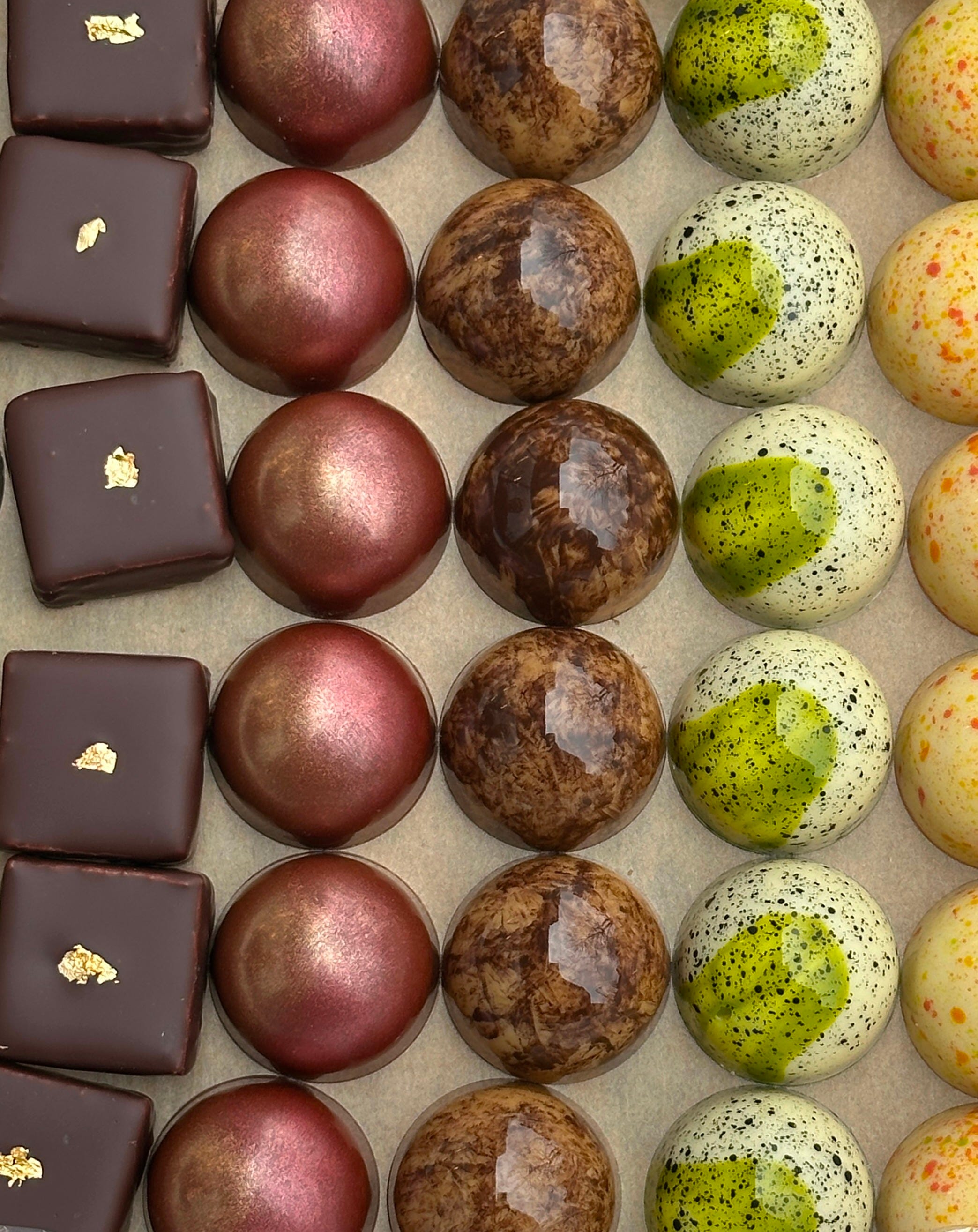
Yes friends, Octavia is dedicating one of her one-off handmade chocolates inspired by… yes, my book SIFT! How unbelievably cool is that? You’ll get a selection of chocolates in six different flavours, which are all ridiculously perfect and will arrive in time for Easter.
From croissant praline (I am going to be making the croissants on pg. 298 for this, of course!) to Salted Vanilla & Pistachio (the cake on pg. 243) to an Olive oil cake and cream cheese dome (pg. 241), I am so excited for you to dig into these. These will go on sale officially tomorrow, but orders are open to KP+ subscribers now (who also get an exclusive 10% off as a gift from me if you order today!) Click here for more details.
Let’s talk Torrijas
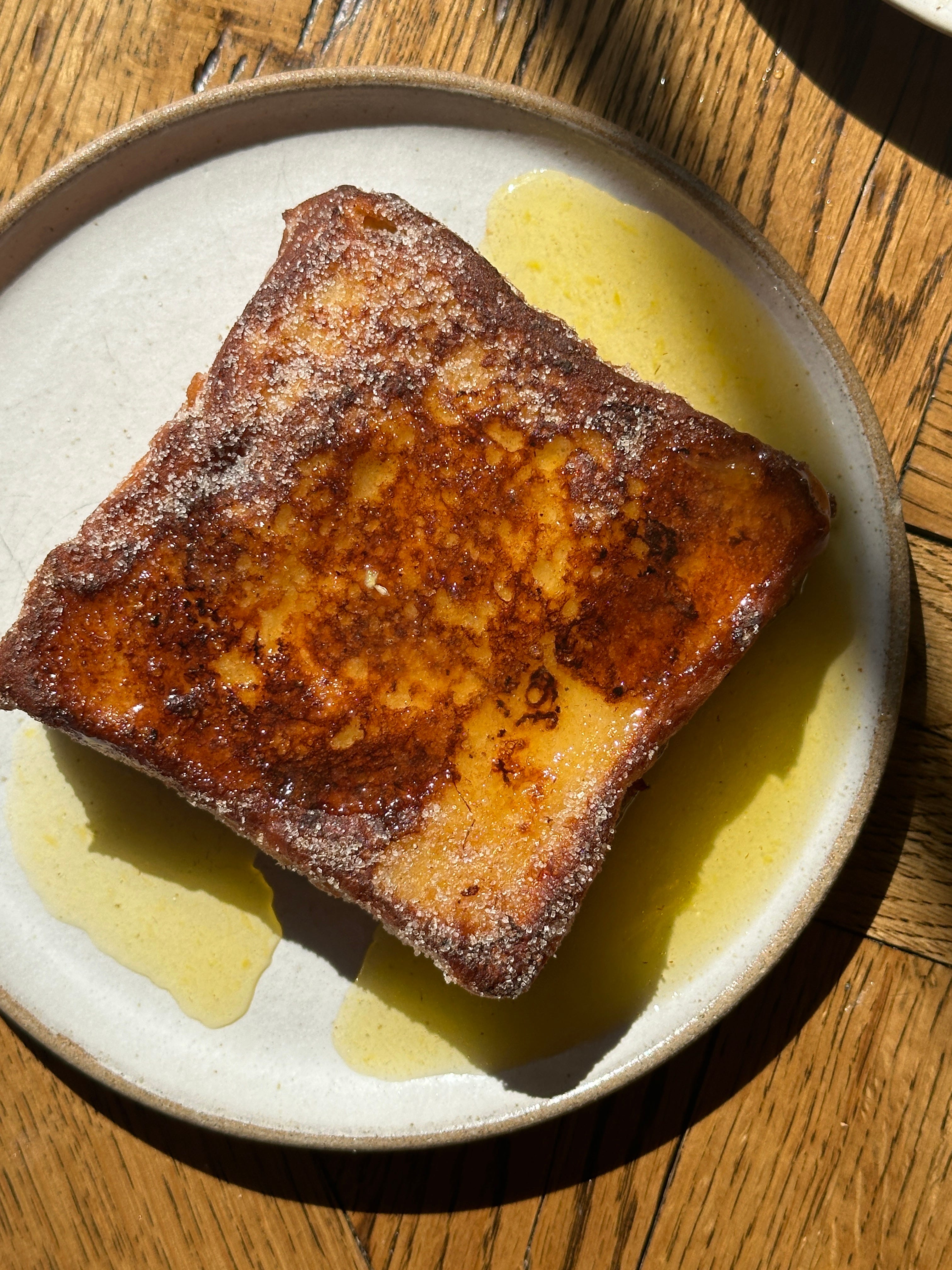
The first time I tried Torrijas (pronounced tor-EE-has) I was having one of those dream holiday scenarios that you think only happen in Richard Curtis films. Pitched up at Bar Ganbara in San Sebastian, my boyfriend (now husband) and I were eager eaters but untalented Spanish speakers. Despite the helpful and welcoming staff, Ganbara was - as ever - heaving and to get your order in, you needed confidence. Our tactic of pointing and smiling got us quite far, but it wasn’t until the group to our right, whose English was as extensive as our Spanish, took pity on us that our meal really got going.
So began an epic charades session and, eventually, an enthusiastic back-and-forth dish and drinks sending that (somehow) culminated in mutual Torrijas ordering come dessert. Truthfully, when it arrived, I had no idea what it was. It looked like a loose battered omelette with a scoop of ice cream on the side. It was hot from the fryer and had a neat dusting of cinnamon in a line down the centre. I dug in.
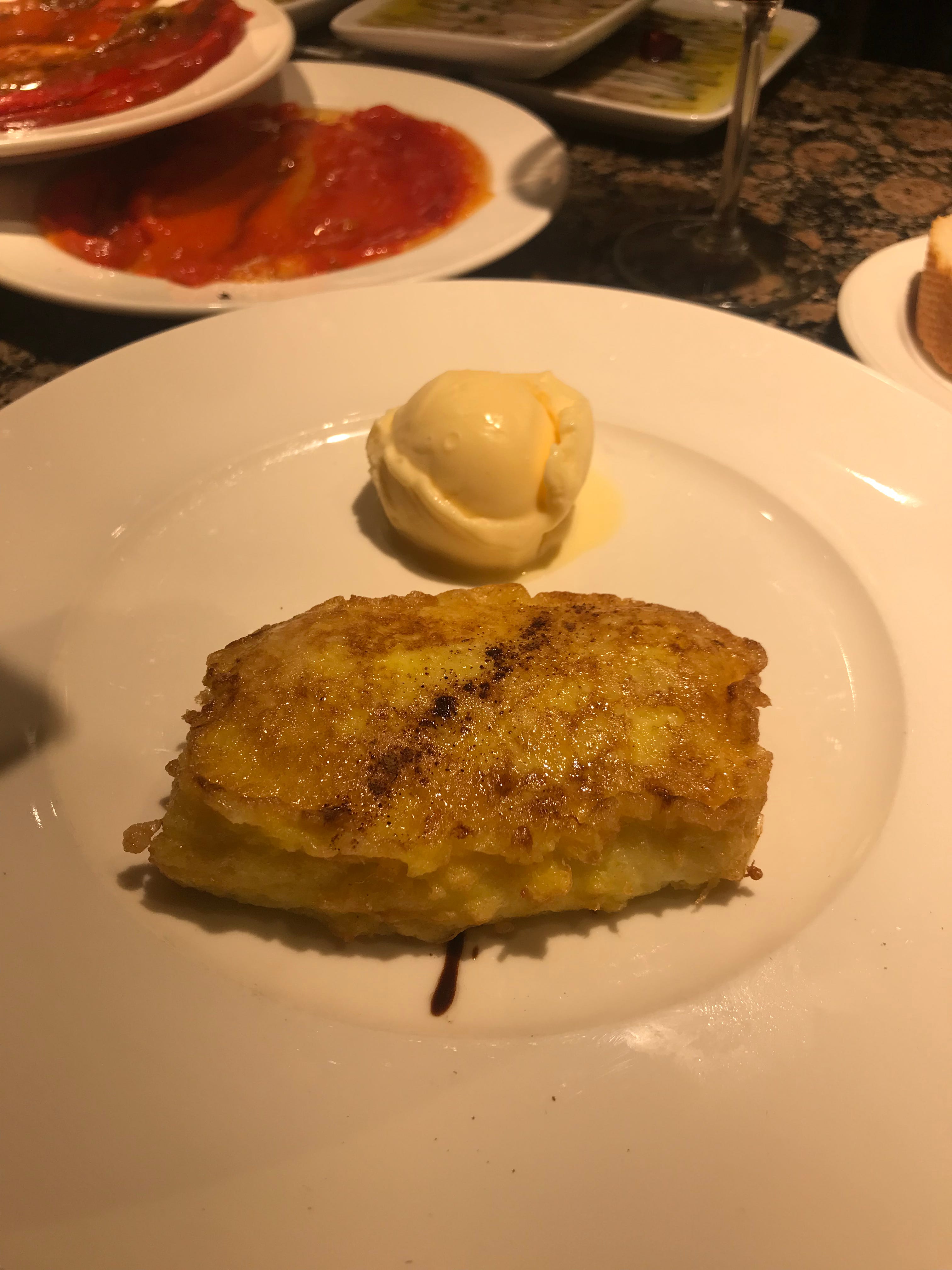
Like custard that has been teleported, dismantled, and then put back together, torrijas have a golden outer case with a pudding-like milky centre with subtle vanilla, cinnamon and citrus spicing. The ice cream, melting quickly into the puddle of torrijas, softens the bread pudding even further. It is not unlike back-to-front, inside-out french toast, though it has an overall sense of milkiness rather than egginess - more soft and yielding. It was glorious. Since that trip in 2019, I’ve made it a few times at home but am yet to come across it on a dessert menu.
It wasn’t until I returned to San Sebastian a few weeks ago that I realised how popular Torrijas are in the region. Appearing on almost every dessert menu, we found out quickly that Basque Country Torrijas are like snowflakes - no two alike. Even more confusing was the intel of Milli Taylor, Chef and author of When in Rome, whose knowledge of Torrijas BEYOND the Basque region informed us that they are usually only available around Easter and often served cold; Milli was, at first, considerably confused to see them on a dessert menu at all, let alone hot and with ice cream. It was sort of like randomly bumping into a friend you haven’t seen for years in a place that neither of you usually go to (side note: This did actually happen in San Sebastian to another of our friends we were travelling with and I can confirm his reaction was similar to Milli seeing Torrijas on the dessert menu at legendary restaurant Elkano for the first time)


And so began our quest to try torrijas anytime we saw one, from fancy restaurants to local bakeries. Friends, now it is time for me to report back and for us to dive in together.
Over on KP+
Whilst eating our seventh Torrijas of the trip, up a mountain whilst looking out at the bay of San Sebastian, we realised that Torrijas are for fans of Tres Leches cake; Though unfamiliar at first, if you can get on board with wet cake, there’s a delight of wet bread waiting for you. Inspired by this sisterhood of bakes, I’ve developed a tres leches cake with torrijas spicing and a creme brulee-like crisp top, which is genuinely a joy to make and eat. The sponge is probably the spongiest sponge I’ve ever developed. It DRINKS up the milk like no other:


Oh, and since this newsletter has been inspired entirely by my trips to San Sebastian, it would be remiss of me not to share a few of my favourite bites. You’ll find my top 5 (sweet and savoury) picks / restaurant reccs from San Sebastian on KP+:
If you are looking for a more detailed itinerary, useful information about getting around the town and a guide to every single place we ate (there were a LOT!) and how to approach the trip, look no further than Milli Taylor’s guide to the city here:

Her recently launched Substack, ‘When in Rome,’ will give you regular travel itineraries, recommendations, and recipes inspired by the travel. I trust no one more than Milli when it comes to restaurants and where to eat.
A bit more about Torrijas
Dipping stale bread in milk or eggs, recognisable to us as French Toast or indeed Torrijas, has a long history that takes us back to ancient Rome. The first known recipe for French toast appears in Apicius, the Roman cookery book compiled in 500 AD. It reads, "Break fine white bread, crust removed, into rather large pieces which soak in milk, fry in oil, cover with honey and serve." From here, it made its way across the world, becoming ‘golden toast’, then pain perdu in France, bread pudding in the UK and to Spain as Torrijas, being officially recorded in the early 17th century. Now, torrijas are ever-popular, with annual national competitions taking place to find the very best - truly the sign of a national dish.
In most of Spain (San Sebastian notwithstanding), Torrijas reach their peak popularity around Easter, which is Holy Week (semana santa), so now is a good time for you to get involved.
According to the chefs at Rancho Del Ingles, the events venue that Milli Taylor’s family runs in Southern Spain, Torrijas started appearing outside of holy week ‘about 20 years ago’ and are often a regular and popular fixture at bakeries. Though the ‘torrijas de leche’ (torrijas with milk) are the most prevalent, you might find torrijas soaked with sherry or sweet wine or as the base for any number of flavours and textures. Jose Pizzaro recently doubled down on Easter by making hot cross bun torrijas!
One of the significant differences between torrijas and French toast is the ratio of eggs in the soaking custard. A classic French toast recipe is predominantly eggs (with milk or cream to dilute and flavour), while torrijas is soaked in milk then dipped in egg (though not always) before frying. Rather than the egg going the whole way through the bread, leading to that springy texture you might be familiar with, torrijas has a gooier, softer, more yielding inner texture.
Curiously, some torrijas are so mushy (let it be known I use this word with love) that they form a sort of custard - the bread seems to completely dissolve into the milk, and it forms a homogenous, smooth, pudding-like texture. I mean, what is custard but starch-thickened milk? It might be a roundabout way of making it, but custard it is.
Type of Bread
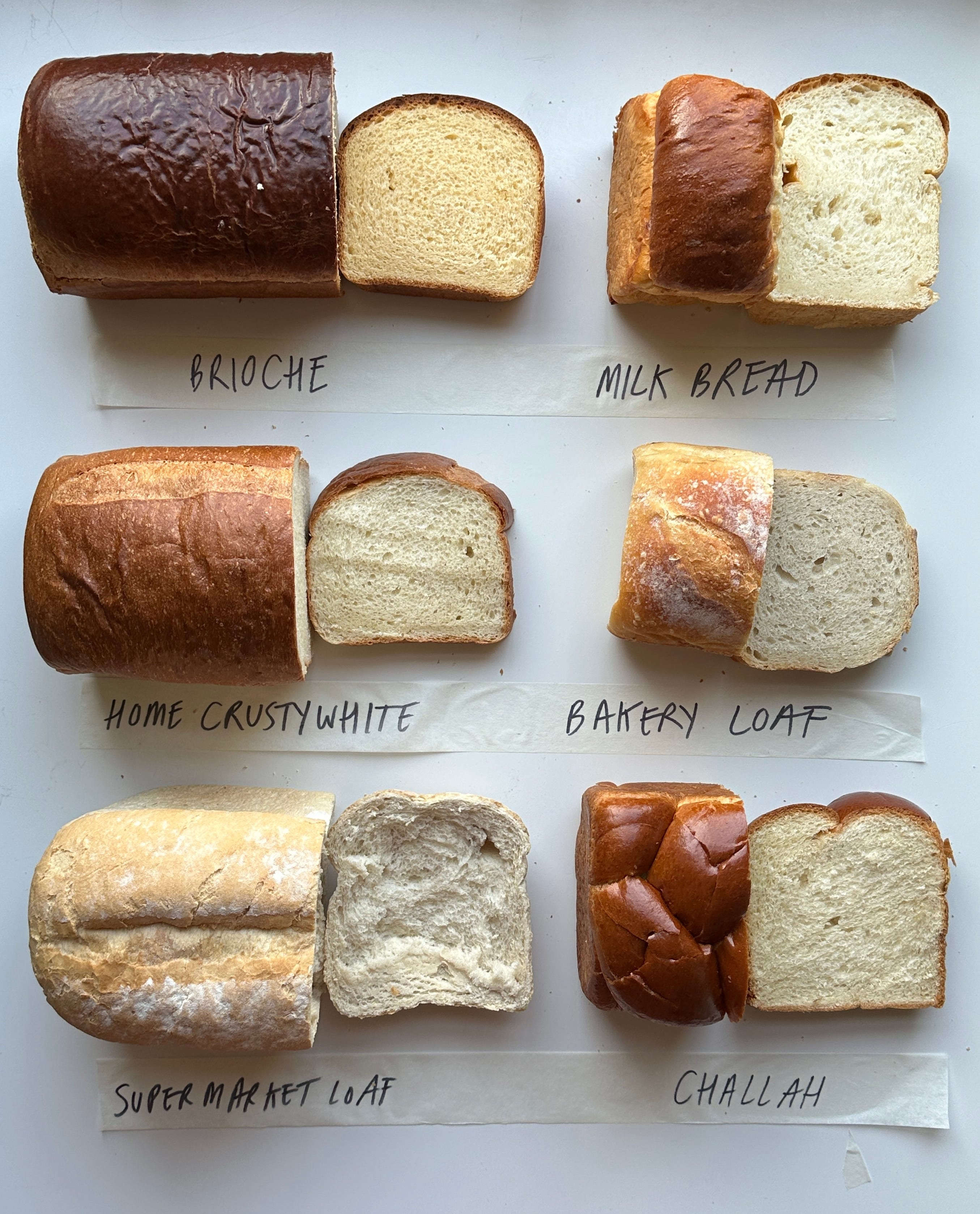
I understand the irony of this week’s tests: Torrijas were perhaps invented in the pursuit of frugality, to use leftover stale bread. And here I am, buying and/or making loaves to test. I know my ancestors are tutting. And yet, not all bread is created equal - not for Torrijas anyway.
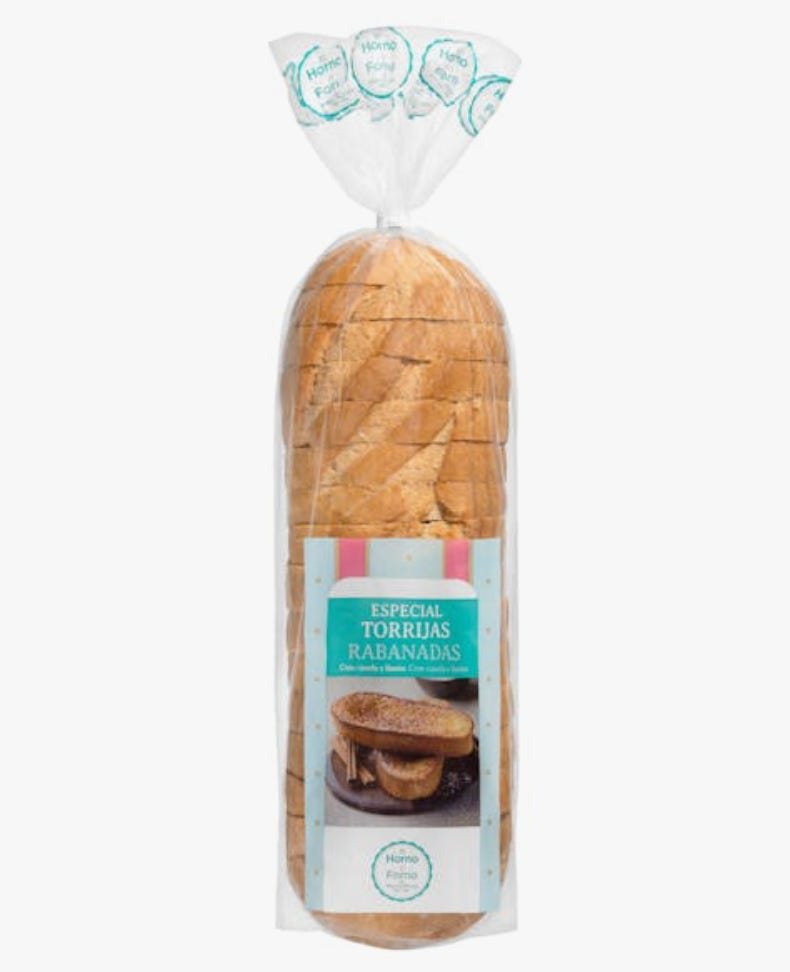
In Spain, nowadays you can find bread especially for torrijas at the supermarket to make the typical version - it is sliced thickly and long and oval in shape:
One thing I love about torrijas is the presentation - you can slice, cut or carve your bread into whatever shape you desire. Though I love the classic slice of white soft bloomer bread, I wanted to look at a broader spectrum of options.
The contenders are: Milk Bread, Brioche, Homemade Crusty White Loaf, Supermarket White Loaf, Bakery White Loaf and Challah.
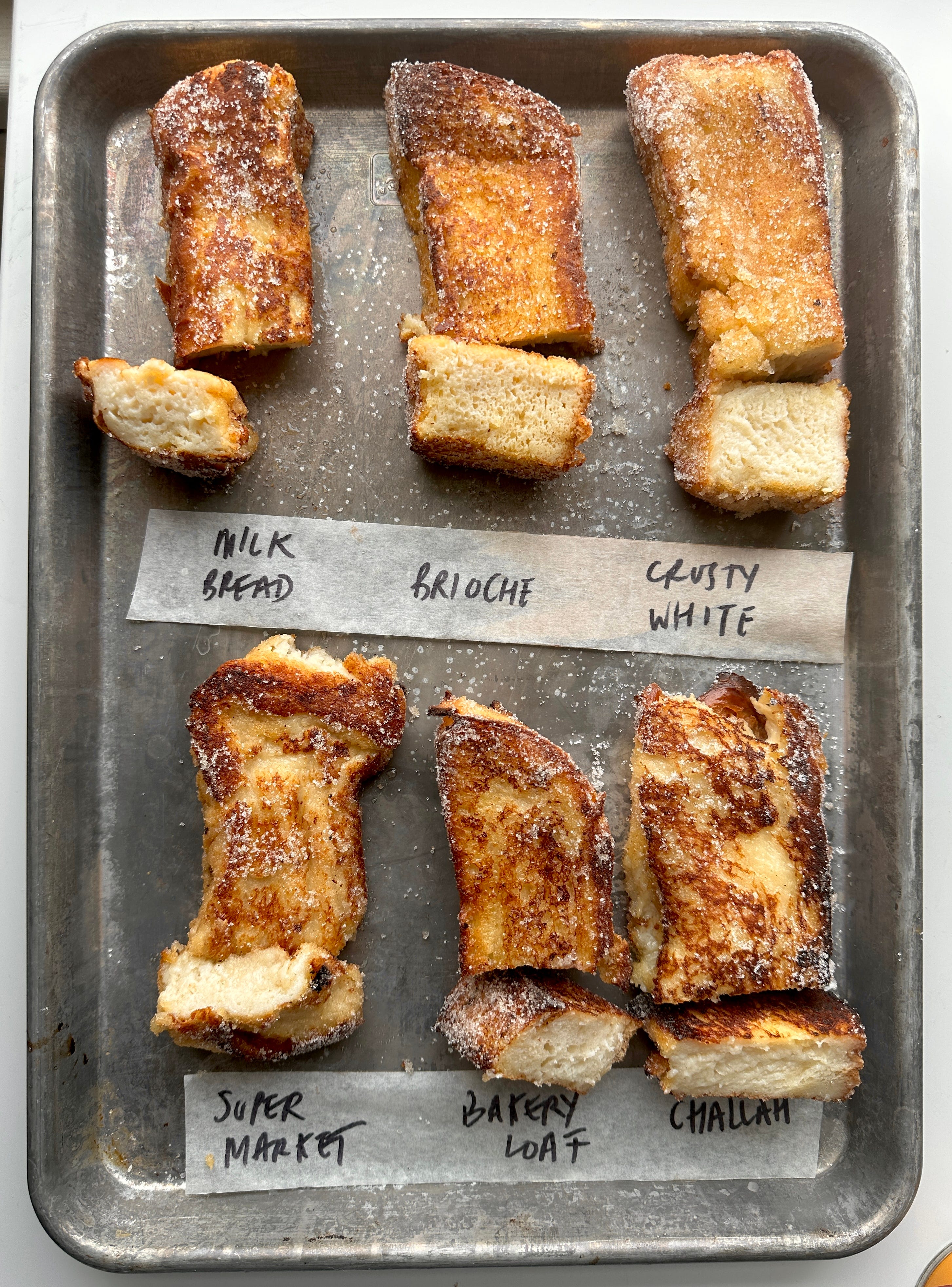
To understand the final texture of your torrijas, consider how the individual ingredients of bread interact with moisture. As we know, starch can be washed away with water or will gelatinise in the presence of water and heat. Fat, or butter, is entirely insoluble, as are eggs. This means enriched breads, whose structure is provided predominantly by eggs and fat - think brioche, challah, etc. - will retain their structure well, even when soaked.
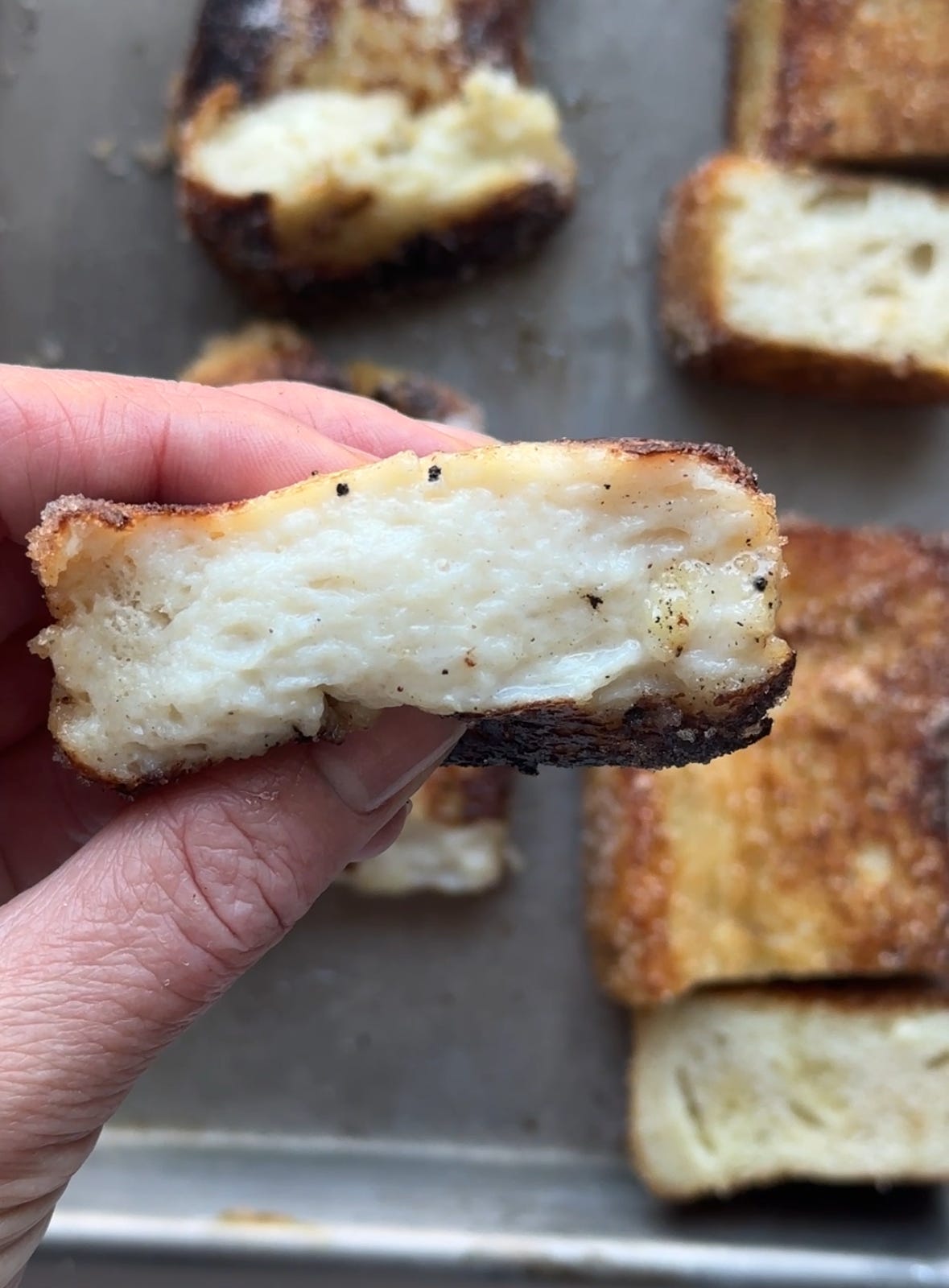
So, if you are someone who likes the look of a custardy, pudding-like centre, a classic farmhouse white loaf might be the bread for you. If you want your torrijas to retain water in its sponge-like structure, with the pockets formed and protected by fat (think about the butter acting like silicone or beeswax to help waterproof a material!) holding drops of milk, enriched dough like brioche might be for you.
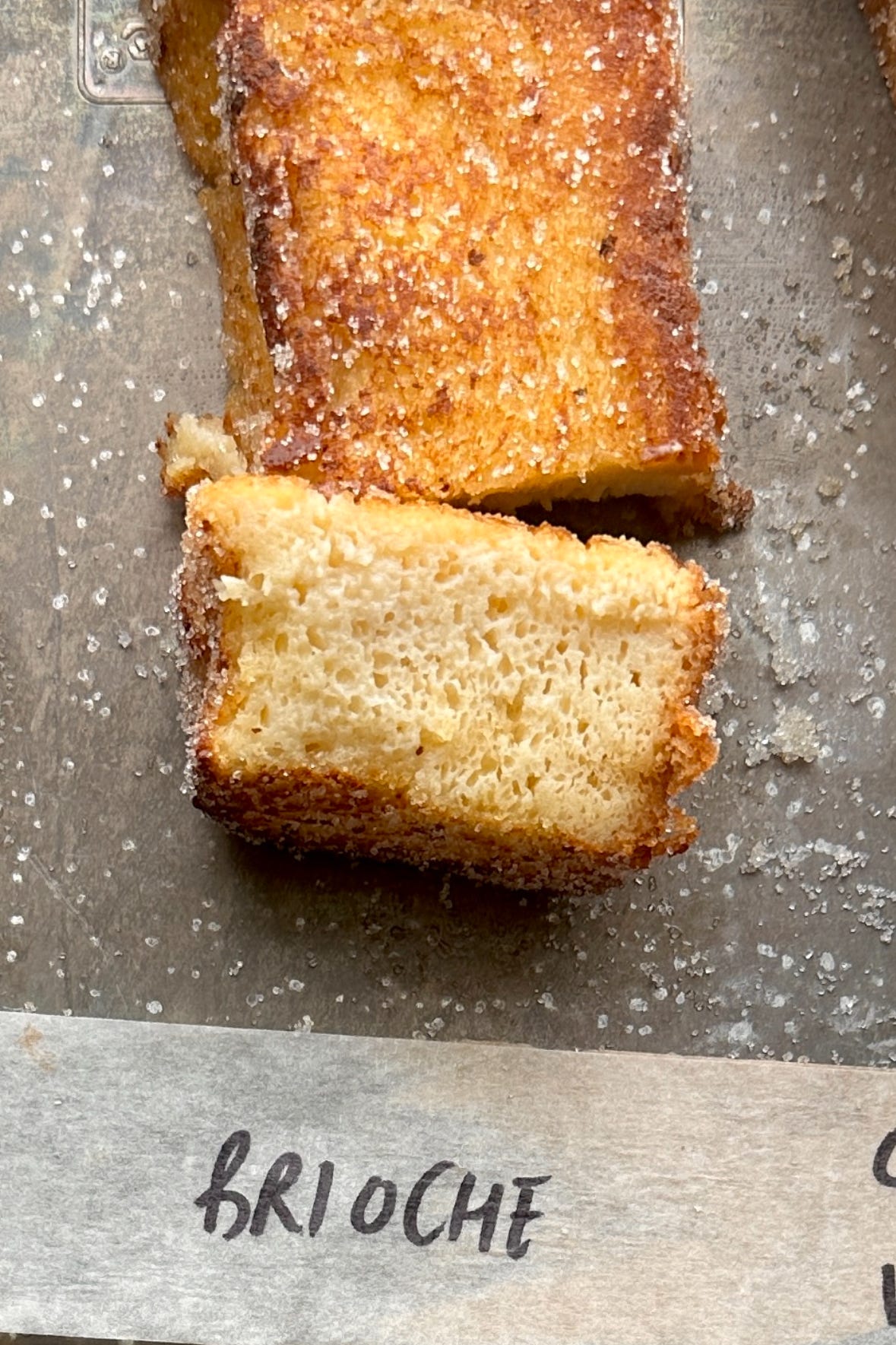
Milk Bread (my recipe here) is somewhere in between these two, closer to a classic white loaf. It is predominantly starch with its fluffy, light crumb, making it highly absorbent. A little bit of egg and butter makes the milk bread crumb slightly more defensive to the onslaught of moisture. A classic white farmhouse loaf or bloomer bread works well, too.
In conclusion, bread with (small) holes or pores is great for torrijas, resulting in a juicy sponge that retains its texture. But, honestly, those breads - the challahs and brioches of the world - are expensive or challenging to make. I’d never insist you use something so fancy for a dish whose origins are humble and designed to use up leftovers.
The deal with crusts
I love crusts, but they are a double-edged sword in the case of torrijas. Crusts act as a barrier which can prevent absorption at the edges. The crust also acts as a handy barrier to prevent the absorbed liquid from escaping during the cooking process. You see, milk squirting out into hot olive oil is messy and, undergoing immediate Maillard (ok, burning) reactions, can create a lot of smoke. It doesn’t affect the flavour, but it is - frankly - more annoying to clean up. I decided against removing crusts, though if you really are in a rush, I suppose you could - it would probably cut the absorption time by a third, if not by half.
Stale vs Fresh
Since Torrijas were invented to use up stale bread, it makes sense that you would want a drier bread. The thinking is: If the bread is dry, it will re-hydrate with milk more gently and not break apart. Plus, since it has lost some of its moisture, it can replace it with the liquid you introduce it to, ergo higher absorption capacity. If you don’t have stale bread on hand, some recipes ask you to dry the bread overnight, put it in the fridge for several days, or even just toast it in a low oven. I gave it a shot:
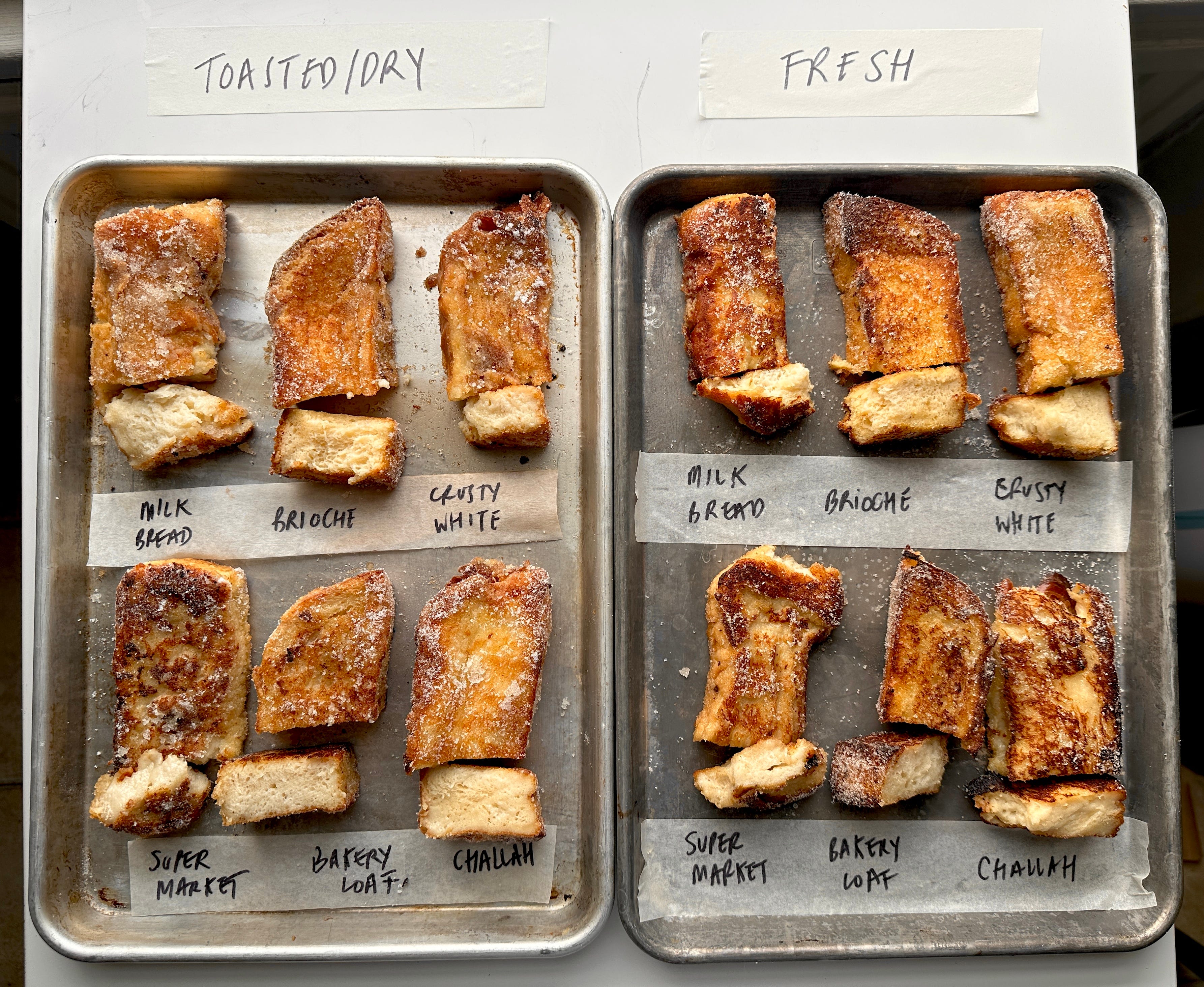
Surprisingly, I found there to be very little difference at the end. In fact, the extremely dry bread that had been left out for 5+ days was weak and brittle by the time it was rehydrated. What was more important was the type of bread we were using and how thickly it was cut. The supermarket loaf (which, honestly, was barely cooked inside and very doughy and gummy) definitely benefited from being toasted, if not dried. The brioche, milk bread and bloomer worked just as well fresh and after a night out on the counter. Obviously, this is a handy recipe to keep in your back pocket when you’ve got a loaf past its best, but don’t let it stop you from making torrijas right now.
Every loaf I tested was at least one day old (bc logistics), so if your loaf is FRESH baked that day, I’m going to suggest a 15 minute toast in a 140c fan oven to give it a bit of extra structure.
The Soak: Ingredients
Torrijas can be soaked in wine, milk or just about anything you’ve got lying around. Remember, these are supposed to be a way to make the most of your leftovers. Most modern renditions I’ve come across are made with lightly sweetened and spiced milk, which is sometimes made richer with cream or eggs. I mixed up four options: A classic spiced milk, half milk half cream, a light creme anglaise - cooked, and an uncooked anglaise (ie, eggs whisked into the milk but not heated).
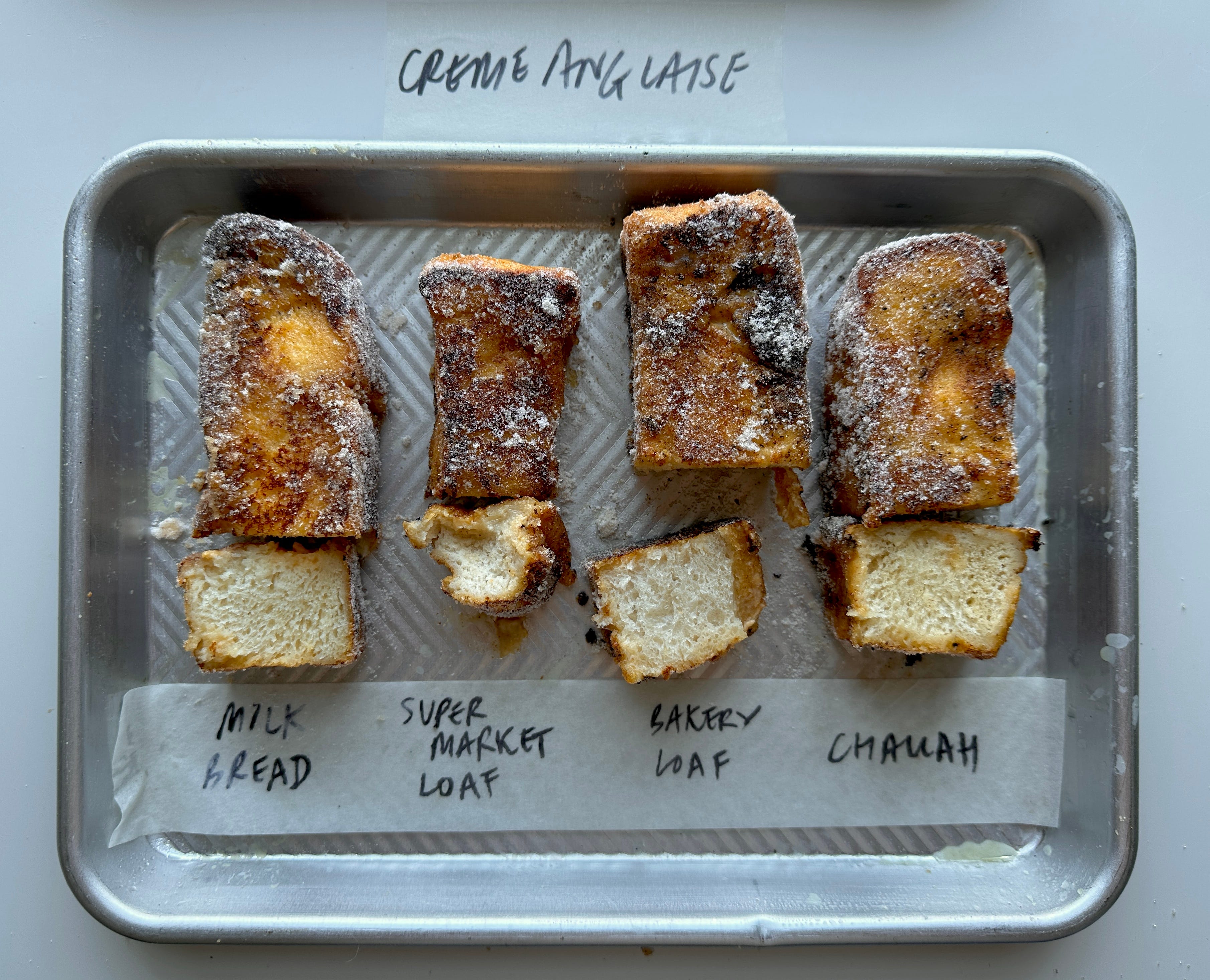
Much to my surprise, my favourite by far was the plain old milk. I really surprised myself here. Normally, I’m mad about custard, but to be honest, the egg in the mixture gives the torrijas a structure that it doesn’t need, in my opinion. I prefer the less firm, gooier texture compared to what you get from just milk. Plus, the cooked anglaise - already being thick and viscous - really struggled to penetrate the bread.
The sweetness of your soak will depend on the bread you are using - though we do douse the torrijas in cinnamon sugar after frying, a completely lean bread like a standard white loaf might enjoy a touch more sugar in the soak compared to a brioche, for example. We aren’t talking huge quantities here, and the sugar doesn't seem to affect the viscosity or density of the milk enough to change the way it absorbs, so I’d suggest doing this to taste.
The Soak: Dunk time
So now you’ve got your soak, it’s time to dunk. The two key factors I investigated were length of time and thickness of bread.
I was shocked to find how hard it was, on visiting two major supermarkets last Tuesday morning, to find unsliced bread. All of that thinly pre-sliced bread won’t do (though I have reason to believe you can stack two slices together in a pinch, though I did not have time to test it). There’s no chance that a supermarket loaf, soft-crusted and all and barely thick, could stand up to a soaking.
Intriguingly, I realised that undersoaking is less of an issue than you might think. In theory, when you seal the torrijas, the moisture is forced into the centre - it can’t escape a buttery or eggy crust - so with enough cooking, so long as the seal is in place, you should get a soft centre.
Here’s a rough guide to soaking time - white loaves will need to be soaked for the shorter range, while enriched doughs are better in the longer range:
Less than 1inch: 15-25 minutes with a turn halfway
1inch: 40-60 minutes, turning half way
2inch: 2 hours (or overnight!)
The cooking method
Traditionally, torrijas are dipped in an egg and then shallow (or deep!) fried in olive oil before being doused in cinnamon sugar. As torrijas have made their way from home kitchens to bakeries to fancy restaurants, the cooking methods have adapted, too. Some recipes choose to fry in butter, others add a coating of flour along with egg, and more restaurant-y recipes call for butter and sugar for caramelisation and others gild the lily even further with a visit from the blowtorch after cooking for a super crackly, creme-brulee-esque crust. Others forgo the pan sealing and skip straight to the blowtorch kiss, giving this kind the maximal ‘wet bread’ essence.
I took a run at several methods and finishes:
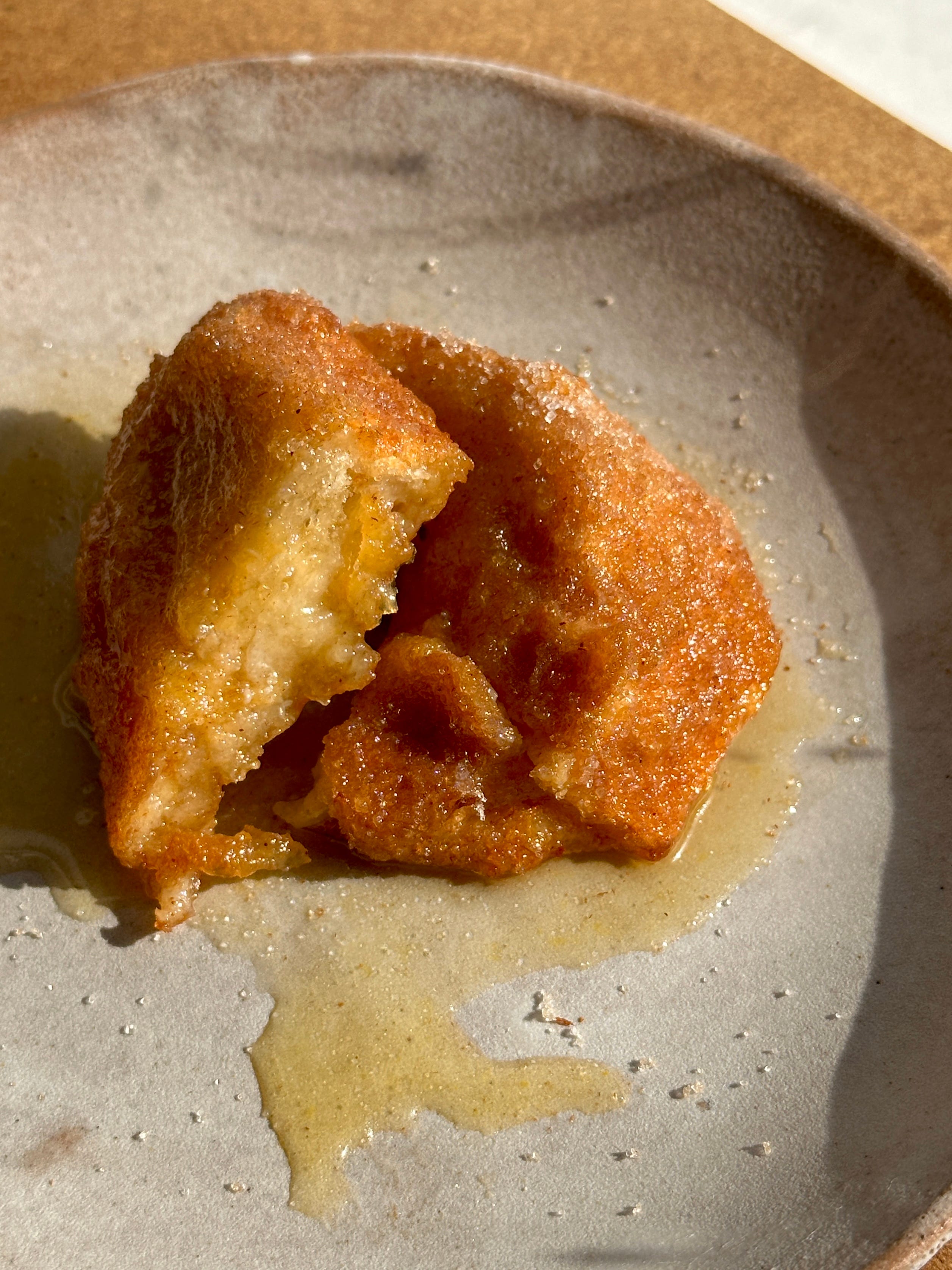
Though I love deep frying, I know it’s not a popular method for cooking at home. So, while delicious and almost certainly the very best way to enjoy these - especially when covered in syrup - I’ll offer you some alternatives. (Side note: If you do feel confident enough to deep fry, know that it is quite a noisy fry - little bits of milk escape and sizzle almost constantly through the cooking process, and the milk solids burn in the oil, so be aware that this is normal!)
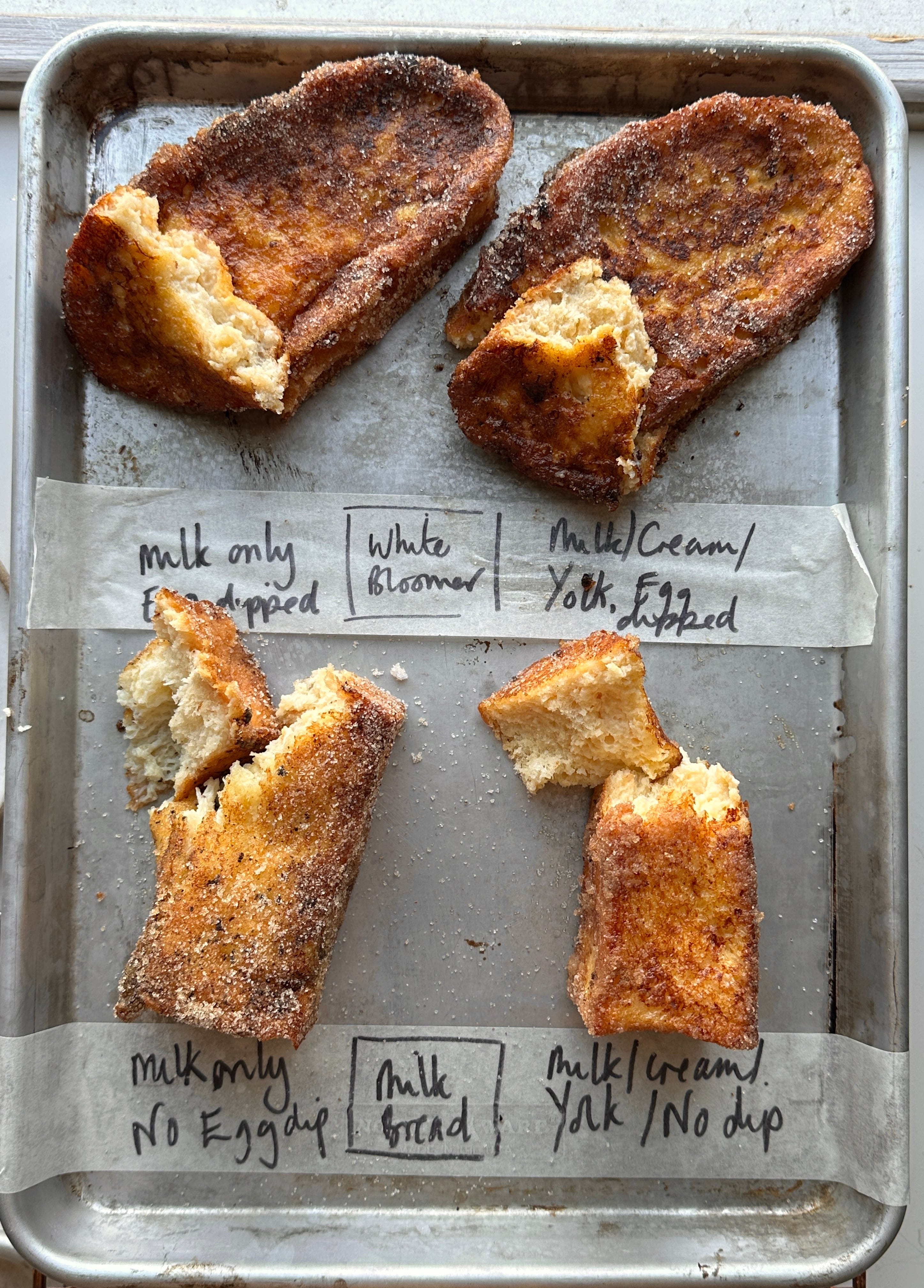
Dipping in egg is tasty, as is with flour (though I felt this was an unnecessary step), but the milk-only dip works well, too, especially if you are frying in butter and caramelising. This certainly gives dessert energy and is perfect with ice cream:


Does this make it NOT a torrijas? I’m not sure. Either way, it’s good, though less crusty, but certainly an option for anyone who is looking for an egg free alternative for french toast, or - america i am looking for you - a reason not to include eggs at every meal (man, they are pricey!). Of course, the egg is typical so I will include it in my classic recipe. Not here to ruffle feathers.
To syrup or not to syrup?
One inconsistent direction in torrijas recipes seems to be the final soak - or lack of - in a flavored syrup. Another recipe even suggested redunking in milk to retain moisture. Another finish, as we’ve talked about, is a dunk into cinnamon sugar to create a crunchy, crusty coating. As a general rule, recipes seem to choose one route or another, either a crunchy or sticky finish.
My opinion? It is up to you. If you love a sticky, syrupy dessert then dousing with syrup is gorgeous. Otherwise, a quick toss in sugar gives a gorgeously sparkling wink to the torrijas as well as a bit of extra texture. If you go down the caramelised butter and sugar route, forgo syrup and have ice cream instead.
What about the oven?
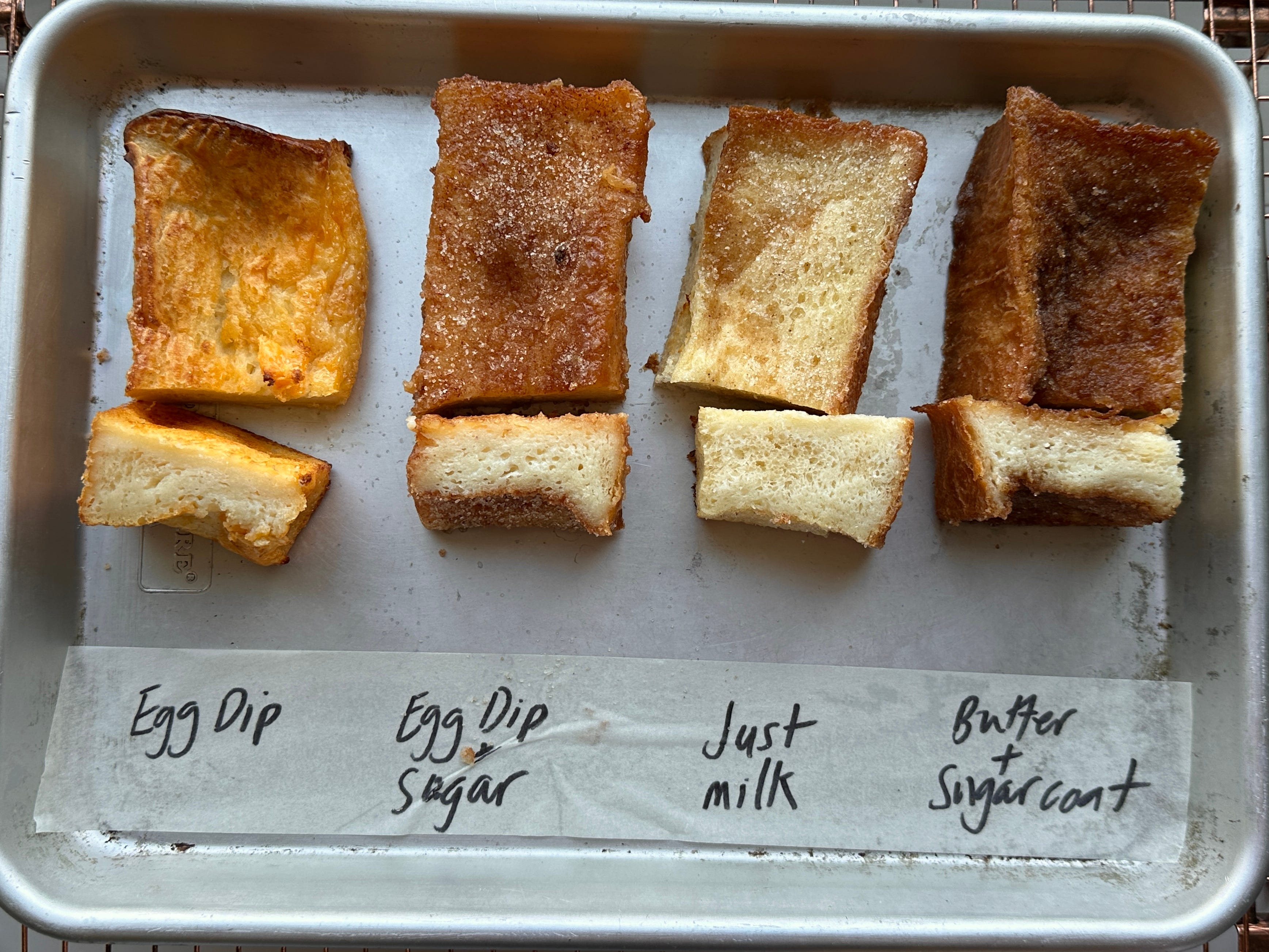
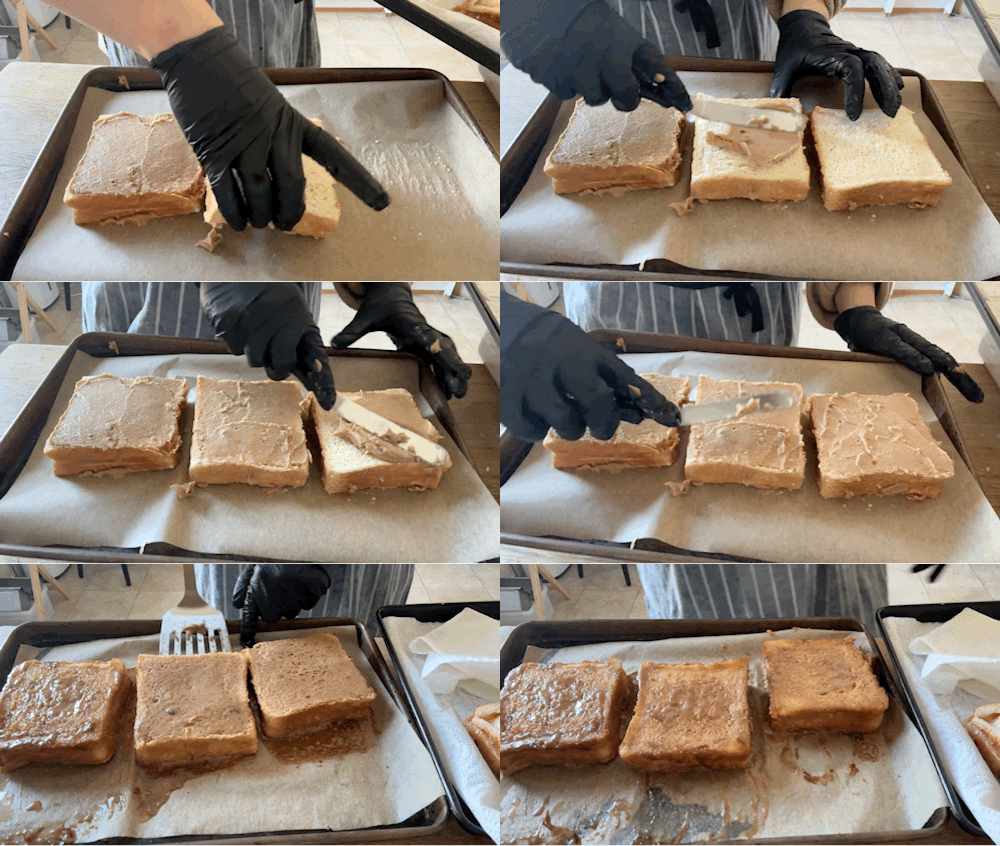
Curious to see if we could get good results without splattering oil everywhere, I decided to give the torrijas the ‘honey butter toast’ treatment - made famous at Arome in London, honey toast is cooked with a mixture of butter, sugar and honey in the oven until crisp. With the torrijas, it works surprisingly well, though only ever going crispy at the edges and staying very gooey and soft in the centre.
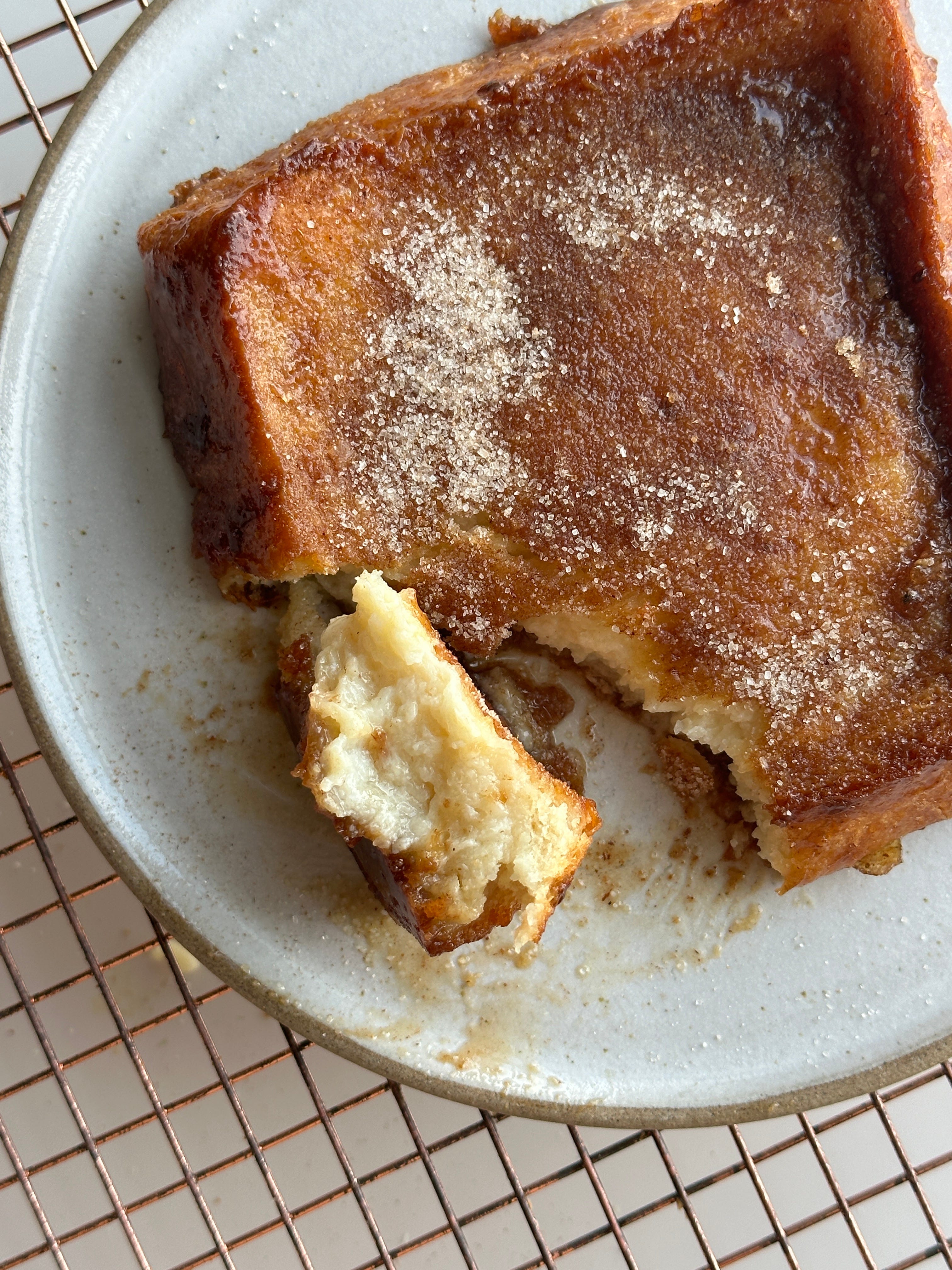
This is a great frying-free / relatively mess free alternative and is best enjoyed warm. Bread dipped in egg then cooked in the oven gave me fairly uninspiring results. Once the bread was dipped in sugar, too, though, it was much better. You get a really funny, fuzzy-looking crust that locks in all the moisture. It also low key looks like a piece of battered fish, which weirdly, I am into.
I’ll share the classic pan methods and the gooey oven method. This is a choose your own torrijas adventure after all.
Shall we make them?
Classic Torrijas
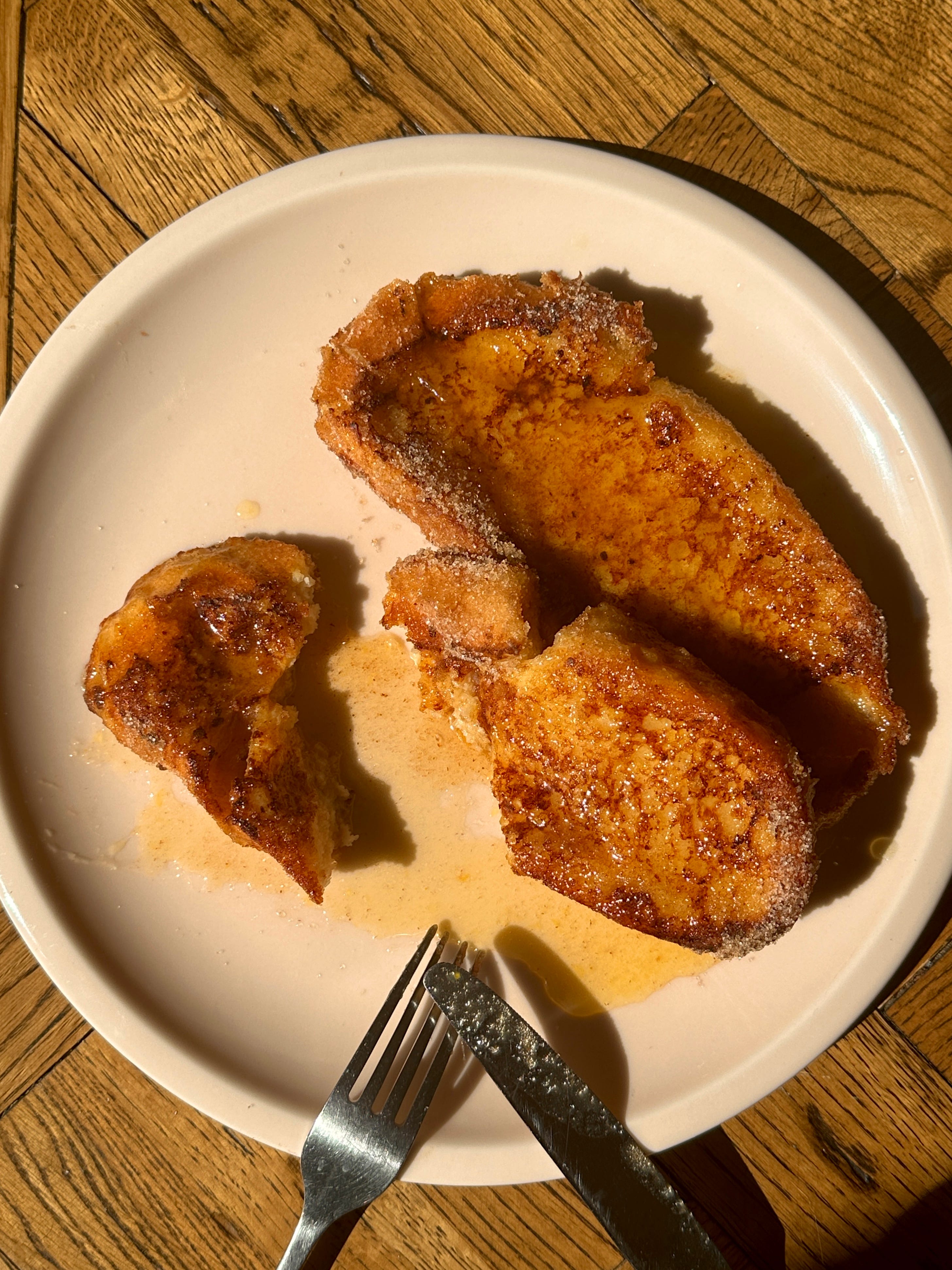
About 10 pieces
Torrijas
White farmhouse or bloomer, about 400-500g sliced into 3/4inch thick pieces (for classic shape, go for something like this). You can also use milk bread, challah or brioche
1L Whole Milk
120-150g Caster sugar, to taste (and depending on what bread you are using)
25g orange peel (from about 1 orange)
15g lemon peel (from about 1 lemon)
1 vanilla pod
1 cinnamon stick, or 1 tsp cinnamon
1/4 - 1/2 tsp flaky salt
1-2 eggs for frying (note you can omit these but eggs are typical!)
Olive oil for frying
Butter for frying (optional)
Cinnamon Sugar
150g granulated sugar (i like this as it sparkles better than caster)
2 tsp cinnamon, or to taste
Pinch of flaky salt, or to taste.
Orange syrup
150ml orange juice
100g Sugar
Pinch of salt
Method
For the milk, heat milk, sugar, orange and lemon peel, vanilla pod (scraped) and cinnamon stick until simmering - add salt to taste. Pour into a shallow container to infuse and cool. You can do this the night before and leave it in the fridge to chill, though about an hour will do. It is best for your milk to be cool to the touch when you add the bread for soaking.
If the bread is very fresh, toast it in a 140 ° C fan oven for 15-20 minutes or until it is a little dry.
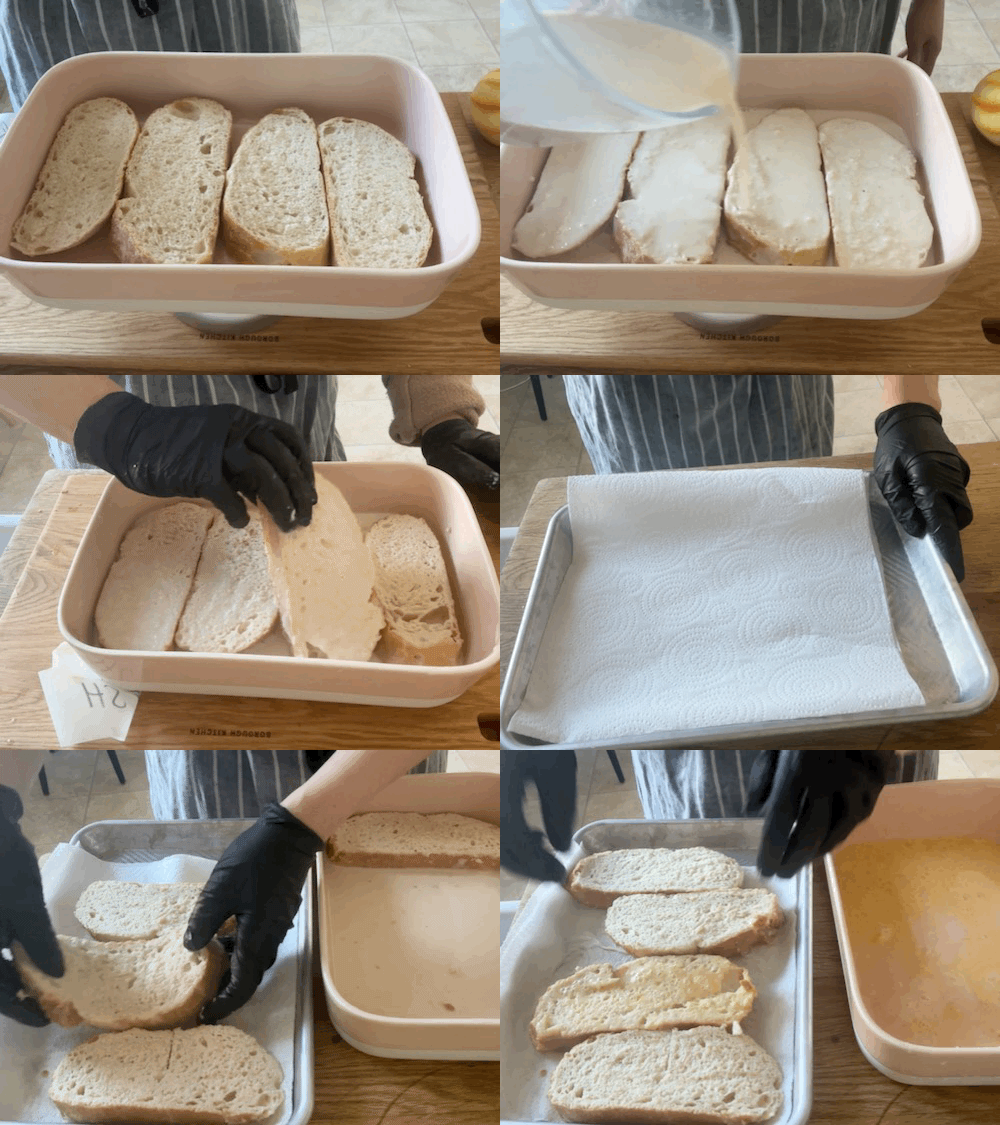
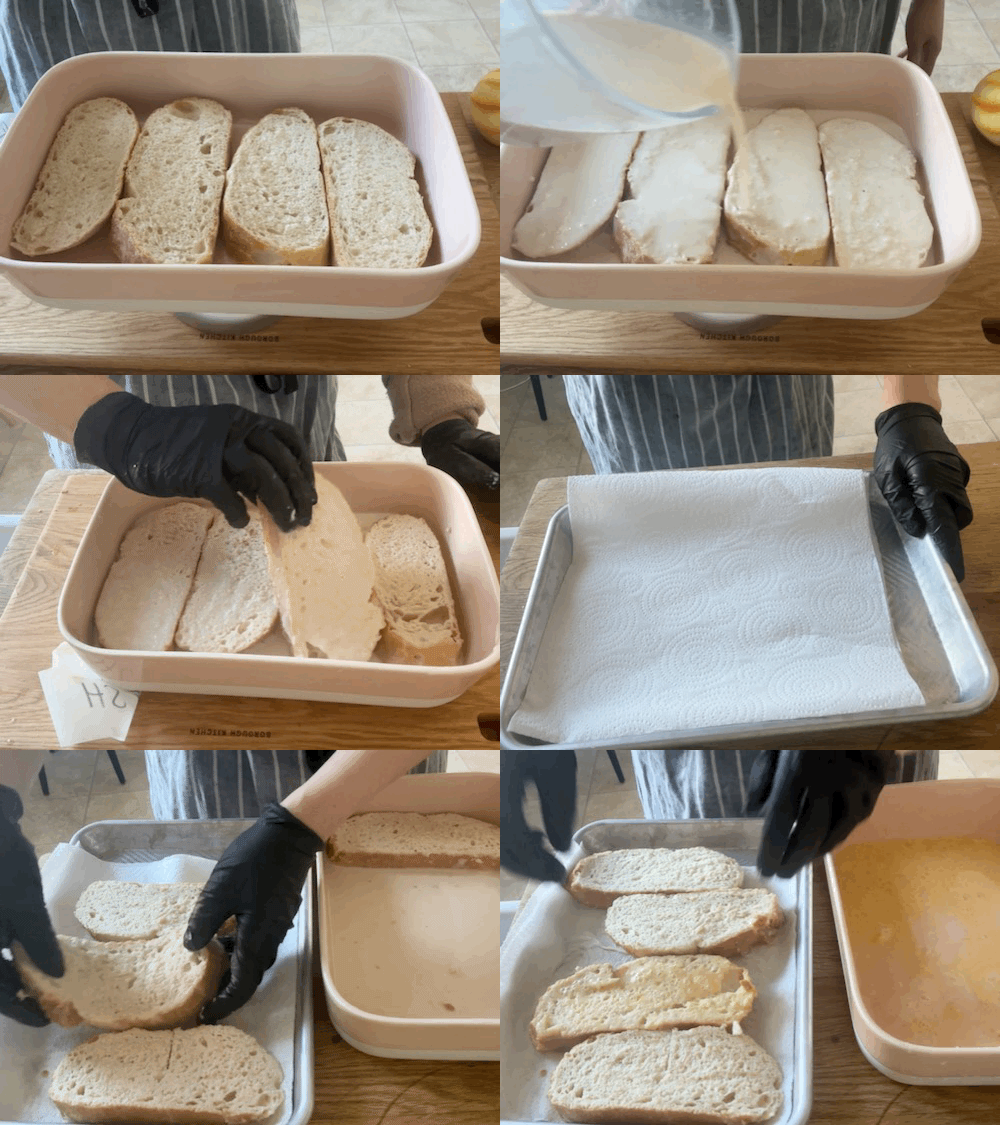
Place the bread into the milk (spreading over a few containers if you need to) and turn a few times to get the soaking going. Depending on the thickness (see earlier in the newsletter for guidance), soak the bread, turning it halfway. For the ¾ inch pieces, this should be about 30 minutes total. Lift the soaked bread out carefully onto a tray lined with kitchen paper or clean cloths to remove excess liquid.
Toss the ingredients for the cinnamon sugar and set aside.
Heat together all the ingredients for the syrup until boiling then leave to cool.
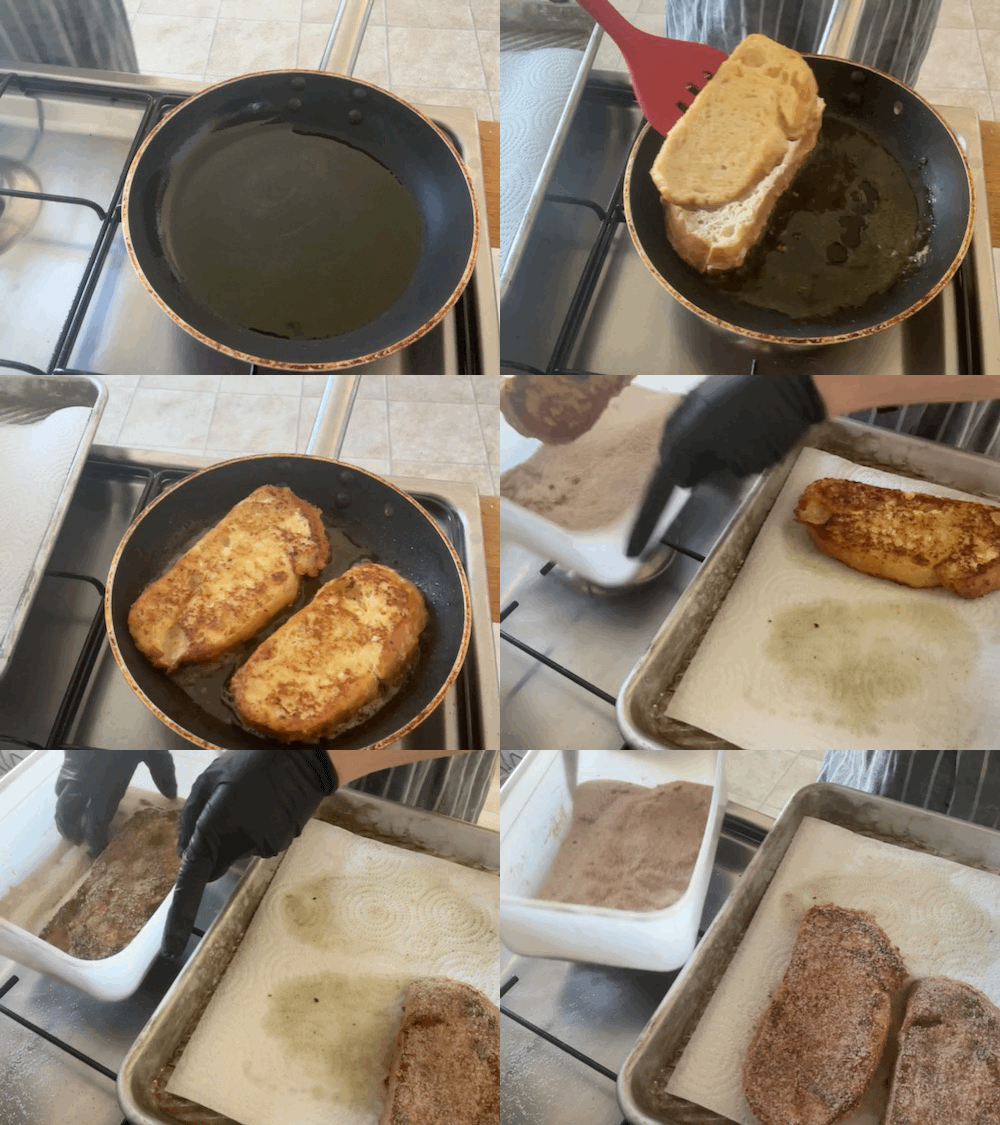
To fry, heat 2 tbsp of oil in a small frying pan until shimmering but not smoking. If you have a heat gun or thermometer, you want this to be about 170c.
Whisk the eggs in a shallow pan and, before frying each piece, dip the soaked bread pieces, gently turning it to coat.
Gently lay thee egg-coated, soaked bread in the hot oil. Turn down the heat - you don’t want the oil to smoke or bread to burn. Cook for 2 minutes, flip carefully (I always angle the pan toward me so all the oil is in one side, then flip the bread onto the ‘dry’ area of the pan so it doesn’t splash) and cook for a further 2 minutes. If desired, throw in the butter and cook for another minute.
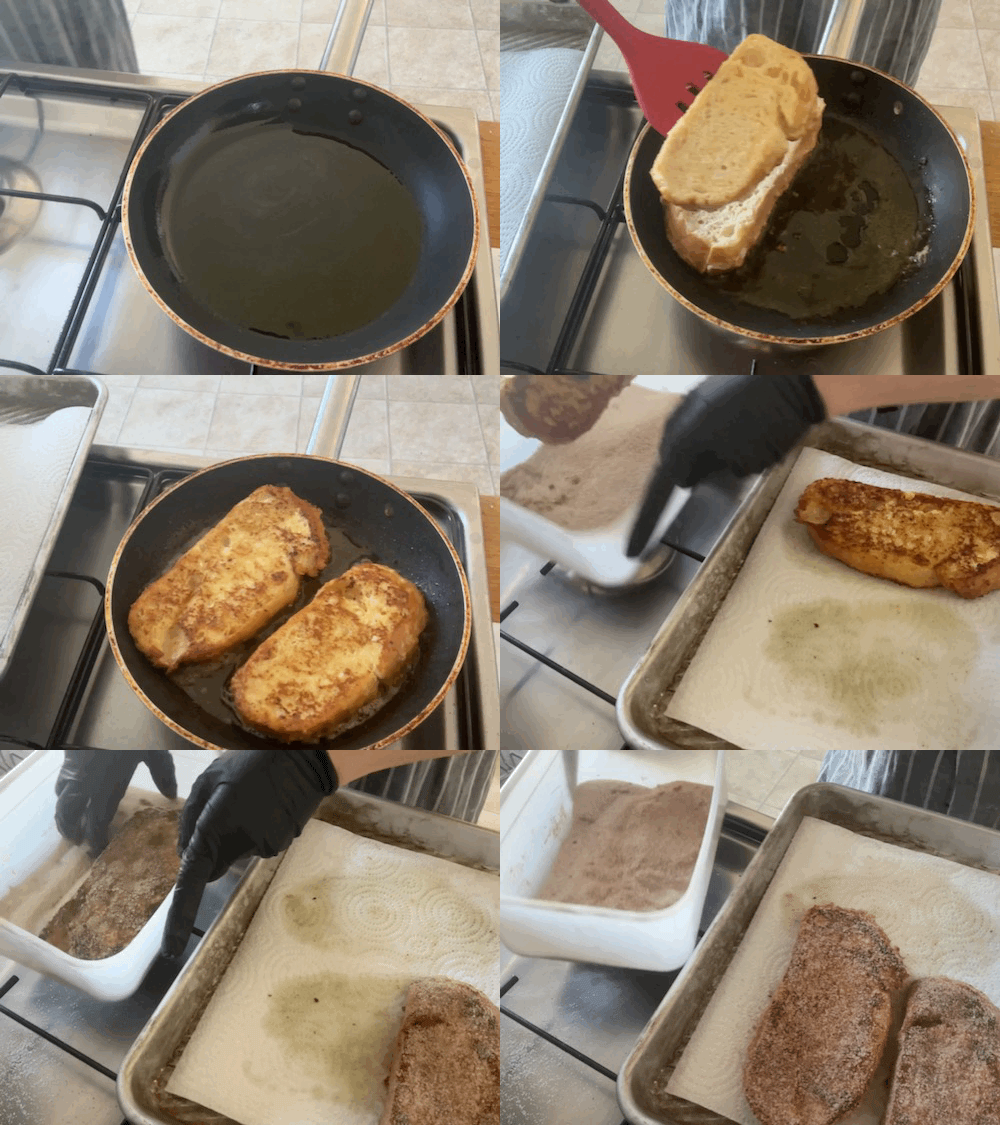
Lift out of the oil and drain on kitchen paper briefly before tossing in cinnamon sugar. Move to a warmed plate or low oven to keep warm. Repeat the cooking process with all the other soaked breads - use a spoon to remove any burnt milk solids and add more oil as needed. I find 2 tbsp is plenty for a few slices, then you need to add the same amount in again to continue.
If desired (and I always do), pour the slightly warm orange syrup over the warm torrijas and enjoy.
Buttery Caramelised Torrijas
Makes 4 large torrijas, or 8 smaller
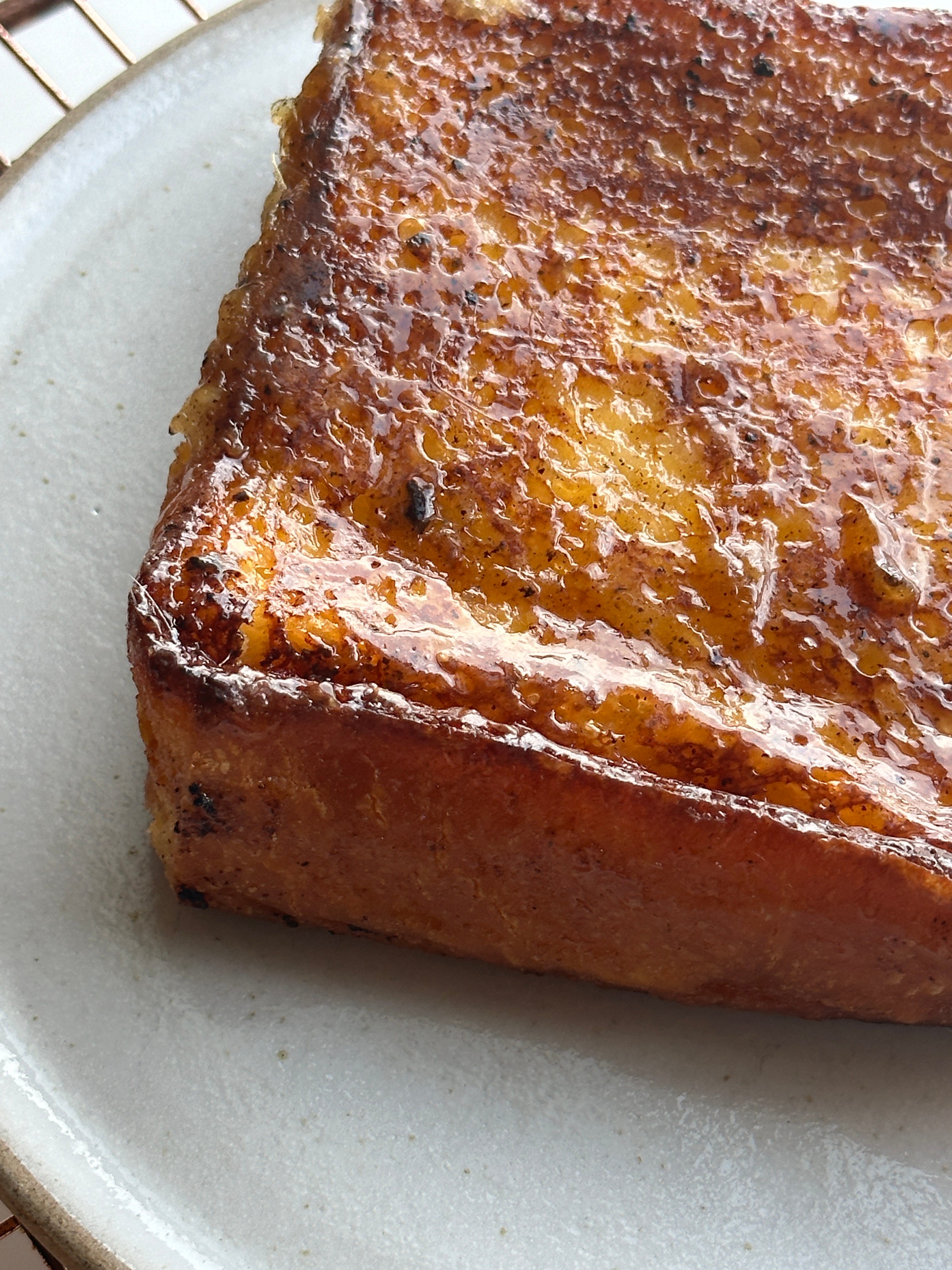
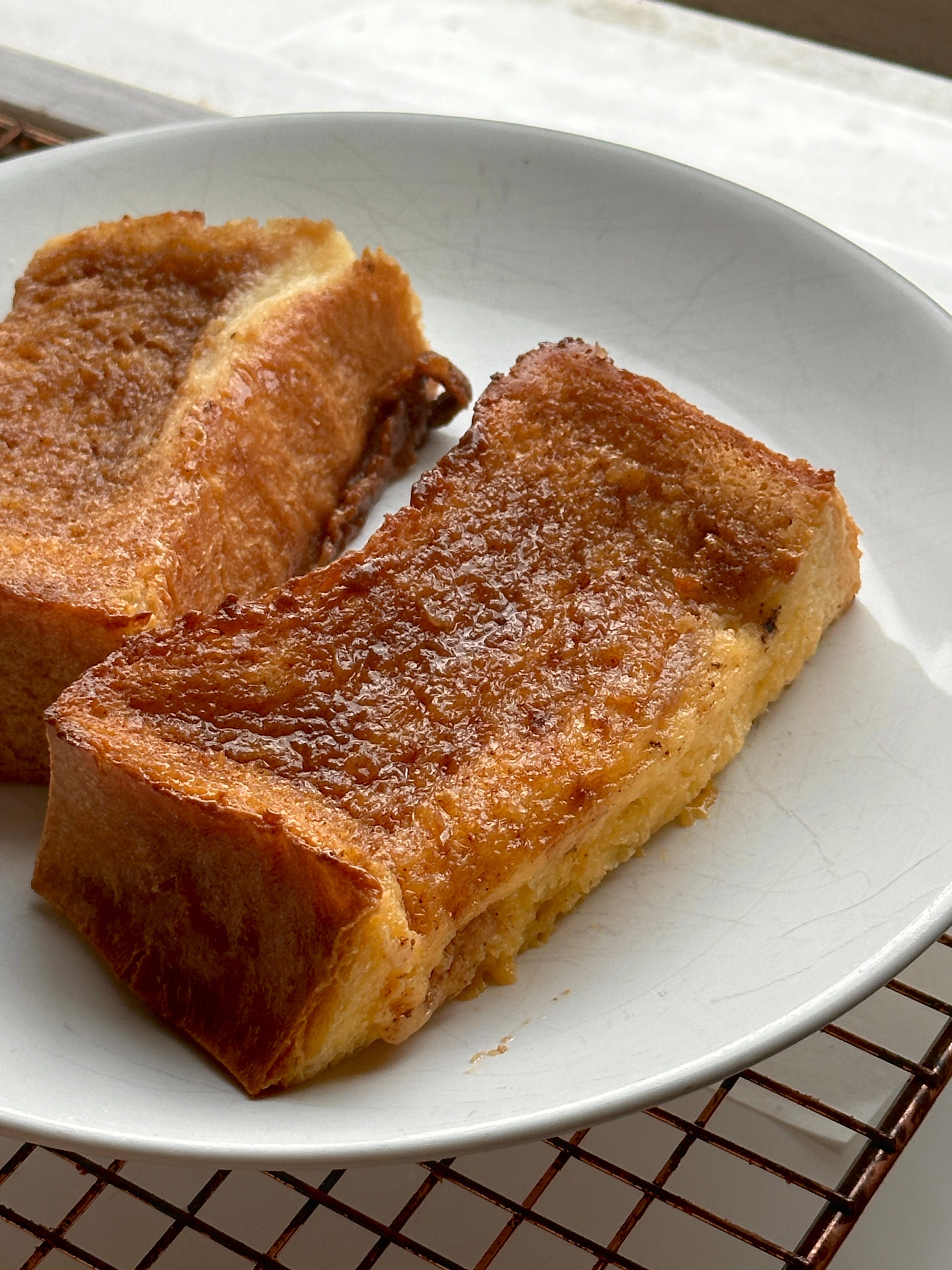
These make caramelised, crisp torrijas with a sugar crusted shell that cracks when you tap it with a spoon. This version doesn’t use eggs and is a non traditional version that is good for a dessert. It looks best with the square toasts or large rectangles and should be served hot with ice cream.
Ingredients
4 x slices of 1inch thick Milk Bread, 80g each. You could halve these and make smaller rectangles or ‘fingers’ as honestly, one is massive.
If bread is very fresh, toast in an 140c fan oven for 15-20 minutes or until a little dry
400ml-500ml spiced milk from above
Butter for frying
120g sugar (30g per piece)
Vanilla ice cream for serving
Method
Soak the milk bread well in the spiced milk, about 1 hour in the fridge, turning half way. If you are doing halves, soak for 15 minutes, turn then another 5-10 minutes (it is much faster as you have exposed the edge of one of the fingers!)
Lift the soaked bread out carefully onto a tray lined with kitchen paper or clean cloths to remove excess liquid.
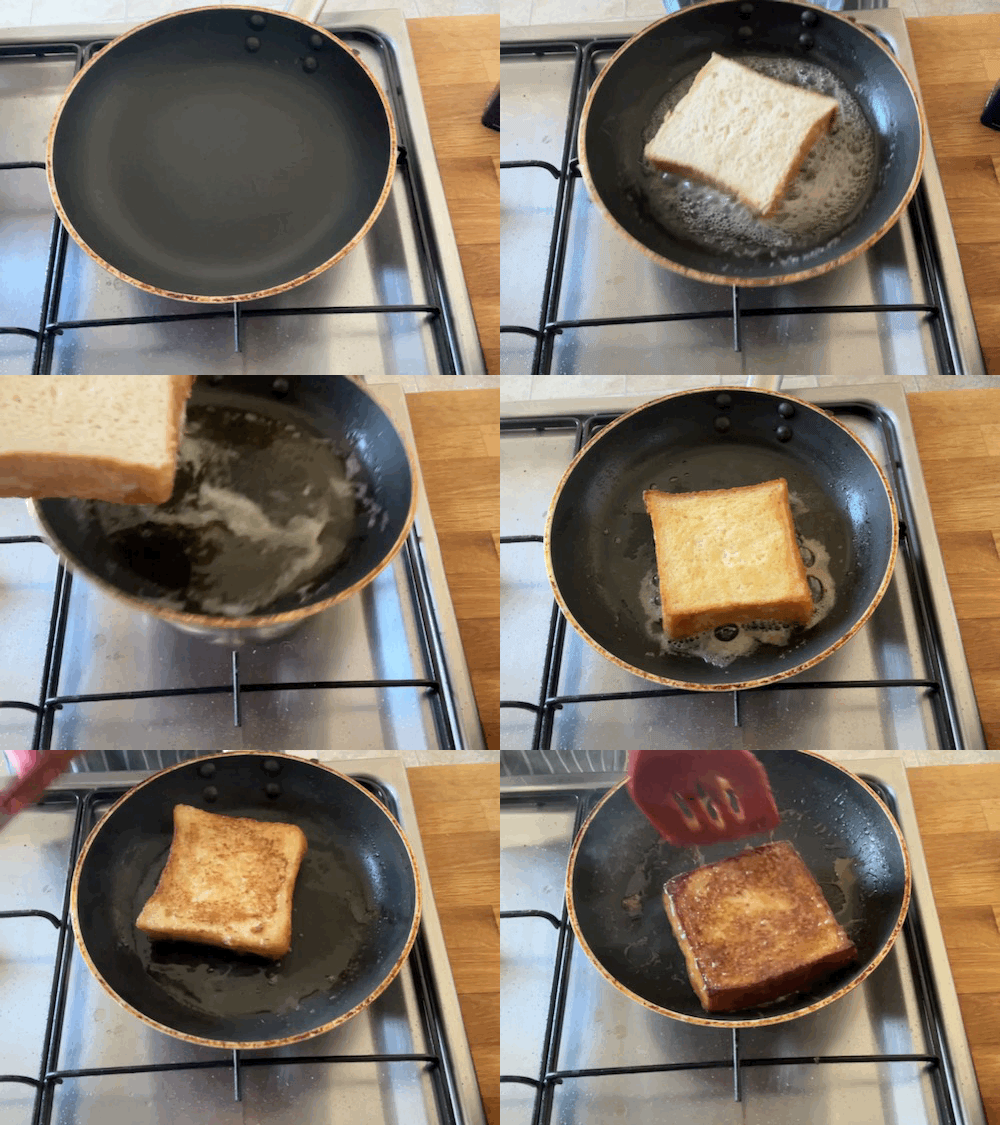
To fry, heat 20g of butter in a small frying pan. When mostly melted and beginning to foam, gently lay your soaked bread in the hot butter and cook for about 2 minutes. You don’t want it to be very dark or have the pan too hot - you are just sealing and toasting the edge. Flip and cook for another 2 minutes.
Once golden (Turn up the heat if it's really pallid, but butter burns when too hot!), sprinkle in 1tbsp of sugar, about 10g, around the torrija. Let it melt into the sugar and start to caramelise, then flip the torrijas over, soaking up all the caramel. Repeat twice more, letting it form caramel and flipping and dragging the torrija through the buttery caramel. This should take about 2-3 minutes.
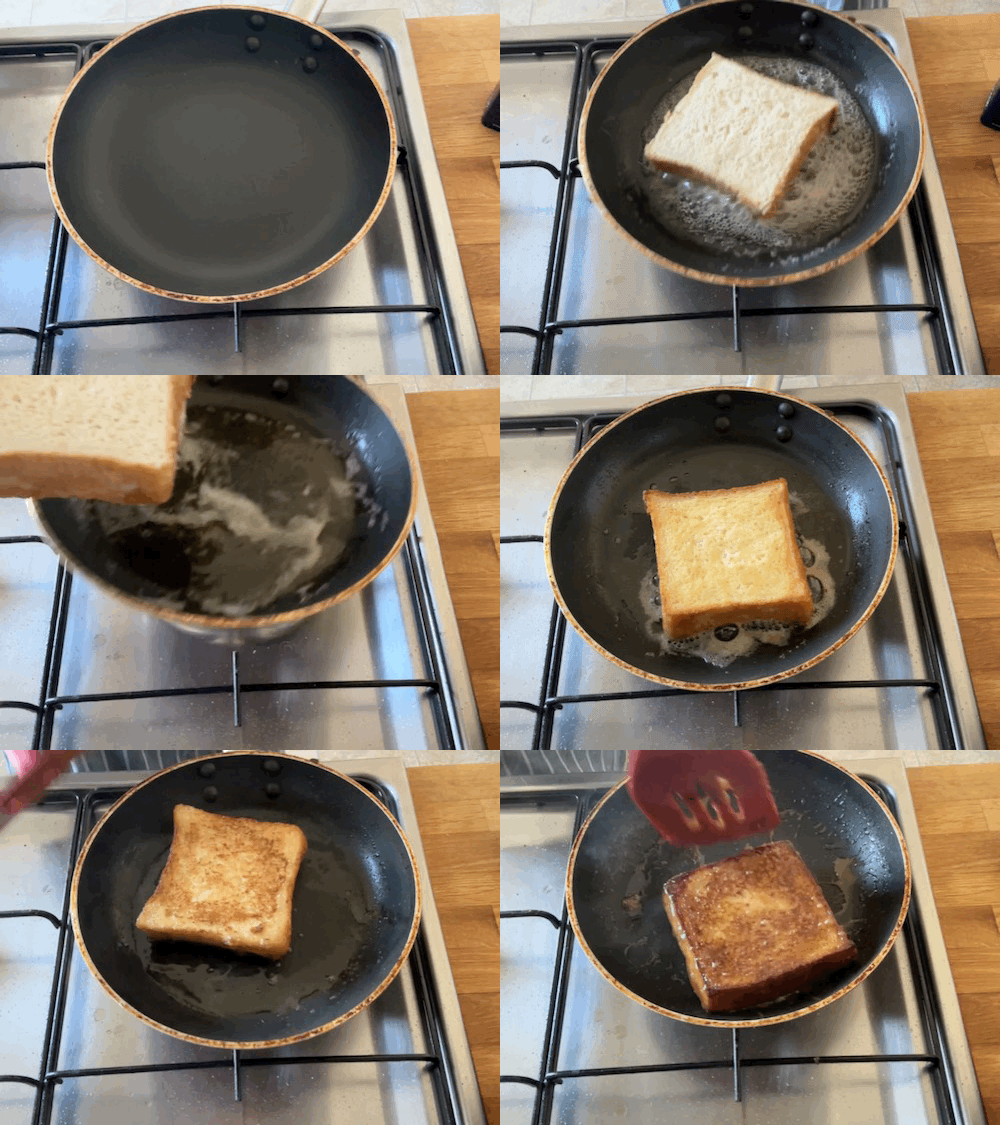
Remove and put on a plate, let the sugar harden for 1 minute or so then top with ice cream and serve immediately. (Note: If you are preparing quite a few, you can place onto baking paper on a tray in a warm - but not hot!!! It will dry them out - say 100c oven to stay warm whilst you cook the rest)
Oven torrijas-inspired bread
These make gooey, sticky, non-traditional torrijas with crisp edges. These expand quite a lot in the oven. I suggest making half portions. This recipe is based on my honey butter toast recipe, inspired by Arome bakery. Unlike the honey butter toast, because of the gooey middle, the faces of the bread don’t get crispy, however you get lots of buttery crisp bits on the edge.
Makes 2 XL torrijas (share size)
2 x slices of 1-inch thick Milk Bread, 80g each then halved into 40g
You could halve these and make smaller rectangles or ‘fingers’ as honestly, one is massive (see photo above).
If bread is very fresh, toast in a 140c fan oven for 15-20 minutes or until a little dry
400ml spiced milk from above
50g butter, very soft
50g light brown sugar
25g honey
½ tsp cinnamon
¼ tsp Flaky salt
Method
Pre-heat oven to 180c fan.
Soak the bread as described in the ‘buttery caramelised torrijas’ recipe.
Before you lift the bread out the milk, mix together the very soft butter, light brown sugar, honey, cinnamon and salt to make a paste. It needs to be very soft and spreadable, like a runny peanut butter texture.
Press kitchen roll to the surface of each slice to remove any excess milk, then spread about 25g of the paste on each (halve if
Gently lift out the milk and place butter side down onto a baking tray lined with baking paper. Press kitchen roll to the surface to remove excess milk then spread around 25g of the paste as before.
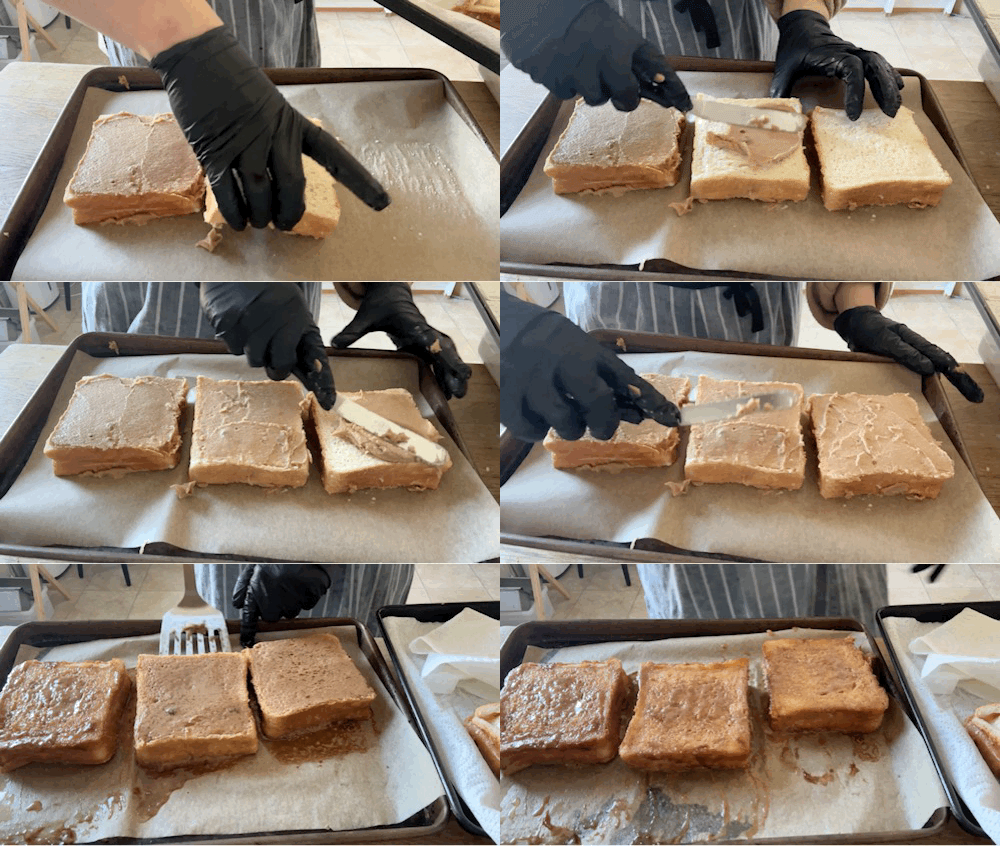
Cook in the oven for 8 minutes, flip carefully, and then cook for another 8 minutes. It will expand a little. Leave to cool on the tray til just warm then enjoy. These are also great after a rest in the fridge!
I lived in Spain for a long while and can confirm that torrijas has entirely taken over hot cross buns for me at easter. Thanks, Nicola, this is great. Happy to hear you were treated very kindly by the basque people in San Sebastian x
Hi, Nicola. The link to pre-order Octavia's chocolates just goes to her IG. Is there a different link to pre-order with the discount? Thanks! Claire x